Share this article



Accelerating security solutions for small businesses Tagore offers strategic services to small businesses. | A partnership that can scale Tagore prioritized finding a managed compliance partner with an established product, dedicated support team, and rapid release rate. | Standing out from competitors Tagore's partnership with Vanta enhances its strategic focus and deepens client value, creating differentiation in a competitive market. |
Last year, Vanta's AI Governance Survey found that 92% of leaders trust vendors that use AI.
However, new hiring data suggests that confidence rests on a thin foundation.
Consider this: Axipro's 2026 State of AI Governance Hiring in Europe study found that for every governance job listing, companies are looking to fill seven AI builder roles. Plus, fewer than three in 10 of those governance postings named the EU AI Act, the regulation most of them exist to serve.
AI buy-in might be high, but the capacity to verify it isn't being built at anything close to the same speed. Here's why.
“There's a pattern we see frequently: A company tells us in the first call that they are fairly confident AI risk is under control, but by the second call we're listing off opaque AI systems that only a few employees have knowledge of. The confidence in AI is real, but it isn't attached to anything you could audit.”
Ali Hayat, CEO, Axipro
Note: This data is from Axipro's 2026 State of AI Governance Hiring in Europe report, which analyzed 3,519 AI-related job postings across eight EU countries.
Axipro's study sorted AI-related job postings across Germany, France, Spain, Italy, the Netherlands, Belgium, Ireland, and Sweden into two categories: roles that build AI and roles that govern it. The result was 3,004 builder roles against 446 governance roles, a ratio of roughly 7 to 1.
The variation between countries is significant as well. Sweden, home to one of Europe's strongest engineering cultures, runs 16 builders per governance hire, the widest gap in the study. France runs 11 to 1. The most balanced market is Ireland at 3.5 to 1, possible because US technology firms headquartered in Dublin import mature compliance functions. However, the overall pattern held everywhere: The faster a market ships AI, the fewer people it hires to keep that AI compliant.
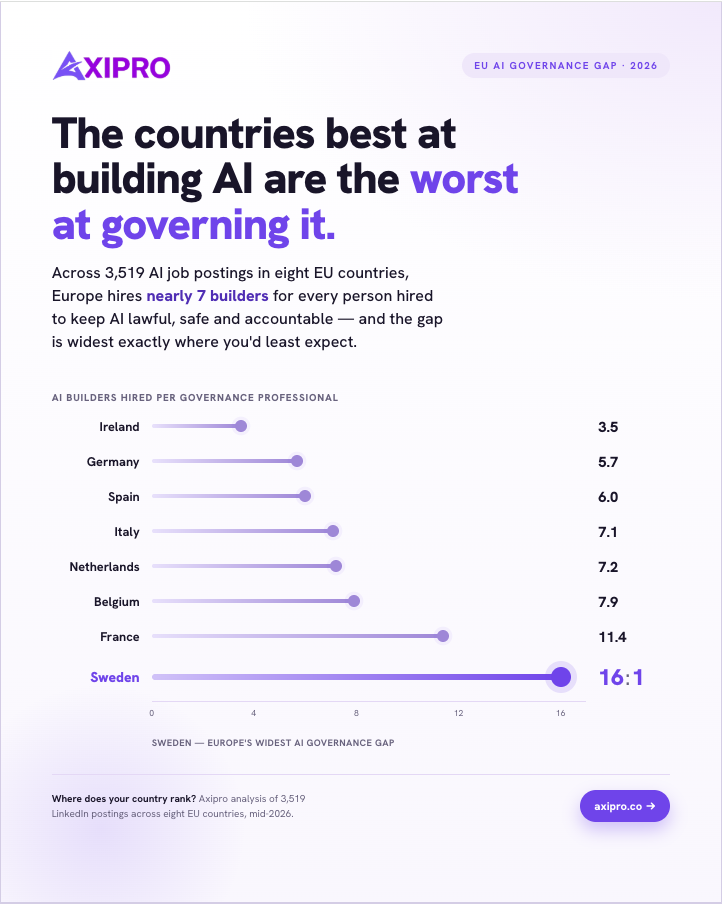
The study's strangest finding is also its most revealing. Fewer than 3 in 10 governance postings mentioned the AI Act by name. Companies are opening roles that will likely need to adhere to a specific regulation, then writing job descriptions that never reference it.
This suggests that organizations might be creating governance roles by imitation, because peers have them and the pressure is rising, rather than from a mapped set of obligations. When responsibilities are unclear or undefined, roles become difficult to scope and support.
The deadlines that governance roles will answer to, though, are already fixed. The EU confirmed the final timeline in the Digital Omnibus agreement this May:
Of note is the fact that the European Commission is finalizing a Code of Practice on AI-generated content to standardize how content marking works. In other words, the expectations are getting concrete faster than most governance functions are taking shape.
Even organizations that define the governance role precisely face a market problem. Half of all governance postings in the study came from enterprises with more than 5,000 employees, which means the largest companies are absorbing a talent pool that was small to begin with. Independent AI governance consultants in mature markets now bill $800 to $2,000 per day, a rate set by enterprise demand and paid by everyone.
The mid-market gets the worst of it: They have the same legal obligations as the enterprises but often with a fraction of the budget, and in sectors with the heaviest obligations and the least hiring activity of all. For example, healthcare organizations posted four governance roles across all eight countries in a month of data. Government administration also posted four.
“What actually happens in the mid-market is one of two things. The requisition sits open for six months while the risk sits unattended, or the company panic-buys consulting at rates set by enterprise demand. Neither is a foolproof strategy, and we are seeing the fallout from this approach in many of our prospects.”
Ali Hayat, CEO, Axipro
If the hiring market can't close the confidence gap, something else has to. The missing mental model will come from the same place it did in security: A certifiable framework that tells organizations what the function actually contains.
That procurement pressure is already happening. When leaders say they're confident in vendors' use of AI, the natural next step is to ask vendors to prove it, much like SOC 2 reports became table stakes in security reviews. Governance evidence becomes a sales artifact: deals move faster for companies that can hand over their AI posture on request.
The organizations that close the gap won't be the ones that win the talent war. They'll be the ones that stop treating governance as a hiring problem and build it as an operating model. In practice, that sequence looks like this.
AI itself isn't the problem—confidence with nothing standing behind it is. The hiring data shows organizations believe in the function enough to post the roles, and the vacancy patterns show the roles alone won't get there. The companies that treat the next 18 months as a systems-building window rather than a recruiting cycle will be the ones whose confidence, by December 2027, is actually earned.
The hiring findings in this article come from Axipro's 2026 State of AI Governance Hiring in Europe study, which analyzed 3,519 AI-related job postings collected from LinkedIn over 30-day windows in mid-2026 across eight EU countries: Belgium, France, Germany, Ireland, Italy, the Netherlands, Spain, and Sweden. Postings were deduplicated by job identifier and classified into two categories: builder roles (3,004), covering positions hired to develop and deploy AI systems, and governance roles (446), covering compliance, risk, model validation, and related oversight functions. The AI Act mention rate is the share of governance postings that explicitly name the regulation in the job description.
All headline figures are ratios rather than raw counts. Because builder and governance postings come from the same source, window, and method, any over- or under-counting by the platform applies to both sides and largely cancels out. Two limitations are worth knowing. The data measures the flow of new hiring, not the stock of existing teams, so a company that built its governance function last year and isn't currently advertising won't appear. And the search used English-language terms, which undercounts roles posted in local languages, meaning the true ratio is likely narrower; the direction and scale were consistent across all eight countries. Employer-size figures reflect the distribution of roles posted by each segment, not total headcount employed. Consultant day rates ($800 to $2,000) are from the VerifyWise AI Governance Salary Report 2026, and demand for external support is an inference from the gap between obligations and staffing, not a directly measured figure. The 92% confidence figure is from Vanta's AI Governance Survey.
Note: This is a guest post from Axipro. The views and research shared here are those of the author.

Learn how to scale, manage, and optimize alongside your business goals.
.svg)
.svg)