Every organization handles data worth protecting. Customer records, financial information, product roadmaps, employee details, and the dozens of systems that hold all of it. Keeping that data secure isn't a matter of buying the right tools or writing a few policies. It requires a system, one that ties your people, processes, and technology together so security decisions happen the same way every time, by design rather than by accident.
That system is called an information security management system, or ISMS. It's the operating framework of any serious security program, and it's what turns a collection of security tools into a coordinated defense. Organizations with a well-built ISMS identify threats faster, respond to incidents more consistently, and can prove to customers, partners, and regulators that they're handling sensitive information responsibly. With the global average cost of a data breach sitting at $4.99 million in 2026, according to IBM's Cost of a Data Breach Report, the business case for formalizing your approach has never been stronger.
This article covers what an ISMS is, how it works, who needs it, how it connects to ISO 27001, and how to build one that scales with your organization. Whether you're preparing for your first certification audit or tightening up an existing security program, you'll walk away with a clear, practical roadmap.
What is an information security management system?
An information security management system, often called an ISMS, is a system set up with policies and practices that keep an organization's data and its customers' data secure. The purpose of an ISMS is to reduce your risk of a data breach and minimize the possible impact when one happens. By creating an ISMS, you're establishing an organized system to help your business protect its data in a consistent, repeatable way.
Every ISMS is built on three principles known as the CIA triad. Confidentiality ensures that only authorized people can access sensitive data. Integrity ensures that data remains accurate and unaltered. Availability ensures that information and systems are accessible when your team and customers need them. Together, these three principles guide every decision you make about how to protect your information.
What makes an ISMS different from ad hoc security measures is that it connects all the moving parts into a single, repeatable framework. Policies define what your organization will and won't allow. Processes dictate how your team carries out those policies day to day. Controls are the specific technical and administrative safeguards you put in place to manage risk. And people bring all of it to life through their actions, training, and accountability.
Without an ISMS, security decisions tend to happen in silos. One team encrypts data at rest while another skips it. Someone writes an access control policy that lives in a Google Doc nobody reads. Incident response is improvised when something goes wrong. An ISMS replaces this patchwork with a documented, governed system that everyone follows. It gives you a clear picture of your risks, a plan for addressing them, and evidence that you're doing what you say you're doing.
ISO/IEC 27001 is the internationally recognized standard for building and certifying an ISMS. While ISO 27001 is the most common framework for ISMS certification, the concept itself isn't locked to any single standard. Any organization can build an ISMS. The standard simply provides a well-tested blueprint for doing it right.
How does an ISMS work?
An ISMS is a collection of best practices and strategies for data security. A strong ISMS should have safeguards in place across several aspects of your data system, from access controls to data encryption to staff-wide security training.
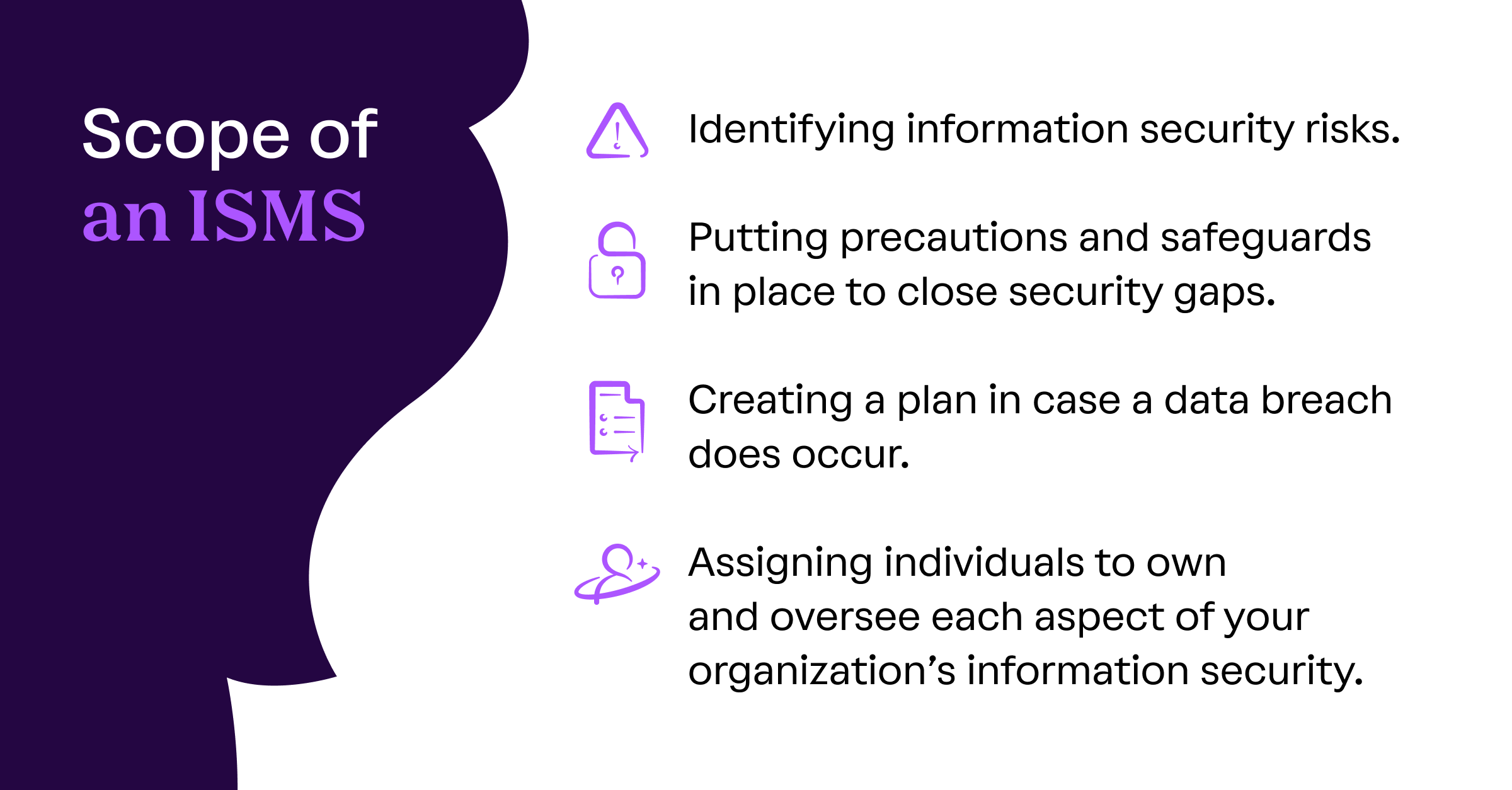
Here’s what’s included in the scope of an ISMS to prevent bad actors from accessing or manipulating your data:
- Identifying information security risks.
- Putting precautions and safeguards in place to close security gaps.
- Creating a plan in case a data breach does occur.
- Assigning individuals to own and oversee each aspect of your organization’s information security.
Who needs an ISMS?
An ISMS is valuable for any organization that handles data, but some industries feel the impact more than others. If your business collects, processes, or stores sensitive information, the case for a formal ISMS becomes harder to ignore.
SaaS organizations are a clear example. You're often holding your customers' data on their behalf, which means a breach of your systems can quickly turn into a breach of theirs. Enterprise buyers know this, which is why most of them require proof of a formal security program before they'll sign a contract. A well-built ISMS gives you that proof while genuinely protecting the data your customers have trusted you with.
Other industries and organizations that also benefit from an ISMS include:
- Healthcare: Patient records are among the most targeted data in the world, and HIPAA requires structured safeguards for protecting them.
- Finance: Financial institutions handle transaction data, account information, and personal identifiers that attackers actively pursue.
- Business analytics: Companies aggregating and analyzing data at scale inherit the security obligations of every source they pull from.
- Government: Public-sector organizations hold citizen data and operate under strict regulatory oversight, often with their own framework requirements.
The pattern is simple. The more your organization relies on data, the more important an ISMS will be for you.
{{cta_withimage2="/cta-modules"}}
How an ISMS connects to ISO 27001
People often use "ISMS" and "ISO 27001" interchangeably, but they're not the same thing. An ISMS is the system itself. ISO 27001 is the internationally recognized standard that defines what a well-built ISMS should look like. You can build an ISMS without pursuing ISO 27001 certification, but you can't get ISO 27001 certified without an ISMS.
ISO/IEC 27001 provides a structured framework for establishing, implementing, maintaining, and continually improving an ISMS. It lays out requirements across clauses 4 through 10, covering everything from organizational context and leadership commitment to risk assessment, control implementation, internal audits, and management reviews. Annex A of the standard lists the specific controls your ISMS should address, organized into 93 controls across four categories in the current version.
The 2022 revision of ISO 27001 introduced several important changes. The previous 114 controls were consolidated into 93 and reorganized into four groups. Organizational controls cover governance, policies, and supplier relationships. People controls address screening, training, and remote work. Physical controls handle facilities, equipment, and media. Technological controls cover access management, encryption, logging, and cloud security. The update also added 11 new controls reflecting modern security challenges, including threat intelligence, cloud service security, data masking, and data leakage prevention. Organizations holding ISO 27001:2013 certifications had until October 31, 2025, to transition to the 2022 version. If you're starting fresh, you'll implement the 2022 standard from day one.
Certification itself follows a two-stage audit process. In Stage 1, an accredited auditor reviews your ISMS documentation to confirm that your policies, risk assessments, Statement of Applicability, and supporting procedures meet the standard's requirements. In Stage 2, the auditor assesses whether your ISMS is actually implemented and operating as described. They'll interview staff, observe processes, and verify that controls are working in practice. If you pass both stages, you receive a certificate valid for three years. Annual surveillance audits check that you're maintaining your ISMS, and a full recertification audit is required before the certificate expires.
Benefits of implementing an ISMS
Building an ISMS takes real investment of time, budget, and team energy. But the returns show up across nearly every part of your business, from security posture to sales performance. Here are six benefits worth weighing as you build your case:
Data security
An ISMS protects your organizational data and the customer data you're entrusted with. By tying your policies, controls, and monitoring into a single system, you close the gaps that typically exist between tools and teams. Sensitive information gets classified, access gets restricted to the people who need it, and risks get addressed before they turn into incidents.
Cost prevention
Data breaches are expensive. Between legal fees, regulatory fines, customer notification costs, lost revenue, and reputational damage, a single incident can reach into the millions. An ISMS lowers your likelihood of experiencing a breach in the first place and shrinks the financial impact when something does happen. Faster detection, clearer response procedures, and well-documented controls all contribute to reducing recovery costs.
Regulatory compliance
Depending on your industry and geography, you may be subject to requirements like GDPR, HIPAA, CCPA, PCI DSS, or sector-specific regulations. An ISMS gives you the structure to meet these obligations without rebuilding your security documentation every time a new law applies to your business. The same controls and evidence often satisfy multiple regulations at once, which reduces duplicate work and audit fatigue.
Business continuity
Some data breaches do more than leak information. They disrupt your ability to operate, whether through ransomware, system outages, or vendor compromises. A well-built ISMS includes incident response plans, backup procedures, and continuity planning that keep your business running when something goes wrong. You'll recover faster, communicate more clearly with customers, and avoid the prolonged downtime that often turns an incident into a crisis.
Ongoing security maturity
An ISMS is designed to improve over time. Regular risk assessments, internal audits, and management reviews force you to reexamine your security posture as your business changes. New tools get evaluated before they're adopted. Emerging threats get addressed as they're identified. Instead of reacting to problems after the fact, you stay ahead of them, which builds stronger security year after year.
Competitive advantage
A strong ISMS turns security from a back-office function into a sales asset. When prospects ask about your security posture during procurement, you have documented proof of your controls, certifications to show, and a Trust Center that answers their questions without a dozen back-and-forth emails. Security becomes a differentiator that helps you win deals, shorten sales cycles, and build long-term customer confidence.
How to implement an ISMS
Each ISMS is unique based on the organization’s needs, how its data system is set up, and the information assets it protects. Many organizations use ISO 27001 as a guide when building an ISMS. ISO 27001 is a well-respected information security standard that lays out the controls and policies you need to create a strong ISMS. ISO 27001 compliance results in a certification that you can use to verify your security posture.
Whether pursuing an ISO 27001 certification or you just want to create a strong ISMS, you’ll follow these steps:
1. Set your scope and objectives
Start by deciding which parts of your business the ISMS will cover. This could be your entire organization, a specific product line, or a particular business unit. Scoping decisions directly affect your timeline, cost, and complexity. It's better to start focused and expand later than to take on too much and stall. At the same time, you need visible support from senior leadership. Auditors will look for evidence that management is actively involved, and your team won't prioritize the project without clear direction from the top.
2. Conduct a gap analysis
A gap analysis compares your current security posture against the requirements of ISO 27001. It reveals what you already have in place and where the gaps are. This step gives you a realistic picture of how much work lies ahead, helps you estimate your timeline, and lets you build a business case for the resources you'll need. If you don't have internal ISO 27001 expertise, bringing in an experienced consultant or using a compliance automation platform for this step can save significant time.
3. Identify risks
Create a list of security risks that your organization faces. You need to identify your information assets, catalog the threats and vulnerabilities associated with each one, and evaluate the likelihood and potential impact of each risk. The output is a prioritized risk register and a risk treatment plan that maps each risk to a specific response. ISO 27005 provides guidance on this process, and many compliance platforms now offer built-in risk assessment workflows that align with it.
4. Write policies and select controls
With your risks identified and prioritized, you write the policies that govern how your organization will manage them. Your information security policy is the top-level document, and it's supported by specific policies for areas like access control, data classification, incident response, and acceptable use. You then select the Annex A controls that apply to your organization and document your reasoning in a Statement of Applicability (SoA). The SoA explains which controls you've chosen, which you've excluded, and why.
5. Implement controls and train your team
Now you put your plan into action. Deploy the technical controls, update processes, and assign ownership. This is also when you roll out security awareness training to ensure everyone understands their responsibilities. Training should cover your policies, common threats like phishing, and how to report incidents. Don't treat training as a one-time checkbox. Build it into onboarding and schedule regular refreshers throughout the year.
6. Run internal audits
Before your external auditor arrives, you need to audit yourself. An internal compliance audit evaluates whether your ISMS meets the requirements of ISO 27001 and whether your controls are operating as intended. It's your chance to catch nonconformities, fix them, and document corrective actions. Many organizations assign an internal auditor or hire a third-party consultant for this step. The findings feed directly into a management review, where leadership assesses the overall performance of the ISMS and approves any necessary changes.
7. Undergo the certification audit
Once your internal audit is clean and your management review is complete, you're ready for the certification audit. Stage 1 focuses on documentation. Your auditor reviews your ISMS scope, policies, risk assessment, SoA, and internal audit results. Stage 2 is the implementation audit, where the auditor verifies that your controls are working in practice through interviews, observations, and evidence review. If you pass, you receive your ISO 27001 certificate. Certification typically costs between $6,000 to more than $40,000 depending on organization size, scope, and the certification body you choose.
8. Establish continuous monitoring
Certification isn't the finish line. Security threats change constantly, which makes it important to build a process for staying ahead of new risks as they emerge. ISO 27001 requires you to monitor, measure, and improve your ISMS on an ongoing basis. You'll undergo annual surveillance audits and a full recertification audit every three years. Between audits, design a system for monitoring your security, whether that means automated monitoring tools, a scheduled review cadence, or a combination of both. Track control performance, reassess risks as your business changes, and address any nonconformities promptly. Organizations that treat their ISMS as a living system stay audit-ready year-round. Those that scramble to prepare before each surveillance visit tend to find gaps they could have caught earlier.
The timeline for this entire process varies. Manual implementation at a mid-size organization typically takes six to 12 months. Compliance automation platforms like Vanta can compress that significantly by automating evidence collection, running continuous control tests across 400+ integrations, and providing built-in templates for policies, risk registers, and SoAs.
Best practices for managing an ISMS
Follow these best practices to build a strong and effective ISMS that fits your needs:
- Create an information security policy: An information security policy defines your organization’s approach to information security and explains the measures you’ve taken to secure your data. Developing this policy can help you see where you stand and what your information security is missing.
- Understand the big picture: You need to understand how your business operates, the tools it uses, and how it functions to design an ISMS that aligns with your day-to-day processes.
- Get guidance from automated software: There are tools to make building and managing your ISMS easier. These tools can guide you through an ISO 27001 implementation to develop your ISMS.
- Administer security training: Each member of your team offers a possible path for hackers into your organization's systems and data. Part of your ISMS should involve training your staff on security practices to help them protect their data.
- Conduct routine security audits: Establish a protocol for internal security audits that you conduct on a regular basis to identify any gaps in your security.
What are the ISMS security objectives?
ISO 27001 Clause 6.2 sets out three security objectives that every ISMS needs to address. These objectives are better known as the CIA triad, and they give you a clear framework for evaluating whether your controls are doing what they're supposed to do. Every policy you write and every safeguard you implement should map back to at least one of these three goals:
Confidentiality
Confidentiality means private data is only accessed by people who are authorized to see it. This is where controls like role-based access, multi-factor authentication, encryption, and least-privilege permissions come in. If a customer's personal information, financial records, or proprietary business data ends up in the wrong hands, you've failed the confidentiality objective. Your ISMS should make it difficult for unauthorized users to reach sensitive data in the first place and obvious when someone tries.
Integrity
Integrity ensures that data stays reliable and can't be altered by unauthorized users. Think of it as trust in your data. If records can be changed without your knowledge, if logs can be tampered with, or if backups can be modified by someone who shouldn't have access, the data itself becomes untrustworthy. Integrity controls include change management processes, audit logging, file integrity monitoring, and strong access controls that prevent unauthorized modifications.
Availability
Availability ensures that data and systems remain accessible when your team, customers, and partners need them. A highly confidential and perfectly accurate database isn't much use if it's offline. Availability objectives cover everything from system uptime and redundancy to disaster recovery planning and incident response. Ransomware attacks, denial-of-service incidents, and hardware failures all threaten availability, which is why your ISMS should include both preventive measures and recovery procedures.
From ISMS to multi-framework compliance
One of the most overlooked advantages of building a strong ISMS is how much it accelerates your next compliance initiative. The controls, policies, and evidence you create for ISO 27001 don't exist in isolation. They map directly to requirements in SOC 2, HIPAA, GDPR, PCI DSS, and dozens of other frameworks. Once you've done the foundational work, expanding into additional certifications becomes a matter of filling gaps rather than starting over.
This is where cross-mapping comes in. Cross-mapping identifies the overlap between frameworks so you can reuse the same control and evidence for multiple requirements. For example, an access control policy that satisfies ISO 27001 Annex A requirements likely also satisfies the relevant SOC 2 trust services criteria and HIPAA security rules. A single risk assessment process can feed evidence into multiple audits simultaneously. Instead of running parallel compliance programs, you run one program with multiple outputs.
The math here is straightforward. If you've already implemented 70% of the controls needed for SOC 2 through your ISO 27001 work, your SOC 2 readiness timeline shrinks dramatically. The same applies when you extend into adjacent ISO standards like ISO 27017 for cloud security, ISO 27018 for privacy in cloud services, or ISO 27701 for privacy information management. Each one builds on your existing ISMS rather than requiring a new one.
Modern compliance platforms make this even easier by supporting 35+ frameworks from a single control set. Vanta, for instance, automatically maps overlapping controls across frameworks, showing you exactly how much of each new standard you've already covered and what remains. This turns compliance from a framework-by-framework cost center into a scalable program where each additional certification requires incrementally less effort. For growing organizations juggling multiple regulatory requirements across different geographies and industries, that compounding return is significant.
An ISMS built for what's next
An ISMS isn't a box to check. It's the operational backbone of your security program, the system that protects your data, satisfies your customers, and scales alongside your business. Whether you're a startup preparing for your first ISO 27001 certification or a growing enterprise managing compliance across multiple frameworks and geographies, the fundamentals are the same. Define your risks, implement proportional controls, monitor continuously, and improve with every cycle.
The organizations that get the most value from their ISMS are the ones that treat it as a living system rather than a static project. They embed security into daily workflows, automate the tedious parts, and use their compliance posture as a competitive advantage in every sales conversation and partnership discussion.
Vanta helps you build that kind of ISMS. With 400+ integrations, 1,400+ automated tests, AI-powered policy generation, and built-in workflows for risk assessment, internal audits, and multi-framework cross-mapping, the platform turns what used to take months of manual work into a streamlined, continuous process. Over 16,000 organizations, from early-stage startups to enterprises like Atlassian and Snowflake, rely on Vanta to earn and prove trust. Request a demo to see how Vanta can get your ISMS up, certified, and running on autopilot.
{{cta_simple2="/cta-modules"}}
FAQs about ISMS
Below we’ve answered some of the most common questions about ISMS implementation and how it can strengthen your security posture:
How are ISMS and ISO 27001 related?
Below we’ve answered some of the most common questions about ISMS implementation and how it can strengthen your security posture:
How are ISMS and ISO 27001 related?
The ISO 27001 framework is built around the objective of developing a powerful ISMS. When you are ISO 27001 compliant, the result is a strong ISMS that occurs after implementing the controls and requirements the standard includes.
What is ISMS certification?
There are many different certifications your organization can get to validate its information security, though there is no established ISMS certification. A reference to ISMS certification is likely talking about ISO 27001 certification.
What is the framework of ISMS?
Every ISMS is customized to suit the implementing organization’s needs, but there are certain frameworks you can use to guide your ISMS development. The most common framework is ISO 27001, which lays out clear guidelines, requirements, and security practices for developing an effective ISMS.
Introduction to ISO 27001
What is an information security management system (ISMS) and how does it work?
Introduction to ISO 27001
What is an information security management system (ISMS) and how does it work?
Download the checklist
Introduction to ISO 27001
Looking to automate up to 80% of the work for ISO 27001 compliance?
Every organization handles data worth protecting. Customer records, financial information, product roadmaps, employee details, and the dozens of systems that hold all of it. Keeping that data secure isn't a matter of buying the right tools or writing a few policies. It requires a system, one that ties your people, processes, and technology together so security decisions happen the same way every time, by design rather than by accident.
That system is called an information security management system, or ISMS. It's the operating framework of any serious security program, and it's what turns a collection of security tools into a coordinated defense. Organizations with a well-built ISMS identify threats faster, respond to incidents more consistently, and can prove to customers, partners, and regulators that they're handling sensitive information responsibly. With the global average cost of a data breach sitting at $4.99 million in 2026, according to IBM's Cost of a Data Breach Report, the business case for formalizing your approach has never been stronger.
This article covers what an ISMS is, how it works, who needs it, how it connects to ISO 27001, and how to build one that scales with your organization. Whether you're preparing for your first certification audit or tightening up an existing security program, you'll walk away with a clear, practical roadmap.
What is an information security management system?
An information security management system, often called an ISMS, is a system set up with policies and practices that keep an organization's data and its customers' data secure. The purpose of an ISMS is to reduce your risk of a data breach and minimize the possible impact when one happens. By creating an ISMS, you're establishing an organized system to help your business protect its data in a consistent, repeatable way.
Every ISMS is built on three principles known as the CIA triad. Confidentiality ensures that only authorized people can access sensitive data. Integrity ensures that data remains accurate and unaltered. Availability ensures that information and systems are accessible when your team and customers need them. Together, these three principles guide every decision you make about how to protect your information.
What makes an ISMS different from ad hoc security measures is that it connects all the moving parts into a single, repeatable framework. Policies define what your organization will and won't allow. Processes dictate how your team carries out those policies day to day. Controls are the specific technical and administrative safeguards you put in place to manage risk. And people bring all of it to life through their actions, training, and accountability.
Without an ISMS, security decisions tend to happen in silos. One team encrypts data at rest while another skips it. Someone writes an access control policy that lives in a Google Doc nobody reads. Incident response is improvised when something goes wrong. An ISMS replaces this patchwork with a documented, governed system that everyone follows. It gives you a clear picture of your risks, a plan for addressing them, and evidence that you're doing what you say you're doing.
ISO/IEC 27001 is the internationally recognized standard for building and certifying an ISMS. While ISO 27001 is the most common framework for ISMS certification, the concept itself isn't locked to any single standard. Any organization can build an ISMS. The standard simply provides a well-tested blueprint for doing it right.
How does an ISMS work?
An ISMS is a collection of best practices and strategies for data security. A strong ISMS should have safeguards in place across several aspects of your data system, from access controls to data encryption to staff-wide security training.
Here’s what’s included in the scope of an ISMS to prevent bad actors from accessing or manipulating your data:
- Identifying information security risks.
- Putting precautions and safeguards in place to close security gaps.
- Creating a plan in case a data breach does occur.
- Assigning individuals to own and oversee each aspect of your organization’s information security.
Who needs an ISMS?
An ISMS is valuable for any organization that handles data, but some industries feel the impact more than others. If your business collects, processes, or stores sensitive information, the case for a formal ISMS becomes harder to ignore.
SaaS organizations are a clear example. You're often holding your customers' data on their behalf, which means a breach of your systems can quickly turn into a breach of theirs. Enterprise buyers know this, which is why most of them require proof of a formal security program before they'll sign a contract. A well-built ISMS gives you that proof while genuinely protecting the data your customers have trusted you with.
Other industries and organizations that also benefit from an ISMS include:
- Healthcare: Patient records are among the most targeted data in the world, and HIPAA requires structured safeguards for protecting them.
- Finance: Financial institutions handle transaction data, account information, and personal identifiers that attackers actively pursue.
- Business analytics: Companies aggregating and analyzing data at scale inherit the security obligations of every source they pull from.
- Government: Public-sector organizations hold citizen data and operate under strict regulatory oversight, often with their own framework requirements.
The pattern is simple. The more your organization relies on data, the more important an ISMS will be for you.
{{cta_withimage2="/cta-modules"}}
How an ISMS connects to ISO 27001
People often use "ISMS" and "ISO 27001" interchangeably, but they're not the same thing. An ISMS is the system itself. ISO 27001 is the internationally recognized standard that defines what a well-built ISMS should look like. You can build an ISMS without pursuing ISO 27001 certification, but you can't get ISO 27001 certified without an ISMS.
ISO/IEC 27001 provides a structured framework for establishing, implementing, maintaining, and continually improving an ISMS. It lays out requirements across clauses 4 through 10, covering everything from organizational context and leadership commitment to risk assessment, control implementation, internal audits, and management reviews. Annex A of the standard lists the specific controls your ISMS should address, organized into 93 controls across four categories in the current version.
The 2022 revision of ISO 27001 introduced several important changes. The previous 114 controls were consolidated into 93 and reorganized into four groups. Organizational controls cover governance, policies, and supplier relationships. People controls address screening, training, and remote work. Physical controls handle facilities, equipment, and media. Technological controls cover access management, encryption, logging, and cloud security. The update also added 11 new controls reflecting modern security challenges, including threat intelligence, cloud service security, data masking, and data leakage prevention. Organizations holding ISO 27001:2013 certifications had until October 31, 2025, to transition to the 2022 version. If you're starting fresh, you'll implement the 2022 standard from day one.
Certification itself follows a two-stage audit process. In Stage 1, an accredited auditor reviews your ISMS documentation to confirm that your policies, risk assessments, Statement of Applicability, and supporting procedures meet the standard's requirements. In Stage 2, the auditor assesses whether your ISMS is actually implemented and operating as described. They'll interview staff, observe processes, and verify that controls are working in practice. If you pass both stages, you receive a certificate valid for three years. Annual surveillance audits check that you're maintaining your ISMS, and a full recertification audit is required before the certificate expires.
Benefits of implementing an ISMS
Building an ISMS takes real investment of time, budget, and team energy. But the returns show up across nearly every part of your business, from security posture to sales performance. Here are six benefits worth weighing as you build your case:
Data security
An ISMS protects your organizational data and the customer data you're entrusted with. By tying your policies, controls, and monitoring into a single system, you close the gaps that typically exist between tools and teams. Sensitive information gets classified, access gets restricted to the people who need it, and risks get addressed before they turn into incidents.
Cost prevention
Data breaches are expensive. Between legal fees, regulatory fines, customer notification costs, lost revenue, and reputational damage, a single incident can reach into the millions. An ISMS lowers your likelihood of experiencing a breach in the first place and shrinks the financial impact when something does happen. Faster detection, clearer response procedures, and well-documented controls all contribute to reducing recovery costs.
Regulatory compliance
Depending on your industry and geography, you may be subject to requirements like GDPR, HIPAA, CCPA, PCI DSS, or sector-specific regulations. An ISMS gives you the structure to meet these obligations without rebuilding your security documentation every time a new law applies to your business. The same controls and evidence often satisfy multiple regulations at once, which reduces duplicate work and audit fatigue.
Business continuity
Some data breaches do more than leak information. They disrupt your ability to operate, whether through ransomware, system outages, or vendor compromises. A well-built ISMS includes incident response plans, backup procedures, and continuity planning that keep your business running when something goes wrong. You'll recover faster, communicate more clearly with customers, and avoid the prolonged downtime that often turns an incident into a crisis.
Ongoing security maturity
An ISMS is designed to improve over time. Regular risk assessments, internal audits, and management reviews force you to reexamine your security posture as your business changes. New tools get evaluated before they're adopted. Emerging threats get addressed as they're identified. Instead of reacting to problems after the fact, you stay ahead of them, which builds stronger security year after year.
Competitive advantage
A strong ISMS turns security from a back-office function into a sales asset. When prospects ask about your security posture during procurement, you have documented proof of your controls, certifications to show, and a Trust Center that answers their questions without a dozen back-and-forth emails. Security becomes a differentiator that helps you win deals, shorten sales cycles, and build long-term customer confidence.
How to implement an ISMS
Each ISMS is unique based on the organization’s needs, how its data system is set up, and the information assets it protects. Many organizations use ISO 27001 as a guide when building an ISMS. ISO 27001 is a well-respected information security standard that lays out the controls and policies you need to create a strong ISMS. ISO 27001 compliance results in a certification that you can use to verify your security posture.
Whether pursuing an ISO 27001 certification or you just want to create a strong ISMS, you’ll follow these steps:
1. Set your scope and objectives
Start by deciding which parts of your business the ISMS will cover. This could be your entire organization, a specific product line, or a particular business unit. Scoping decisions directly affect your timeline, cost, and complexity. It's better to start focused and expand later than to take on too much and stall. At the same time, you need visible support from senior leadership. Auditors will look for evidence that management is actively involved, and your team won't prioritize the project without clear direction from the top.
2. Conduct a gap analysis
A gap analysis compares your current security posture against the requirements of ISO 27001. It reveals what you already have in place and where the gaps are. This step gives you a realistic picture of how much work lies ahead, helps you estimate your timeline, and lets you build a business case for the resources you'll need. If you don't have internal ISO 27001 expertise, bringing in an experienced consultant or using a compliance automation platform for this step can save significant time.
3. Identify risks
Create a list of security risks that your organization faces. You need to identify your information assets, catalog the threats and vulnerabilities associated with each one, and evaluate the likelihood and potential impact of each risk. The output is a prioritized risk register and a risk treatment plan that maps each risk to a specific response. ISO 27005 provides guidance on this process, and many compliance platforms now offer built-in risk assessment workflows that align with it.
4. Write policies and select controls
With your risks identified and prioritized, you write the policies that govern how your organization will manage them. Your information security policy is the top-level document, and it's supported by specific policies for areas like access control, data classification, incident response, and acceptable use. You then select the Annex A controls that apply to your organization and document your reasoning in a Statement of Applicability (SoA). The SoA explains which controls you've chosen, which you've excluded, and why.
5. Implement controls and train your team
Now you put your plan into action. Deploy the technical controls, update processes, and assign ownership. This is also when you roll out security awareness training to ensure everyone understands their responsibilities. Training should cover your policies, common threats like phishing, and how to report incidents. Don't treat training as a one-time checkbox. Build it into onboarding and schedule regular refreshers throughout the year.
6. Run internal audits
Before your external auditor arrives, you need to audit yourself. An internal compliance audit evaluates whether your ISMS meets the requirements of ISO 27001 and whether your controls are operating as intended. It's your chance to catch nonconformities, fix them, and document corrective actions. Many organizations assign an internal auditor or hire a third-party consultant for this step. The findings feed directly into a management review, where leadership assesses the overall performance of the ISMS and approves any necessary changes.
7. Undergo the certification audit
Once your internal audit is clean and your management review is complete, you're ready for the certification audit. Stage 1 focuses on documentation. Your auditor reviews your ISMS scope, policies, risk assessment, SoA, and internal audit results. Stage 2 is the implementation audit, where the auditor verifies that your controls are working in practice through interviews, observations, and evidence review. If you pass, you receive your ISO 27001 certificate. Certification typically costs between $6,000 to more than $40,000 depending on organization size, scope, and the certification body you choose.
8. Establish continuous monitoring
Certification isn't the finish line. Security threats change constantly, which makes it important to build a process for staying ahead of new risks as they emerge. ISO 27001 requires you to monitor, measure, and improve your ISMS on an ongoing basis. You'll undergo annual surveillance audits and a full recertification audit every three years. Between audits, design a system for monitoring your security, whether that means automated monitoring tools, a scheduled review cadence, or a combination of both. Track control performance, reassess risks as your business changes, and address any nonconformities promptly. Organizations that treat their ISMS as a living system stay audit-ready year-round. Those that scramble to prepare before each surveillance visit tend to find gaps they could have caught earlier.
The timeline for this entire process varies. Manual implementation at a mid-size organization typically takes six to 12 months. Compliance automation platforms like Vanta can compress that significantly by automating evidence collection, running continuous control tests across 400+ integrations, and providing built-in templates for policies, risk registers, and SoAs.
Best practices for managing an ISMS
Follow these best practices to build a strong and effective ISMS that fits your needs:
- Create an information security policy: An information security policy defines your organization’s approach to information security and explains the measures you’ve taken to secure your data. Developing this policy can help you see where you stand and what your information security is missing.
- Understand the big picture: You need to understand how your business operates, the tools it uses, and how it functions to design an ISMS that aligns with your day-to-day processes.
- Get guidance from automated software: There are tools to make building and managing your ISMS easier. These tools can guide you through an ISO 27001 implementation to develop your ISMS.
- Administer security training: Each member of your team offers a possible path for hackers into your organization's systems and data. Part of your ISMS should involve training your staff on security practices to help them protect their data.
- Conduct routine security audits: Establish a protocol for internal security audits that you conduct on a regular basis to identify any gaps in your security.
What are the ISMS security objectives?
ISO 27001 Clause 6.2 sets out three security objectives that every ISMS needs to address. These objectives are better known as the CIA triad, and they give you a clear framework for evaluating whether your controls are doing what they're supposed to do. Every policy you write and every safeguard you implement should map back to at least one of these three goals:
Confidentiality
Confidentiality means private data is only accessed by people who are authorized to see it. This is where controls like role-based access, multi-factor authentication, encryption, and least-privilege permissions come in. If a customer's personal information, financial records, or proprietary business data ends up in the wrong hands, you've failed the confidentiality objective. Your ISMS should make it difficult for unauthorized users to reach sensitive data in the first place and obvious when someone tries.
Integrity
Integrity ensures that data stays reliable and can't be altered by unauthorized users. Think of it as trust in your data. If records can be changed without your knowledge, if logs can be tampered with, or if backups can be modified by someone who shouldn't have access, the data itself becomes untrustworthy. Integrity controls include change management processes, audit logging, file integrity monitoring, and strong access controls that prevent unauthorized modifications.
Availability
Availability ensures that data and systems remain accessible when your team, customers, and partners need them. A highly confidential and perfectly accurate database isn't much use if it's offline. Availability objectives cover everything from system uptime and redundancy to disaster recovery planning and incident response. Ransomware attacks, denial-of-service incidents, and hardware failures all threaten availability, which is why your ISMS should include both preventive measures and recovery procedures.
From ISMS to multi-framework compliance
One of the most overlooked advantages of building a strong ISMS is how much it accelerates your next compliance initiative. The controls, policies, and evidence you create for ISO 27001 don't exist in isolation. They map directly to requirements in SOC 2, HIPAA, GDPR, PCI DSS, and dozens of other frameworks. Once you've done the foundational work, expanding into additional certifications becomes a matter of filling gaps rather than starting over.
This is where cross-mapping comes in. Cross-mapping identifies the overlap between frameworks so you can reuse the same control and evidence for multiple requirements. For example, an access control policy that satisfies ISO 27001 Annex A requirements likely also satisfies the relevant SOC 2 trust services criteria and HIPAA security rules. A single risk assessment process can feed evidence into multiple audits simultaneously. Instead of running parallel compliance programs, you run one program with multiple outputs.
The math here is straightforward. If you've already implemented 70% of the controls needed for SOC 2 through your ISO 27001 work, your SOC 2 readiness timeline shrinks dramatically. The same applies when you extend into adjacent ISO standards like ISO 27017 for cloud security, ISO 27018 for privacy in cloud services, or ISO 27701 for privacy information management. Each one builds on your existing ISMS rather than requiring a new one.
Modern compliance platforms make this even easier by supporting 35+ frameworks from a single control set. Vanta, for instance, automatically maps overlapping controls across frameworks, showing you exactly how much of each new standard you've already covered and what remains. This turns compliance from a framework-by-framework cost center into a scalable program where each additional certification requires incrementally less effort. For growing organizations juggling multiple regulatory requirements across different geographies and industries, that compounding return is significant.
An ISMS built for what's next
An ISMS isn't a box to check. It's the operational backbone of your security program, the system that protects your data, satisfies your customers, and scales alongside your business. Whether you're a startup preparing for your first ISO 27001 certification or a growing enterprise managing compliance across multiple frameworks and geographies, the fundamentals are the same. Define your risks, implement proportional controls, monitor continuously, and improve with every cycle.
The organizations that get the most value from their ISMS are the ones that treat it as a living system rather than a static project. They embed security into daily workflows, automate the tedious parts, and use their compliance posture as a competitive advantage in every sales conversation and partnership discussion.
Vanta helps you build that kind of ISMS. With 400+ integrations, 1,400+ automated tests, AI-powered policy generation, and built-in workflows for risk assessment, internal audits, and multi-framework cross-mapping, the platform turns what used to take months of manual work into a streamlined, continuous process. Over 16,000 organizations, from early-stage startups to enterprises like Atlassian and Snowflake, rely on Vanta to earn and prove trust. Request a demo to see how Vanta can get your ISMS up, certified, and running on autopilot.
{{cta_simple2="/cta-modules"}}
FAQs about ISMS
Below we’ve answered some of the most common questions about ISMS implementation and how it can strengthen your security posture:
How are ISMS and ISO 27001 related?
Below we’ve answered some of the most common questions about ISMS implementation and how it can strengthen your security posture:
How are ISMS and ISO 27001 related?
The ISO 27001 framework is built around the objective of developing a powerful ISMS. When you are ISO 27001 compliant, the result is a strong ISMS that occurs after implementing the controls and requirements the standard includes.
What is ISMS certification?
There are many different certifications your organization can get to validate its information security, though there is no established ISMS certification. A reference to ISMS certification is likely talking about ISO 27001 certification.
What is the framework of ISMS?
Every ISMS is customized to suit the implementing organization’s needs, but there are certain frameworks you can use to guide your ISMS development. The most common framework is ISO 27001, which lays out clear guidelines, requirements, and security practices for developing an effective ISMS.
Your checklist to ISO 27001 certification
Need to get ISO certified but not sure where to start? This guide walks you through the steps to get ISO 27001 compliant.
See how our ISO 27001 automation works
Request a demo to learn how Vanta can automate up to 80% of the work it takes to get ISO 27001 certified
Your checklist to ISO 27001 certification
Need to get ISO certified but not sure where to start? This guide walks you through the steps to get ISO 27001 compliant.

See how our ISO 27001 automation works
Request a demo to learn how Vanta can automate up to 80% of the work it takes to get ISO 27001 certified
Your checklist to ISO 27001 certification
Need to get ISO certified but not sure where to start? This guide walks you through the steps to get ISO 27001 compliant.
See how our ISO 27001 automation works
Request a demo to learn how Vanta can automate up to 80% of the work it takes to get ISO 27001 certified
Explore more ISO 27001 articles
Introduction to ISO 27001
ISO 27001 requirements
Preparing for an ISO 27001 audit
Streamlining ISO 27001 compliance
Understanding ISO differences
Get started with ISO 27001
Start your ISO 27001 journey with these related resources.
The ISO 27001 Compliance Checklist
ISO 27001 is the global gold standard for ensuring the security of information and its supporting assets. Obtaining ISO 27001 certification can help an organization prove its security practices to potential customers anywhere in the world.

ISO 27001 Compliance for SaaS
On 10 October at 2 PM BST, join the Ask Me (Almost) Anything with Herman Errico and Kim Elias, compliance experts at Vanta. They’ll answer (almost) all your questions about ISO 27001 compliance.

ISO 27001 vs. SOC 2: Which standard is right for my business?
Complying with security standards such as ISO 27001 or SOC 2 can help boost your business, but for technology startups, security compliance is often lower on the list of company priorities.