


Share this article



Accelerating security solutions for small businesses Tagore offers strategic services to small businesses. | A partnership that can scale Tagore prioritized finding a managed compliance partner with an established product, dedicated support team, and rapid release rate. | Standing out from competitors Tagore's partnership with Vanta enhances its strategic focus and deepens client value, creating differentiation in a competitive market. |
Security leaders often face challenges that extend beyond the firewall: a major gap in communication between the security function and executive leadership. This misalignment can have severe consequences, including stalling deals, increasing organizational risk, and preventing security from being recognized as a key driver of business growth.
To better understand this disconnect, our new survey reveals how security professionals view their communication challenges, which security metrics matter most to the C-suite, and how often executives truly factor security trends into critical business decisions.
Let’s dive into key insights from the survey data and expert perspectives on improving business communication.
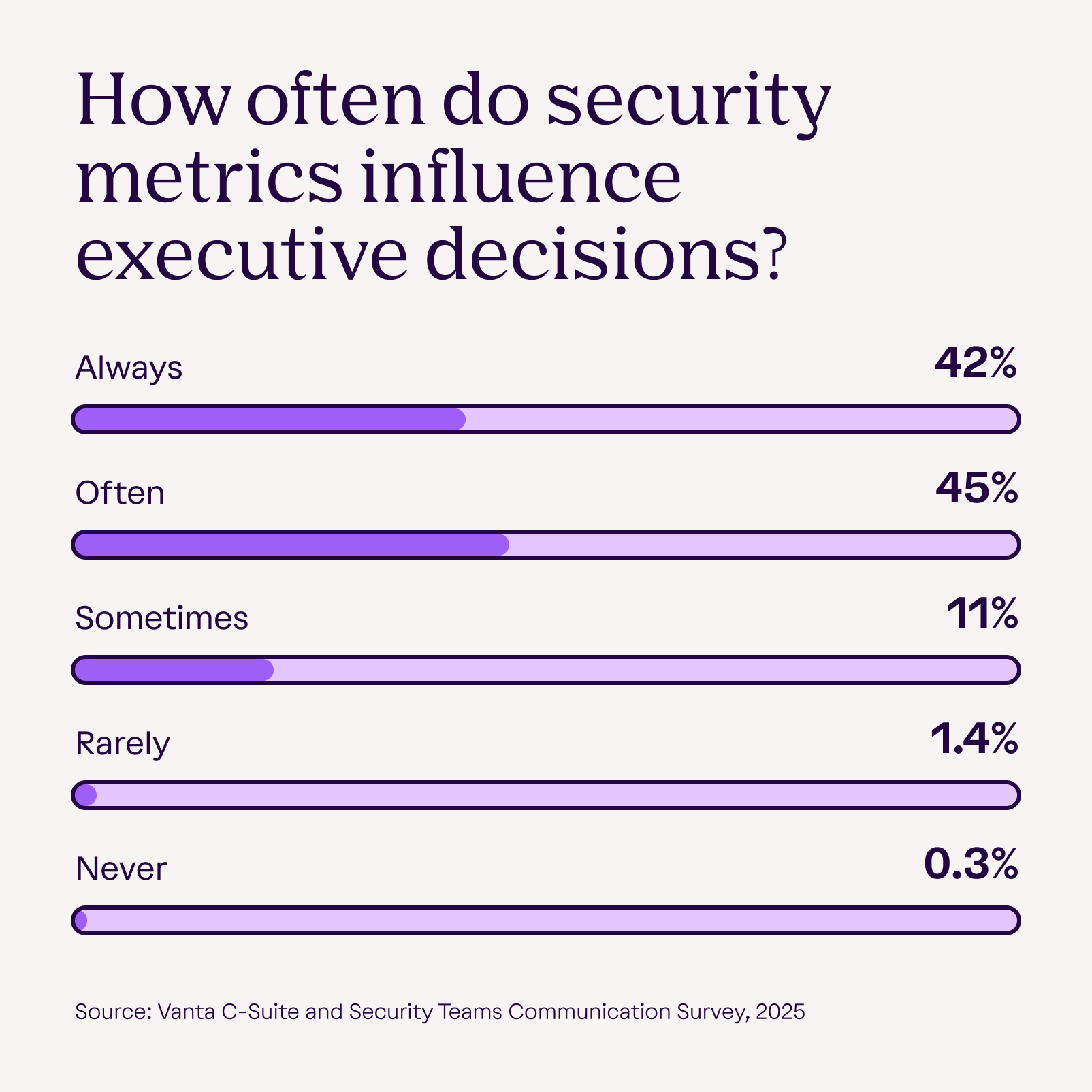
Our survey reveals that security indicators and insights play a critical role in executive decision-making, with 87% of respondents reporting that these insights “always” or “often” influence business decisions.
These indicators, such as incident prevention metrics, compliance achievements, and operational resilience data, are more than technical health checks. They directly influence executive decisions, guiding strategic choices around budgeting, partnerships, product launches, and risk management. Security isn’t operating on the sidelines; it’s helping define the direction of the business.
But as the following findings reveal, this influence may not always translate into shared understanding. While executives rely on security policies and insights to steer key decisions, many still struggle to interpret the data’s full business implications—a disconnect that limits security’s potential as a growth driver.
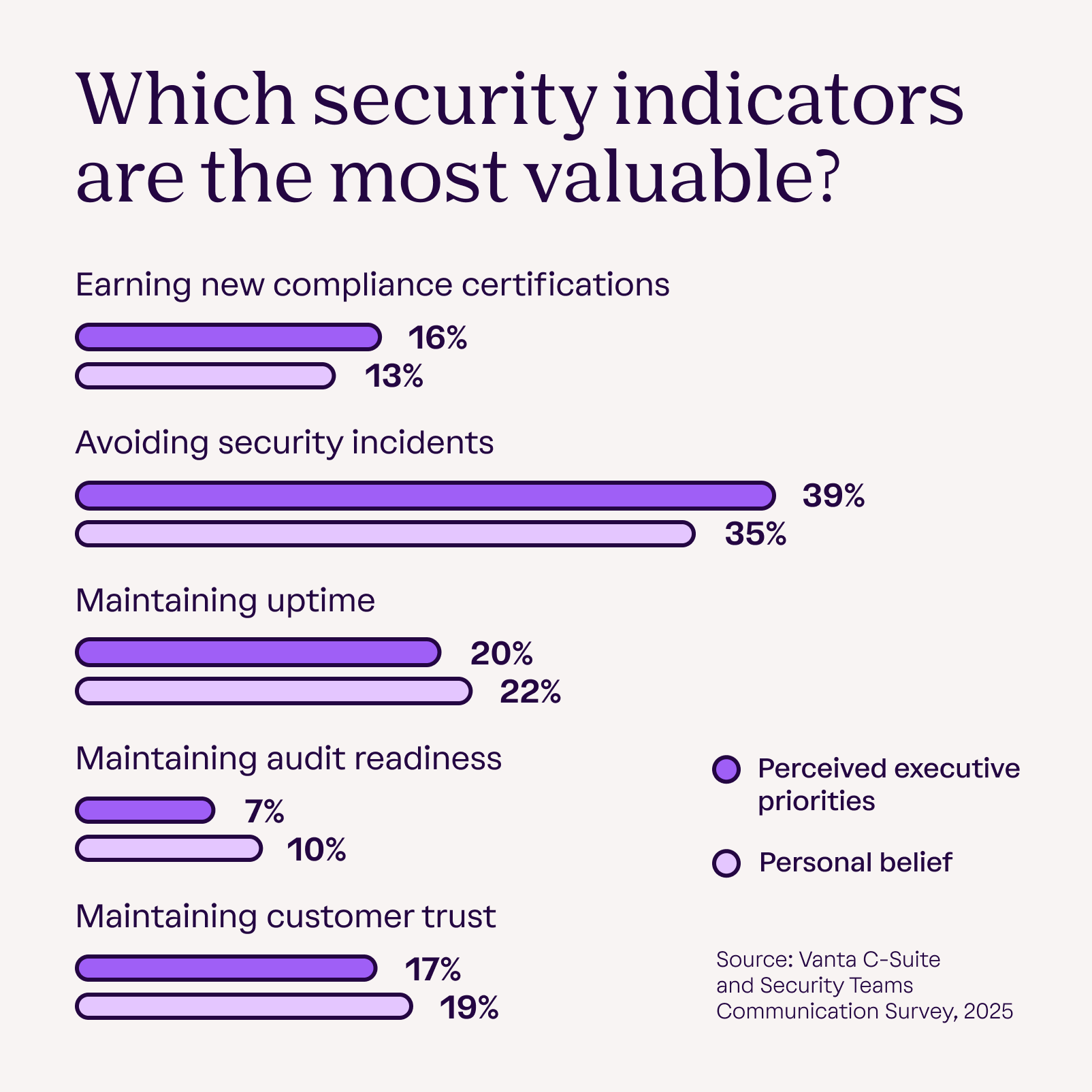
At first glance, security leaders and executives appear closely aligned. Most security leaders said avoiding security incidents is their most valuable initiative, both in their own view (35%) and in what they believe executives value most (39%). Operational continuity and customer trust followed, showing shared priorities around resilience and reputation.
Yet alignment in theory does not always translate in practice.
The biggest disconnect between security leaders and executives is language. Security leaders speak in technical risks, while executives focus on business impact. When we translate threats into outcomes like revenue, trust, and resilience, security becomes a strategic driver instead of just a cost.”

While both sides agree on priorities, differences in framing create a language gap. Executives emphasize measurable business outcomes like revenue and brand perception, while security teams focus on risk reduction and operational resilience. This gap can limit how well alignment is realized in practice, even when priorities appear closely matched.
Over half of survey respondents (54%) reported that misalignment between security and sales has led to lost deals or delayed sales cycles at their company. Including those who haven’t experienced it yet but expect to, the true impact could affect nearly three-quarters of companies.
This disconnect directly affects revenue and deal velocity. When security is seen as a challenge, sales cycles slow, opportunities are lost, and potential customers may walk away. Enterprise deals often stall when compliance requirements aren’t clearly communicated or when security policies are introduced late in the sales process.
Security teams can prevent lost deals by engaging early with sales and translating compliance and risk requirements into clear business outcomes. Framing security as an enabler rather than a blocker helps accelerate the sales cycle. Practical steps include aligning documentation for prospects and clarifying regulatory requirements upfront. Tools like Vanta make this easier by centralizing controls, automating compliance, and providing detailed insights to keep deals moving.
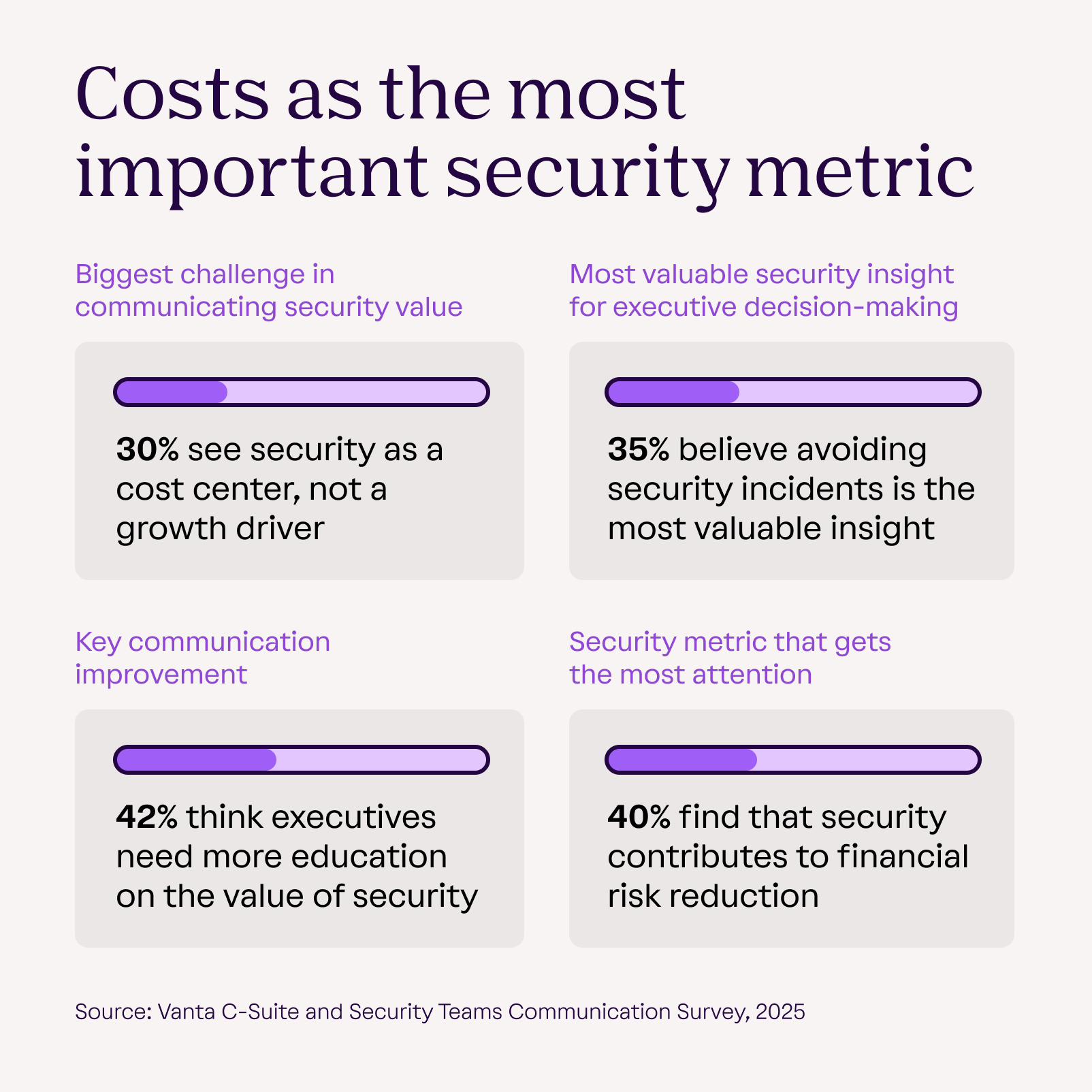
Nearly a third of respondents (30%) still see security as an operational expense rather than a growth driver, limiting how its value is perceived across the business. This perception is reinforced by inconsistent ROI reporting and a lack of standardized metrics—1 in 4 cited these gaps as a major communication challenge.
Key findings highlight how this plays out internally:
This isn’t a failure of security; it’s a failure to communicate impact consistently. Security teams can reframe value by tracking business-aligned metrics, standardizing reporting, and linking security outcomes to revenue protection, risk reduction, and operational resilience. By telling the story in business terms, security shifts from being seen as a cost to being recognized as an advantage.
Security and IT professionals are generally confident that their leadership understands regulatory and security compliance requirements needed to close enterprise deals. Almost half (45%) are very confident that executives fully grasp these requirements, while 46% are somewhat confident, meaning leadership understands the basics but may lack detailed knowledge.
Executives who understand the nuances of regulatory and security requirements don’t just mitigate risk; they enable growth. This depth of understanding allows them to align compliance efforts with business strategy, demonstrating to customers and partners that security is embedded in the organization’s DNA. The companies that make this shift —treating compliance as a driver of trust and opportunity rather than an obligation—will be the ones that stand out in an increasingly competitive and regulated marketplace.”
While overall confidence is high, communicating the relevance of security metrics in terms of business impact remains important.
Several common barriers, as reinforced by our survey results, can hinder effective security communication:
These challenges persist because security teams and business leaders often operate with different perspectives. Standardized reporting and compliance management software can help—providing consistent ways to demonstrate ROI.
Improving communication across the board is the foundation of progress for any company. Several tips include:
These tips can help shift the perception of security from a solely operational function to a strategic enabler.
Clear security communication turns compliance into business value. By connecting metrics to outcomes, standardizing reporting, and using dashboards to show impact, teams can build executive confidence and generate security wins across the organization.
Vanta’s agentic trust platform helps teams centralize controls, automate compliance, and provide actionable insights, making it easier to demonstrate ROI and show how security supports business growth. Explore how Vanta can help earn and manage trust.
In September 2025, quantitative research conducted by Centiment was commissioned by Vanta to explore the communication gap between security teams and executives. The goal was to better understand how well U.S.-based business decision-makers perceive, engage with, and act on security-related information from their security teams. The survey was co-designed by Vanta and Siege Media and collected responses from 600 business decision-makers in the United States. Data is unweighted, and the margin of error is approximately +/-4% for the overall sample with a 95% confidence level.

Learn how to scale, manage, and optimize alongside your business goals.
.svg)
.svg)









.png)