The General Data Protection Regulation (GDPR) is an EU law adopted in 2018 with the goal of protecting the personal data of EU residents.
It’s an elaborate regulation that imposes numerous obligations on organizations operating within or targeting the EU market. However, compliance with the GDPR is mandatory, and violations can result in significant financial penalties or corrective action.
In this article, we’ll break down the key GDPR requirements and provide practical guidance on how to approach compliance efficiently.
A breakdown of the GDPR compliance requirements
GDPR compliance requirements are primarily based on the seven data protection principles outlined in Article 5. The principles provide broad guidance on how organizations should handle personal data. However, the exact scope of GDPR compliance can vary depending on your organization’s role in data processing activities.
There are two roles under the GDPR: data controllers and data processors. Data controllers are entities that determine the purpose and means of data processing, while data processors act on behalf of controllers, follow their instructions, and implement GDPR-appropriate data safeguards.
To meet GDPR compliance requirements regardless of role, in-scope organizations need to:
- Establish a lawful basis for processing activities
- Appoint a data protection officer (DPO) where applicable
- Implement data subject rights workflows
- Conduct data protection impact assessments (DPIAs)
- Maintain the necessary documentation
- Develop incident response procedures
Let’s walk through these six requirements in detail.
{{cta_withimage14="/cta-blocks"}} | GDPR compliance checklist
1. Establish a lawful basis for processing activities
Before you can start collecting personal data as a controller, you must establish a lawful basis that aligns with your processing purpose. The GDPR defines six bases for lawful data processing:
- Data subject consent: The data subjects provide voluntary, informed, and unambiguous consent for their information to be processed for a specified purpose
- Contractual requirements: Processing is necessary to perform a contract with the data subject or to fulfill a request made before entering a contract
- Legal obligations: Processing helps comply with a legal requirement (e.g., tax or employment laws)
- Protecting vital interests: Processing is necessary to protect the life or health of individuals who are unable to give consent, such as in medical emergencies or during natural disasters
- Public task: The information must be processed so that a task can be performed in the public interest or under official authority—this is primarily relevant for public authorities or organizations carrying out tasks laid down by law
- Legitimate interests: Information needs to be processed to pursue the controller’s or their third-party’s legitimate interests, unless overridden by data subjects’ rights and freedoms
Consent is emphasized under the GDPR, but it may not always be required depending on the situation and your purpose for processing.
To meet this requirement more efficiently, define the processing purpose and data scope early. This makes it easier to choose, document, and demonstrate an adequate lawful basis to the data subjects, auditors, and supervisory bodies.
2. Appoint a data protection officer (DPO) where applicable
A DPO is the stakeholder responsible for overseeing your organization’s GDPR program. They ensure data protection practices and manage compliance-related workflows within your organization.
Some of the typical duties of a DPO include:
- Conducting data protection impact assessments (DPIAs)
- Monitoring staff training
- Performing policy reviews and assisting with updates
- Serving as the point of contact for data subjects and supervisory authorities
You can appoint an internal stakeholder for the role or bring in an external consultant. The DPO must be free of conflicts of interest and possess expertise proportional to the scale and complexity of your organization’s data processing activities.
Under the GDPR, appointing a DPO is only mandatory for organizations that:
- Are public authorities or bodies, except courts acting in a judicial capacity
- Carry out large-scale systematic monitoring of individuals (like online tracking behavior)
- Carry out large-scale processing of special category data, such as health or biometric data, or data relating to criminal convictions
Even if your organization doesn’t meet these criteria, you can still appoint a DPO voluntarily as a way to demonstrate compliance. In this case, you’d need to inform the relevant supervisory body of the decision and make the DPO’s contact information publicly available.
3. Implement data subject rights workflows
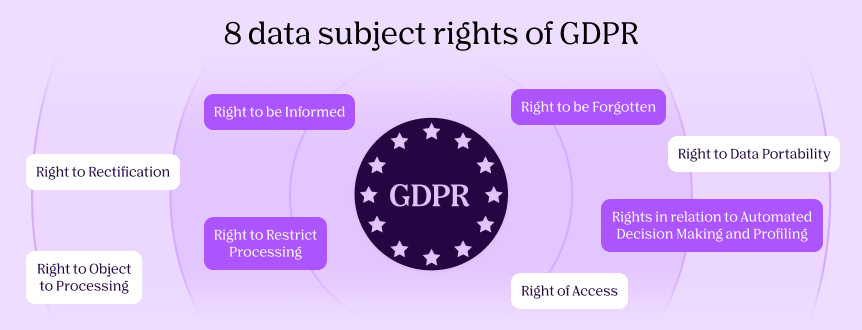
The GDPR emphasizes eight data subject rights that form the basis for all compliance requirements. The table below outlines the rights and provides a brief overview of each:
The GDPR expects organizations to establish communication channels and operational workflows that allow them to quickly recognize and fulfill data subject requests relating to these rights.
In practice, this means implementing clear procedures for notifying data subjects, updating and correcting their data, and safely disposing of it when required.
“
Applying privacy-by-design principles can provide an immense long-term impact related to GDPR data subject requirements. Trying to backtrack and add functionality related to data subject rights retroactively can lead to regulatory risk and engineering rework.”

4. Conduct data protection impact assessments (DPIAs)
Conducting aDPIA is required whenever you start a new project that’s likely to pose a high risk to personal information.
Specific situations that require a DPIA include:
- Using new technology in a way that may impact privacy
- Tracking data subject locations or behaviors
- Systematically monitoring a publicly available location at a large scale
- Large-scale processing of special category data (e.g., health, biometrics) or criminal conviction data
Your DPIA needs to evaluate every aspect of the processing activity. This means you’ll need to:
- Map your processing activities and define their purpose
- Evaluate the necessity of each processing activity for your stated goal
- Assess the risks your operations may pose to individual rights and freedoms
- Review how your existing safeguards and controls mitigate identified risks
The DPIA shouldn’t be limited to a single assessment. Have relevant stakeholders revisit your assessments throughout the project planning process and periodically after the launch to ensure controls remain appropriate.
{{cta_withimage11="/cta-blocks"}} | The US data privacy checklist
5. Maintain the necessary documentation
Maintaining thorough records of processing activities (RoPA) is a key requirement of the GDPR and is tied to the accountability principle. You need to be able to demonstrate the records to auditors and customers.
Both controllers and processors need to maintain a RoPA, but there are slight differences in the required contents:
Regularly review and update your RoPA so it accurately reflects any changes in your organization’s processing activities.
Controllers must also maintain contracts or data processing agreements with vendors that process personal data on their behalf.
6. Develop incident response procedures
GDPR imposes strict incident response requirements. From the moment a breach is discovered, organizations typically have 72 hours to send out notifications to relevant parties, which include:
- Supervisory authority: You must notify the authority in the country where your main branch is located
- Data subjects: If you determine the breach is likely to result in a high risk to data subjects’ rights or freedoms, you should inform the affected individuals
- Controller: If your organization acts as a processor, you must inform the controller for that specific activity
The report should contain details about the nature of the breach, the type and volume of affected data, and the measures taken to remediate it. If it’s not possible to send out the full information within the original time frame, you may send it in phases as new data becomes available.
Because of the tight timelines, it’s essential to develop an incident response plan with clear procedures for detecting, investigating, and reporting breaches, so that you can reduce the risk of non-compliance.
Potential challenges to meeting GDPR requirements
The GDPR is a comprehensive regulation, and ensuring ongoing compliance can be challenging. Some of the most common roadblocks organizations face include:
- Budget and resource limitations: Achieving GDPR compliance demands specialized expertise, staff training, and new technologies. These factors present up-front costs that smaller and medium-sized organizations may struggle to fund.
- Lack of prescriptive guidance: The GDPR has a broad reach by design. It’s up to organizations to determine which safeguards are appropriate and applicable to their risk landscape and processing activities.
- Limited visibility into vendor security posture: You must ensure that your vendors meet strict GDPR compliance requirements. While you can get assurance through a data processing agreement, limited visibility into third-party security posture means you can’t verify it on an ongoing basis.
- Ensuring information remains up to date: GDPR requires accuracy and timeliness for the data you collect, your privacy notices, and your internal documentation. Regular reviews are essential, but can strain ongoing compliance efforts.
{{cta_withimage14="/cta-blocks"}} | GDPR compliance checklist
5 tips to meet GDPR requirements more efficiently
Follow these key practices to achieve and maintain GDPR compliance efficiently:
- Understand your data processing needs: Conduct thorough assessments to determine the type and amount of data needed for a processing activity and the retention period. This will help your processing activities align with data protection principles from the earliest stages.
- Embed data subject rights: Data subject rights are a fundamental part of GDPR. Familiarize yourself with them and build them into your products and services to maintain long-term alignment.
- Streamline assessment workflows: Ongoing GDPR compliance requires regular assessments to verify that data policies and security measures are appropriate for your current processing activities. Define and implement clear procedures to ensure consistency, save time, and reduce costs.
- Centralize data management and documentation for easy access: Establish a central repository for storing all GDPR-related documentation. Centralized records speed up updates and make compliance audits significantly smoother.
- Leverage a dedicated compliance solution: Many GDPR workflows are resource- and time-intensive, which creates room for oversights, delays, and inefficiencies. Implement a dedicated compliance solution to automate low-impact tasks and free up your teams for more strategic objectives.
How Vanta supports your GDPR compliance efforts
Vanta is a trust management platform that helps accelerate your GDPR compliance efforts. It operationalizes complex principles into practical workflows that enhance your overall security posture, save time on research, and minimize the risk of non-compliance fines.
The platform offers a dedicated GDPR product that comes with various helpful features, such as:
- Inventory management in a unified dashboard
- Automated evidence collection powered by 400+ integrations
- Pre-built policy templates with a customization tool
- Real-time monitoring and instant security reports
- Stakeholder training modules
Schedule a custom demo for Vanta’s GDPR product and get tailored insights for your organization.
{{cta_simple19="/cta-blocks"}} | GDPR product page
A note from Vanta: Vanta is not a law firm, and this article does not constitute or contain legal advice or create an attorney-client relationship. When determining your obligations and compliance with respect to relevant laws and regulations, you should consult a licensed attorney.
Understanding GDPR requirements
Your guide to meeting key GDPR compliance requirements
Understanding GDPR requirements
Looking to streamline the work for GDPR compliance?
The General Data Protection Regulation (GDPR) is an EU law adopted in 2018 with the goal of protecting the personal data of EU residents.
It’s an elaborate regulation that imposes numerous obligations on organizations operating within or targeting the EU market. However, compliance with the GDPR is mandatory, and violations can result in significant financial penalties or corrective action.
In this article, we’ll break down the key GDPR requirements and provide practical guidance on how to approach compliance efficiently.
A breakdown of the GDPR compliance requirements
GDPR compliance requirements are primarily based on the seven data protection principles outlined in Article 5. The principles provide broad guidance on how organizations should handle personal data. However, the exact scope of GDPR compliance can vary depending on your organization’s role in data processing activities.
There are two roles under the GDPR: data controllers and data processors. Data controllers are entities that determine the purpose and means of data processing, while data processors act on behalf of controllers, follow their instructions, and implement GDPR-appropriate data safeguards.
To meet GDPR compliance requirements regardless of role, in-scope organizations need to:
- Establish a lawful basis for processing activities
- Appoint a data protection officer (DPO) where applicable
- Implement data subject rights workflows
- Conduct data protection impact assessments (DPIAs)
- Maintain the necessary documentation
- Develop incident response procedures
Let’s walk through these six requirements in detail.
{{cta_withimage14="/cta-blocks"}} | GDPR compliance checklist
1. Establish a lawful basis for processing activities
Before you can start collecting personal data as a controller, you must establish a lawful basis that aligns with your processing purpose. The GDPR defines six bases for lawful data processing:
- Data subject consent: The data subjects provide voluntary, informed, and unambiguous consent for their information to be processed for a specified purpose
- Contractual requirements: Processing is necessary to perform a contract with the data subject or to fulfill a request made before entering a contract
- Legal obligations: Processing helps comply with a legal requirement (e.g., tax or employment laws)
- Protecting vital interests: Processing is necessary to protect the life or health of individuals who are unable to give consent, such as in medical emergencies or during natural disasters
- Public task: The information must be processed so that a task can be performed in the public interest or under official authority—this is primarily relevant for public authorities or organizations carrying out tasks laid down by law
- Legitimate interests: Information needs to be processed to pursue the controller’s or their third-party’s legitimate interests, unless overridden by data subjects’ rights and freedoms
Consent is emphasized under the GDPR, but it may not always be required depending on the situation and your purpose for processing.
To meet this requirement more efficiently, define the processing purpose and data scope early. This makes it easier to choose, document, and demonstrate an adequate lawful basis to the data subjects, auditors, and supervisory bodies.
2. Appoint a data protection officer (DPO) where applicable
A DPO is the stakeholder responsible for overseeing your organization’s GDPR program. They ensure data protection practices and manage compliance-related workflows within your organization.
Some of the typical duties of a DPO include:
- Conducting data protection impact assessments (DPIAs)
- Monitoring staff training
- Performing policy reviews and assisting with updates
- Serving as the point of contact for data subjects and supervisory authorities
You can appoint an internal stakeholder for the role or bring in an external consultant. The DPO must be free of conflicts of interest and possess expertise proportional to the scale and complexity of your organization’s data processing activities.
Under the GDPR, appointing a DPO is only mandatory for organizations that:
- Are public authorities or bodies, except courts acting in a judicial capacity
- Carry out large-scale systematic monitoring of individuals (like online tracking behavior)
- Carry out large-scale processing of special category data, such as health or biometric data, or data relating to criminal convictions
Even if your organization doesn’t meet these criteria, you can still appoint a DPO voluntarily as a way to demonstrate compliance. In this case, you’d need to inform the relevant supervisory body of the decision and make the DPO’s contact information publicly available.
3. Implement data subject rights workflows
The GDPR emphasizes eight data subject rights that form the basis for all compliance requirements. The table below outlines the rights and provides a brief overview of each:
The GDPR expects organizations to establish communication channels and operational workflows that allow them to quickly recognize and fulfill data subject requests relating to these rights.
In practice, this means implementing clear procedures for notifying data subjects, updating and correcting their data, and safely disposing of it when required.
“
Applying privacy-by-design principles can provide an immense long-term impact related to GDPR data subject requirements. Trying to backtrack and add functionality related to data subject rights retroactively can lead to regulatory risk and engineering rework.”
4. Conduct data protection impact assessments (DPIAs)
Conducting aDPIA is required whenever you start a new project that’s likely to pose a high risk to personal information.
Specific situations that require a DPIA include:
- Using new technology in a way that may impact privacy
- Tracking data subject locations or behaviors
- Systematically monitoring a publicly available location at a large scale
- Large-scale processing of special category data (e.g., health, biometrics) or criminal conviction data
Your DPIA needs to evaluate every aspect of the processing activity. This means you’ll need to:
- Map your processing activities and define their purpose
- Evaluate the necessity of each processing activity for your stated goal
- Assess the risks your operations may pose to individual rights and freedoms
- Review how your existing safeguards and controls mitigate identified risks
The DPIA shouldn’t be limited to a single assessment. Have relevant stakeholders revisit your assessments throughout the project planning process and periodically after the launch to ensure controls remain appropriate.
{{cta_withimage11="/cta-blocks"}} | The US data privacy checklist
5. Maintain the necessary documentation
Maintaining thorough records of processing activities (RoPA) is a key requirement of the GDPR and is tied to the accountability principle. You need to be able to demonstrate the records to auditors and customers.
Both controllers and processors need to maintain a RoPA, but there are slight differences in the required contents:
Regularly review and update your RoPA so it accurately reflects any changes in your organization’s processing activities.
Controllers must also maintain contracts or data processing agreements with vendors that process personal data on their behalf.
6. Develop incident response procedures
GDPR imposes strict incident response requirements. From the moment a breach is discovered, organizations typically have 72 hours to send out notifications to relevant parties, which include:
- Supervisory authority: You must notify the authority in the country where your main branch is located
- Data subjects: If you determine the breach is likely to result in a high risk to data subjects’ rights or freedoms, you should inform the affected individuals
- Controller: If your organization acts as a processor, you must inform the controller for that specific activity
The report should contain details about the nature of the breach, the type and volume of affected data, and the measures taken to remediate it. If it’s not possible to send out the full information within the original time frame, you may send it in phases as new data becomes available.
Because of the tight timelines, it’s essential to develop an incident response plan with clear procedures for detecting, investigating, and reporting breaches, so that you can reduce the risk of non-compliance.
Potential challenges to meeting GDPR requirements
The GDPR is a comprehensive regulation, and ensuring ongoing compliance can be challenging. Some of the most common roadblocks organizations face include:
- Budget and resource limitations: Achieving GDPR compliance demands specialized expertise, staff training, and new technologies. These factors present up-front costs that smaller and medium-sized organizations may struggle to fund.
- Lack of prescriptive guidance: The GDPR has a broad reach by design. It’s up to organizations to determine which safeguards are appropriate and applicable to their risk landscape and processing activities.
- Limited visibility into vendor security posture: You must ensure that your vendors meet strict GDPR compliance requirements. While you can get assurance through a data processing agreement, limited visibility into third-party security posture means you can’t verify it on an ongoing basis.
- Ensuring information remains up to date: GDPR requires accuracy and timeliness for the data you collect, your privacy notices, and your internal documentation. Regular reviews are essential, but can strain ongoing compliance efforts.
{{cta_withimage14="/cta-blocks"}} | GDPR compliance checklist
5 tips to meet GDPR requirements more efficiently
Follow these key practices to achieve and maintain GDPR compliance efficiently:
- Understand your data processing needs: Conduct thorough assessments to determine the type and amount of data needed for a processing activity and the retention period. This will help your processing activities align with data protection principles from the earliest stages.
- Embed data subject rights: Data subject rights are a fundamental part of GDPR. Familiarize yourself with them and build them into your products and services to maintain long-term alignment.
- Streamline assessment workflows: Ongoing GDPR compliance requires regular assessments to verify that data policies and security measures are appropriate for your current processing activities. Define and implement clear procedures to ensure consistency, save time, and reduce costs.
- Centralize data management and documentation for easy access: Establish a central repository for storing all GDPR-related documentation. Centralized records speed up updates and make compliance audits significantly smoother.
- Leverage a dedicated compliance solution: Many GDPR workflows are resource- and time-intensive, which creates room for oversights, delays, and inefficiencies. Implement a dedicated compliance solution to automate low-impact tasks and free up your teams for more strategic objectives.
How Vanta supports your GDPR compliance efforts
Vanta is a trust management platform that helps accelerate your GDPR compliance efforts. It operationalizes complex principles into practical workflows that enhance your overall security posture, save time on research, and minimize the risk of non-compliance fines.
The platform offers a dedicated GDPR product that comes with various helpful features, such as:
- Inventory management in a unified dashboard
- Automated evidence collection powered by 400+ integrations
- Pre-built policy templates with a customization tool
- Real-time monitoring and instant security reports
- Stakeholder training modules
Schedule a custom demo for Vanta’s GDPR product and get tailored insights for your organization.
{{cta_simple19="/cta-blocks"}} | GDPR product page
A note from Vanta: Vanta is not a law firm, and this article does not constitute or contain legal advice or create an attorney-client relationship. When determining your obligations and compliance with respect to relevant laws and regulations, you should consult a licensed attorney.
Explore more GDPR articles
Introduction to GDPR
Understanding GDPR requirements
Preparing for GDPR compliance
Streamlining GDPR compliance
Get started with GDPR:
Start your GDPR journey with these related resources.

GDPR basics: Everything you need to know to keep your business compliant
Learn the basics of GDPR, what GDPR compliance means for your organization, and how the GDPR rights granted to those in the EU may impact your business.

A step-by-step GDPR compliance checklist
Vanta makes it easy to prove your GDPR compliance.
An essential guide to GDPR compliance for SaaS companies
Learn about the basic principles of GDPR compliance for SaaS companies.