The General Data Protection Regulation (GDPR) is the EU's landmark data protection law in place since 2018. It sets a global benchmark for privacy by outlining how organizations can collect, process, store, and safeguard personal information, with a strong emphasis on accountability and individual rights.
For many organizations, the GDPR is both a legal requirement and an opportunity to build trust and demonstrate resilient data management practices. However, its comprehensive nature and evolving requirements can make long-term compliance planning challenging.
In this guide, we’ll walk you through all the essentials of GDPR compliance, including:
- The regulation’s core objective
- Who needs to comply
- Subject matter and compliance requirements
- Non-compliance penalties
- GDPR compliance challenges and best practices
What is the main objective of the GDPR?
The primary objective of the GDPR is to safeguard individuals’ fundamental rights and freedoms by protecting their personal data in the EU. It does this by establishing baseline protection standards and granting individuals greater control over how their information is collected, used, shared, stored, and deleted.
Another key objective of the GDPR is transparency, so people know how organizations are using their personal data. This regulation asks businesses to be upfront about how they collect and use the information.
By harmonizing data privacy standards for all Member States, the GDPR supports the free flow of data in the EU's digital economy and enables cross-border services like cloud computing, e-commerce, and digital healthcare without compromising privacy.
{{cta_withimage14="/cta-blocks"}} | GDPR compliance checklist
Who needs to comply with the GDPR?
All organizations that process personal information of individuals in the EU must comply with the GDPR. This requirement is independent of location: Even organizations outside the EU must comply if they offer goods and services to EU residents or monitor their behavior. Compliance applies regardless of organization size, although smaller organizations might have some flexibility in implementing certain requirements.
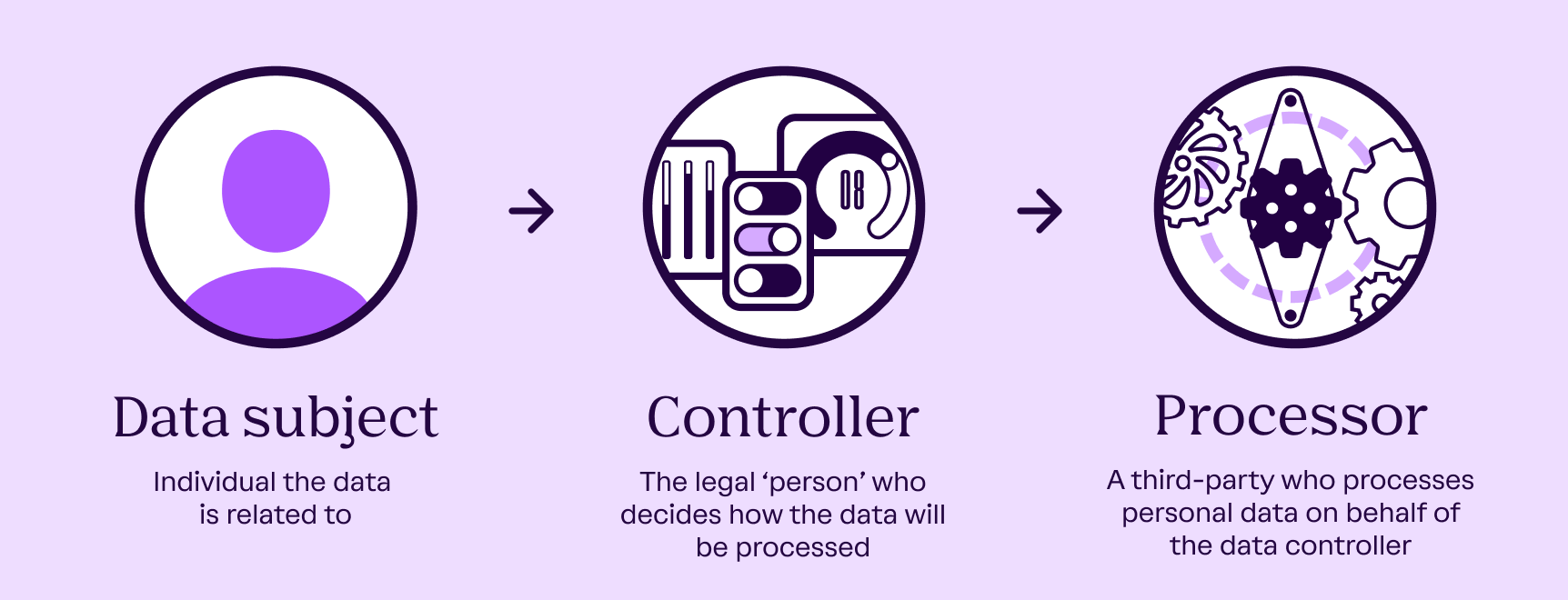
The GDPR recognizes two types of organizations involved in processing personal data:
- Controllers: Determine why personal information is collected and how it’s processed
- Processors: Handle sensitive information on behalf of controllers
Clarifying your role is essential because controllers and processors have different regulatory obligations. The most notable distinction is the data processing agreement (DPA): a contract processors must sign that defines the rights and responsibilities of both parties in alignment with GDPR requirements.
If two organizations jointly determine the scope and purpose of processing activities, they may act as joint controllers. In this case, they divide their controller obligations based on agreement, but data subjects must still be able to exercise their rights in relation to each.
To meet your GDPR obligations, you need to familiarize yourself with data subject rights and data protection principles, explained in the following sections.
Who needs to comply with the GDPR?
All organizations that process personal information of individuals in the EU must comply with the GDPR. This requirement is independent of location: Even organizations outside the EU must comply if they offer goods and services to EU residents or monitor their behavior. Compliance applies regardless of organization size, although smaller organizations might have some flexibility in implementing certain requirements.
The GDPR recognizes two types of organizations involved in processing personal data:
- Controllers: Determine why personal information is collected and how it’s processed
- Processors: Handle sensitive information on behalf of controllers
Clarifying your role is essential because controllers and processors have different regulatory obligations. The most notable distinction is the data processing agreement (DPA): a contract processors must sign that defines the rights and responsibilities of both parties in alignment with GDPR requirements.
If two organizations jointly determine the scope and purpose of processing activities, they may act as joint controllers. In this case, they divide their controller obligations based on agreement, but data subjects must still be able to exercise their rights in relation to each.
To meet your GDPR obligations, you need to familiarize yourself with data subject rights and data protection principles, explained in the following sections.
What are the 8 data subject rights in the GDPR?
The GDPR’s data subject rights give people in the EU eight key rights they can use to protect and control their personal information. These rights enhance transparency and help individuals hold an organization accountable for how it handles their data.
1. Right to be informed
Data subjects have the right to know what data is collected, why it’s collected, how long it will be retained, and how they can lodge potential complaints. This information should be explained in a privacy notice in plain, easily understandable language, either in written or electronic form.
2. Right of access
Data subjects may request access to their personal data held by an organization by submitting a data subject access request (DSAR). Organizations must share information on how the data is processed, as well as additional details such as the storage duration and the existence of automated decision-making. Typically, organizations are required to respond to such requests within a month in the format requested.
3. Right to rectification
Data subjects can request that organizations update their outdated or incomplete personal data. Usually, controllers have one month to fulfill this request, but the deadline can be extended by up to two months in complex cases. If there’s a delay, the data subject must be notified with a reasonable explanation.
{{cta_withimage14="/cta-blocks"}} | GDPR compliance checklist
4. Right to erasure (‘right to be forgotten’)
Data subjects have the right to request that their information be erased, which must be addressed without undue delay. Exceptions apply if data processing is necessary for freedom of expression, legal compliance, and public interest.
5. Right to restriction of processing
Data subjects may request that controllers limit the processing of their data. During this time, the information may only be used with explicit consent and for legal claims, to protect another person’s rights, or for public interest reasons.
6. Right to data portability
Data subjects can request a copy of their personal data, in a format that’s structured, commonly used, and easily readable. They can also request that their data be transferred to another controller. This right applies only to data obtained via consent or a contract, and where the processing activity is automated.
7. Right to object
Data subjects have the right to object to the processing of their data in certain situations, particularly when it relates to direct marketing or when processing is based on legitimate interests. Organizations must stop processing unless they have demonstrated compelling grounds on why the processing outweighs the individual's interests and rights.
8. Rights related to automated decision-making, including profiling
Data subjects have the right not to be subjected to decisions based solely on automated processing and profiling that could have a legal or similarly significant impact on them.
What are the 7 data protection principles in the GDPR?
The GDPR’s data protection principles form the foundation for its data privacy requirements. Understanding and applying them is essential since every compliance obligation under the regulation ties back to one or more of these principles.
1. Lawfulness, fairness, and transparency
Organizations must have a justifiable reason as the basis for their processing activities, such as consent, contractual obligations, or legal necessity.
Fairness and transparency mean that data subjects know how and why their data is being used. This information should be available in easy-to-read language before data collection starts.
2. Purpose limitation
An organization should collect personal information only for a specific purpose under a legal basis. If a basis is reused for a new purpose, individuals must be informed, or a new legal basis must be applied to avoid GDPR violations.
3. Data minimization
The data that you collect should be relevant, adequate, and limited to what is necessary for the intended purpose. Since the scope of your processing activities may change over time, conduct regular reviews to see if you should delete information that is excessive or no longer necessary.
4. Accuracy
All of the data that’s being used for processing activities must be accurate and up-to-date. If you detect any incorrect or incomplete information, you should take reasonable steps to either update or delete it, depending on what it’s being used for.
5. Storage limitation
Organizations must delete or anonymize personal information that is no longer necessary for a specific processing activity. They must define and clearly mention the retention period in the privacy notice.
6. Integrity and confidentiality
All sensitive information must be stored and processed securely. Due to the GDPR’s evolving requirements and best practices, the regulation doesn’t mandate specific safeguards. Instead, this principle can translate to implementing strict technical and administrative measures appropriate to an organization’s risk profile.
7. Accountability
Organizations are responsible for GDPR compliance and must be able to demonstrate it to auditors, partners, and other stakeholders. This includes maintaining detailed documentation, such as DPAs and data subject consent forms, reviewing third-party processors, and assigning data protection officers.
{{cta_withimage11="/cta-blocks"}} | The US data privacy checklist
GDPR compliance requirements: A quick overview
In practice, GDPR compliance means putting the right protections in place based on how you handle data and the level of risk involved. Start by understanding your organization’s role: controllers carry the full weight of GDPR responsibilities, while the requirements for processors are narrower and mainly pertain to implementing appropriate safeguards, maintaining detailed documentation, and assisting with assessments.
The key GDPR compliance requirements are:
- Establish a lawful basis for processing activities: Before you commence any processing activity, determine which of the six lawful bases apply and ensure your data collection is mapped to it. The key to establishing a lawful basis is to be systematic and transparent. Organizations should:
- Strive to establish a repeatable process that maps processing activities and assigns a lawful basis accordingly
- Document and clearly communicate the reasoning
- Review this process regularly and update as needed
- Implement data subject rights workflows: Implement policies and procedures that help fulfill data subject requests adequately and within outlined time frames.
- Conduct data protection impact assessments (DPIAs): Conduct assessments before and during processing activities to identify and address potential data risks early.
- Maintain the necessary documentation: Ensure that all relevant documentation, such as retention policies, data processing activities, and fulfilled data subject requests, is organized and readily accessible to streamline audits.
- Develop incident response procedures: Create an incident response plan to meet GDPR’s strict 72-hour breach notification timeframe and minimize the potential impact of data leaks.
- Appoint a data protection officer (DPO): If your organization processes large amounts of data, monitors individuals, or handles highly sensitive data, you may be required to appoint a DPO. Their role is to oversee compliance and serve as the primary point of contact with regulators and data subjects.
“
As the GDPR matures, data protection officers are evolving from compliance administration-focused roles to strategic data governance leaders. They may start leaning more toward balancing risk, legal, and technical considerations in a dynamic regulatory environment.

Read our blog here to get in-depth insights into GDPR requirements.
{{cta_withimage14="/cta-blocks"}} | GDPR compliance checklist
Penalties for GDPR non-compliance
Non-compliance with the GDPR can result in severe financial penalties or corrective action. This doesn’t have to be a direct violation; failure to follow GDPR-based data protection obligations imposed by the relevant supervisory authority also qualifies as a breach.
Here, a supervisory authority means the independent public body responsible for monitoring and enforcing GDPR compliance in each EU Member State. Examples include Commission Nationale de l’Informatique et des Libertés (CNIL) in France and the Data Protection Commission (DPC) in Ireland.
There are two tiers of financial penalties for non-compliance, depending on the severity of the violation:
There are two tiers of financial penalties for non-compliance, depending on the severity of the violation:
The supervisory authority your organization answers to determines the fine after considering the following factors, which include:
- Nature, gravity, and duration of the infringement
- Intentional or negligent character of the infringement
- Any action taken to mitigate the damage suffered by data subjects
- Degree of responsibility of the controller or processor
- Relevant previous infringements
- Degree of cooperation with the supervisory authority
- Categories of personal data affected
- Manner in which the infringement became known to the authority
- Compliance with prior corrective orders
- Adherence to approved codes of conduct or certification mechanisms
- Any other aggravating or mitigating factors
Data protection authorities can also impose corrective measures ranging from warnings and reprimands to limiting data processing or even suspending international data transfers.
Common GDPR compliance challenges
GDPR compliance can be complex because the regulation is broad and comprehensive. The most common challenges include:
- Process mapping complexity: It's challenging to determine which internal processes and systems are affected by GDPR, especially in growing or global organizations. Many organizations struggle to determine which measures are appropriate and applicable for their needs.
- Manual, fragmented workflows: Meeting GDPR-specific requirements manually, such as addressing breach notifications and data subject requests within tight timelines, increases the risk of errors or inconsistencies.
- Insufficient documentation and retention controls: Teams may lack centralized, up-to-date data retention policies and struggle to respond quickly to audit requests or regulator inquiries.
- Overseeing third-party security posture: Third-party risk management is a key part of GDPR compliance. It requires maintaining complete visibility into your vendor’s risk landscape, which can be challenging in real time.
Best practices for GDPR compliance
Adopting the following practices can help you achieve and maintain GDPR compliance efficiently:
- Understand the scope and purpose of processing activities: Clearly map the personal data necessary for each processing activity, so you can draft an accurate privacy notice and adhere to the minimization principle.
- Centralize data in a single repository: Since you need to regularly review, update, and delete data subject information, keeping everything in a single location can streamline workflows.
- Train staff on GDPR requirements: Conduct regular training sessions to ensure your stakeholders understand GDPR requirements, potential risks to sensitive information, and standard process flows.
- Leverage automation to streamline compliance: Balancing GDPR compliance with day-to-day operations requires significant resources. If not managed effectively, compliance activities can impact product quality and service delivery, and result in churn and reputational damage. That’s why many organizations turn to compliance automation platforms like Vanta to keep compliance workflows agile and build trust as a competitive advantage.
Achieve GDPR compliance efficiently with Vanta
Vanta offers a trust management platform that streamlines GDPR compliance for teams handling the personal data of EU or UK residents. Vanta provides step-by-step guidance for aligning with GDPR principles, eliminating hours of elaborate legal research and consultations.
Vanta’s GDPR product automates up to 50% of compliance tasks and offers a variety of features that reduce the cost and complexity of meeting GDPR obligations. You get:
- Pre-built GDPR policy templates and a customizable builder
- Automated evidence collection powered by 400+ integrations
- Pre-built risk management workflows
- Security awareness training material
- Real-time monitoring with instant security reports
Schedule a personalized demo to explore how Vanta can streamline your GDPR compliance processes.
{{cta_simple19="/cta-blocks"}} | GDPR product page
A note from Vanta: Vanta is not a law firm, and this article does not constitute or contain legal advice or create an attorney-client relationship. When determining your obligations and compliance with respect to relevant laws and regulations, you should consult a licensed attorney.
Introduction to GDPR
What is GDPR compliance? All you need to know
Looking to streamline the work for GDPR compliance?
The General Data Protection Regulation (GDPR) is the EU's landmark data protection law in place since 2018. It sets a global benchmark for privacy by outlining how organizations can collect, process, store, and safeguard personal information, with a strong emphasis on accountability and individual rights.
For many organizations, the GDPR is both a legal requirement and an opportunity to build trust and demonstrate resilient data management practices. However, its comprehensive nature and evolving requirements can make long-term compliance planning challenging.
In this guide, we’ll walk you through all the essentials of GDPR compliance, including:
- The regulation’s core objective
- Who needs to comply
- Subject matter and compliance requirements
- Non-compliance penalties
- GDPR compliance challenges and best practices
What is the main objective of the GDPR?
The primary objective of the GDPR is to safeguard individuals’ fundamental rights and freedoms by protecting their personal data in the EU. It does this by establishing baseline protection standards and granting individuals greater control over how their information is collected, used, shared, stored, and deleted.
Another key objective of the GDPR is transparency, so people know how organizations are using their personal data. This regulation asks businesses to be upfront about how they collect and use the information.
By harmonizing data privacy standards for all Member States, the GDPR supports the free flow of data in the EU's digital economy and enables cross-border services like cloud computing, e-commerce, and digital healthcare without compromising privacy.
{{cta_withimage14="/cta-blocks"}} | GDPR compliance checklist
Who needs to comply with the GDPR?
All organizations that process personal information of individuals in the EU must comply with the GDPR. This requirement is independent of location: Even organizations outside the EU must comply if they offer goods and services to EU residents or monitor their behavior. Compliance applies regardless of organization size, although smaller organizations might have some flexibility in implementing certain requirements.
The GDPR recognizes two types of organizations involved in processing personal data:
- Controllers: Determine why personal information is collected and how it’s processed
- Processors: Handle sensitive information on behalf of controllers
Clarifying your role is essential because controllers and processors have different regulatory obligations. The most notable distinction is the data processing agreement (DPA): a contract processors must sign that defines the rights and responsibilities of both parties in alignment with GDPR requirements.
If two organizations jointly determine the scope and purpose of processing activities, they may act as joint controllers. In this case, they divide their controller obligations based on agreement, but data subjects must still be able to exercise their rights in relation to each.
To meet your GDPR obligations, you need to familiarize yourself with data subject rights and data protection principles, explained in the following sections.
Who needs to comply with the GDPR?
All organizations that process personal information of individuals in the EU must comply with the GDPR. This requirement is independent of location: Even organizations outside the EU must comply if they offer goods and services to EU residents or monitor their behavior. Compliance applies regardless of organization size, although smaller organizations might have some flexibility in implementing certain requirements.
The GDPR recognizes two types of organizations involved in processing personal data:
- Controllers: Determine why personal information is collected and how it’s processed
- Processors: Handle sensitive information on behalf of controllers
Clarifying your role is essential because controllers and processors have different regulatory obligations. The most notable distinction is the data processing agreement (DPA): a contract processors must sign that defines the rights and responsibilities of both parties in alignment with GDPR requirements.
If two organizations jointly determine the scope and purpose of processing activities, they may act as joint controllers. In this case, they divide their controller obligations based on agreement, but data subjects must still be able to exercise their rights in relation to each.
To meet your GDPR obligations, you need to familiarize yourself with data subject rights and data protection principles, explained in the following sections.
What are the 8 data subject rights in the GDPR?
The GDPR’s data subject rights give people in the EU eight key rights they can use to protect and control their personal information. These rights enhance transparency and help individuals hold an organization accountable for how it handles their data.
1. Right to be informed
Data subjects have the right to know what data is collected, why it’s collected, how long it will be retained, and how they can lodge potential complaints. This information should be explained in a privacy notice in plain, easily understandable language, either in written or electronic form.
2. Right of access
Data subjects may request access to their personal data held by an organization by submitting a data subject access request (DSAR). Organizations must share information on how the data is processed, as well as additional details such as the storage duration and the existence of automated decision-making. Typically, organizations are required to respond to such requests within a month in the format requested.
3. Right to rectification
Data subjects can request that organizations update their outdated or incomplete personal data. Usually, controllers have one month to fulfill this request, but the deadline can be extended by up to two months in complex cases. If there’s a delay, the data subject must be notified with a reasonable explanation.
{{cta_withimage14="/cta-blocks"}} | GDPR compliance checklist
4. Right to erasure (‘right to be forgotten’)
Data subjects have the right to request that their information be erased, which must be addressed without undue delay. Exceptions apply if data processing is necessary for freedom of expression, legal compliance, and public interest.
5. Right to restriction of processing
Data subjects may request that controllers limit the processing of their data. During this time, the information may only be used with explicit consent and for legal claims, to protect another person’s rights, or for public interest reasons.
6. Right to data portability
Data subjects can request a copy of their personal data, in a format that’s structured, commonly used, and easily readable. They can also request that their data be transferred to another controller. This right applies only to data obtained via consent or a contract, and where the processing activity is automated.
7. Right to object
Data subjects have the right to object to the processing of their data in certain situations, particularly when it relates to direct marketing or when processing is based on legitimate interests. Organizations must stop processing unless they have demonstrated compelling grounds on why the processing outweighs the individual's interests and rights.
8. Rights related to automated decision-making, including profiling
Data subjects have the right not to be subjected to decisions based solely on automated processing and profiling that could have a legal or similarly significant impact on them.
What are the 7 data protection principles in the GDPR?
The GDPR’s data protection principles form the foundation for its data privacy requirements. Understanding and applying them is essential since every compliance obligation under the regulation ties back to one or more of these principles.
1. Lawfulness, fairness, and transparency
Organizations must have a justifiable reason as the basis for their processing activities, such as consent, contractual obligations, or legal necessity.
Fairness and transparency mean that data subjects know how and why their data is being used. This information should be available in easy-to-read language before data collection starts.
2. Purpose limitation
An organization should collect personal information only for a specific purpose under a legal basis. If a basis is reused for a new purpose, individuals must be informed, or a new legal basis must be applied to avoid GDPR violations.
3. Data minimization
The data that you collect should be relevant, adequate, and limited to what is necessary for the intended purpose. Since the scope of your processing activities may change over time, conduct regular reviews to see if you should delete information that is excessive or no longer necessary.
4. Accuracy
All of the data that’s being used for processing activities must be accurate and up-to-date. If you detect any incorrect or incomplete information, you should take reasonable steps to either update or delete it, depending on what it’s being used for.
5. Storage limitation
Organizations must delete or anonymize personal information that is no longer necessary for a specific processing activity. They must define and clearly mention the retention period in the privacy notice.
6. Integrity and confidentiality
All sensitive information must be stored and processed securely. Due to the GDPR’s evolving requirements and best practices, the regulation doesn’t mandate specific safeguards. Instead, this principle can translate to implementing strict technical and administrative measures appropriate to an organization’s risk profile.
7. Accountability
Organizations are responsible for GDPR compliance and must be able to demonstrate it to auditors, partners, and other stakeholders. This includes maintaining detailed documentation, such as DPAs and data subject consent forms, reviewing third-party processors, and assigning data protection officers.
{{cta_withimage11="/cta-blocks"}} | The US data privacy checklist
GDPR compliance requirements: A quick overview
In practice, GDPR compliance means putting the right protections in place based on how you handle data and the level of risk involved. Start by understanding your organization’s role: controllers carry the full weight of GDPR responsibilities, while the requirements for processors are narrower and mainly pertain to implementing appropriate safeguards, maintaining detailed documentation, and assisting with assessments.
The key GDPR compliance requirements are:
- Establish a lawful basis for processing activities: Before you commence any processing activity, determine which of the six lawful bases apply and ensure your data collection is mapped to it. The key to establishing a lawful basis is to be systematic and transparent. Organizations should:
- Strive to establish a repeatable process that maps processing activities and assigns a lawful basis accordingly
- Document and clearly communicate the reasoning
- Review this process regularly and update as needed
- Implement data subject rights workflows: Implement policies and procedures that help fulfill data subject requests adequately and within outlined time frames.
- Conduct data protection impact assessments (DPIAs): Conduct assessments before and during processing activities to identify and address potential data risks early.
- Maintain the necessary documentation: Ensure that all relevant documentation, such as retention policies, data processing activities, and fulfilled data subject requests, is organized and readily accessible to streamline audits.
- Develop incident response procedures: Create an incident response plan to meet GDPR’s strict 72-hour breach notification timeframe and minimize the potential impact of data leaks.
- Appoint a data protection officer (DPO): If your organization processes large amounts of data, monitors individuals, or handles highly sensitive data, you may be required to appoint a DPO. Their role is to oversee compliance and serve as the primary point of contact with regulators and data subjects.
“
As the GDPR matures, data protection officers are evolving from compliance administration-focused roles to strategic data governance leaders. They may start leaning more toward balancing risk, legal, and technical considerations in a dynamic regulatory environment.
Read our blog here to get in-depth insights into GDPR requirements.
{{cta_withimage14="/cta-blocks"}} | GDPR compliance checklist
Penalties for GDPR non-compliance
Non-compliance with the GDPR can result in severe financial penalties or corrective action. This doesn’t have to be a direct violation; failure to follow GDPR-based data protection obligations imposed by the relevant supervisory authority also qualifies as a breach.
Here, a supervisory authority means the independent public body responsible for monitoring and enforcing GDPR compliance in each EU Member State. Examples include Commission Nationale de l’Informatique et des Libertés (CNIL) in France and the Data Protection Commission (DPC) in Ireland.
There are two tiers of financial penalties for non-compliance, depending on the severity of the violation:
There are two tiers of financial penalties for non-compliance, depending on the severity of the violation:
The supervisory authority your organization answers to determines the fine after considering the following factors, which include:
- Nature, gravity, and duration of the infringement
- Intentional or negligent character of the infringement
- Any action taken to mitigate the damage suffered by data subjects
- Degree of responsibility of the controller or processor
- Relevant previous infringements
- Degree of cooperation with the supervisory authority
- Categories of personal data affected
- Manner in which the infringement became known to the authority
- Compliance with prior corrective orders
- Adherence to approved codes of conduct or certification mechanisms
- Any other aggravating or mitigating factors
Data protection authorities can also impose corrective measures ranging from warnings and reprimands to limiting data processing or even suspending international data transfers.
Common GDPR compliance challenges
GDPR compliance can be complex because the regulation is broad and comprehensive. The most common challenges include:
- Process mapping complexity: It's challenging to determine which internal processes and systems are affected by GDPR, especially in growing or global organizations. Many organizations struggle to determine which measures are appropriate and applicable for their needs.
- Manual, fragmented workflows: Meeting GDPR-specific requirements manually, such as addressing breach notifications and data subject requests within tight timelines, increases the risk of errors or inconsistencies.
- Insufficient documentation and retention controls: Teams may lack centralized, up-to-date data retention policies and struggle to respond quickly to audit requests or regulator inquiries.
- Overseeing third-party security posture: Third-party risk management is a key part of GDPR compliance. It requires maintaining complete visibility into your vendor’s risk landscape, which can be challenging in real time.
Best practices for GDPR compliance
Adopting the following practices can help you achieve and maintain GDPR compliance efficiently:
- Understand the scope and purpose of processing activities: Clearly map the personal data necessary for each processing activity, so you can draft an accurate privacy notice and adhere to the minimization principle.
- Centralize data in a single repository: Since you need to regularly review, update, and delete data subject information, keeping everything in a single location can streamline workflows.
- Train staff on GDPR requirements: Conduct regular training sessions to ensure your stakeholders understand GDPR requirements, potential risks to sensitive information, and standard process flows.
- Leverage automation to streamline compliance: Balancing GDPR compliance with day-to-day operations requires significant resources. If not managed effectively, compliance activities can impact product quality and service delivery, and result in churn and reputational damage. That’s why many organizations turn to compliance automation platforms like Vanta to keep compliance workflows agile and build trust as a competitive advantage.
Achieve GDPR compliance efficiently with Vanta
Vanta offers a trust management platform that streamlines GDPR compliance for teams handling the personal data of EU or UK residents. Vanta provides step-by-step guidance for aligning with GDPR principles, eliminating hours of elaborate legal research and consultations.
Vanta’s GDPR product automates up to 50% of compliance tasks and offers a variety of features that reduce the cost and complexity of meeting GDPR obligations. You get:
- Pre-built GDPR policy templates and a customizable builder
- Automated evidence collection powered by 400+ integrations
- Pre-built risk management workflows
- Security awareness training material
- Real-time monitoring with instant security reports
Schedule a personalized demo to explore how Vanta can streamline your GDPR compliance processes.
{{cta_simple19="/cta-blocks"}} | GDPR product page
A note from Vanta: Vanta is not a law firm, and this article does not constitute or contain legal advice or create an attorney-client relationship. When determining your obligations and compliance with respect to relevant laws and regulations, you should consult a licensed attorney.
Explore more GDPR articles
Introduction to GDPR
Understanding GDPR requirements
Preparing for GDPR compliance
Streamlining GDPR compliance
Get started with GDPR:
Start your GDPR journey with these related resources.

GDPR basics: Everything you need to know to keep your business compliant
Learn the basics of GDPR, what GDPR compliance means for your organization, and how the GDPR rights granted to those in the EU may impact your business.

A step-by-step GDPR compliance checklist
Vanta makes it easy to prove your GDPR compliance.
An essential guide to GDPR compliance for SaaS companies
Learn about the basic principles of GDPR compliance for SaaS companies.