The General Data Protection Regulation (GDPR) is an EU regulation adopted in 2018. Its goal is to safeguard the personal data of people in the EU.
Although the GDPR sets broad and rigorous compliance requirements, most of its provisions are based on seven data protection principles. These principles are designed to empower individuals and hold organizations accountable for how they handle personal information.
Understanding these seven GDPR data protection principles is a crucial first step toward compliance. In this article, we’ll examine each principle in depth and share actionable steps for aligning with them.
What are the 7 GDPR data protection principles?
The seven GDPR data protection principles are the guiding ideas behind every requirement in the regulation. Get familiar with them before you start pursuing compliance to streamline the process and set a solid base for meeting GDPR requirements.
The seven GDPR data protection principles are:
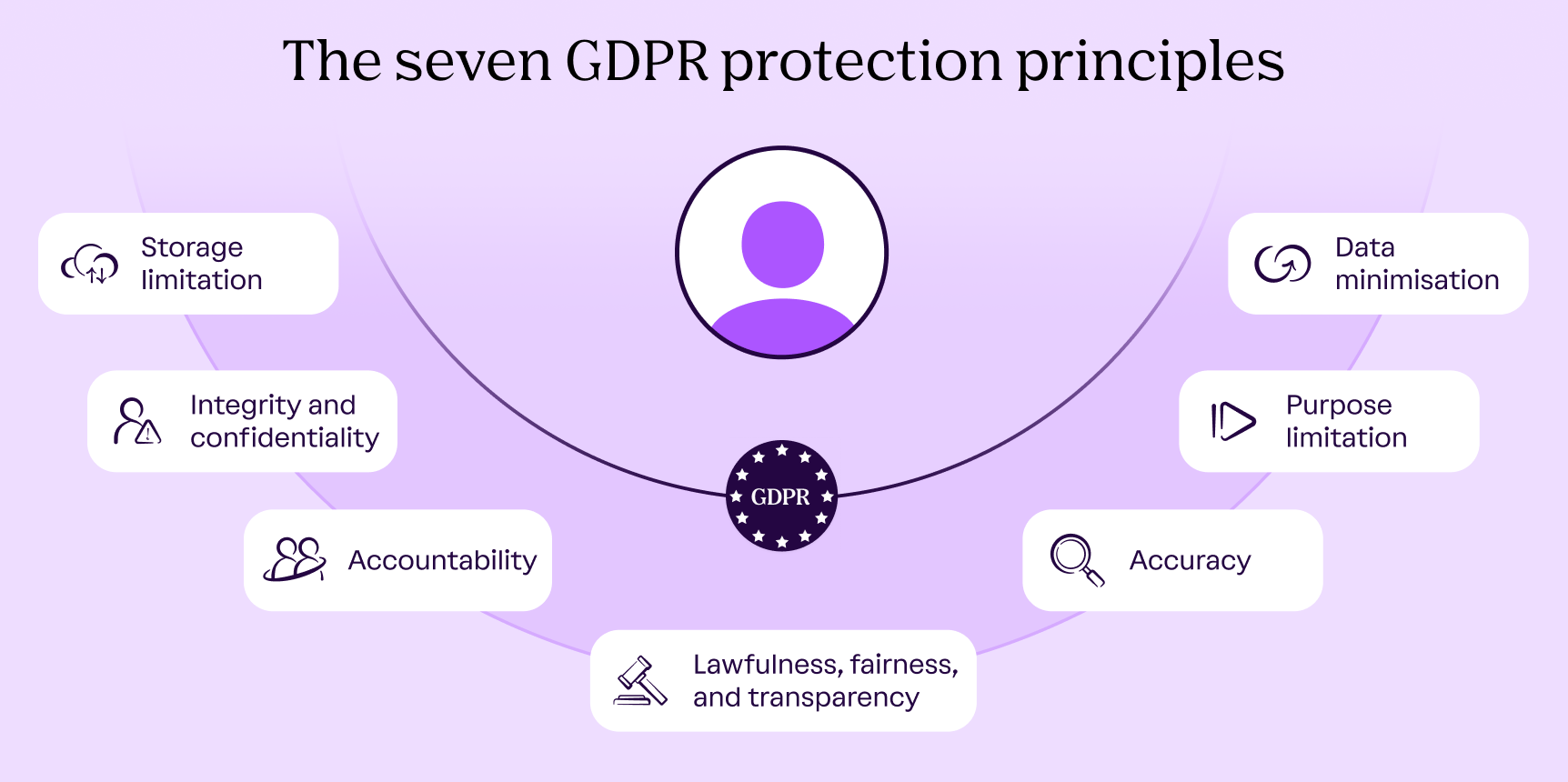
- Lawfulness, fairness, and transparency
- Purpose limitation
- Data minimization
- Accuracy
- Storage limitation
- Integrity and confidentiality
- Accountability
{{cta_withimage14="/cta-blocks"}} | GDPR compliance checklist
Principle 1: Lawfulness, fairness, and transparency
Organizations must establish a clear and justifiable lawful basis for processing personal information before they even start collecting it. The GDPR lists six possible legal bases that organizations can rely on:
- Consent from the data subject
- Fulfilling a contract
- Meeting a legal obligation
- Protecting the vital interests of the subject or another individual
- Performing a task in the public interest or under official authority
- Legitimate interests that override the data subjects’ rights—this decision must be carefully considered and should involve as much transparency as possible
In this context, consent means that data subjects make an informed, voluntary, and unambiguous choice to allow organizations to process their data. This can include enabling cookies, ticking a box, or signing a form that indicates they agree to a specific processing activity.
Consent is also closely related to fairness. Data subjects must know what information is being collected, why it’s collected, and that it won’t be used in a way that can cause harm.
Transparency requires organizations to clearly inform individuals about data collection before it begins or if the processing practices change. The most common way organizations meet the transparency requirement is through a privacy notice.
“
It’s practical for organizations to familiarize themselves with the seven GDPR data protection principles before pursuing full compliance. It’s crucial to educate themselves on what GDPR entails, to ensure they understand the breadth of what GDPR encompasses, and to enable them to align future decisions with GDPR requirements.”

Principle 2: Purpose limitation
Purpose limitation means that organizations must only collect information required for a specified, explicit, and legitimate purpose. Processing data beyond the original purpose would be considered a breach under the GDPR.
However, further processing is allowed in several specific cases, including:
- Archiving in the public interest
- Historical or scientific research
- Statistical purposes
To align with this principle, conduct assessments and establish a clear scope of your processing activities before you start collecting any personal information.
Principle 3: Data minimization
This principle implies that you should only collect personal data that is relevant, adequate, and necessary for your processing purposes. The GDPR doesn’t provide clear guidance on how to assess these criteria, meaning that you must conduct internal assessments and define them based on your organizational needs.
Limiting data collection activities to the necessary minimum can also bring security and operational benefits. Since there’s less data to handle, your attack surface is smaller, and potential breaches may not be as impactful. You also won’t have to invest as many resources to ensure that stored information is up-to-date.
Adherence to the data minimization principle is an ongoing effort. Regularly review what you collect, adjust the scope as purposes evolve, and delete data that’s no longer required.
Principle 4: Accuracy
You must ensure that any personal records you keep are accurate and up to date. If you discover inaccuracies, take reasonable steps to correct or delete the data without undue delay, with the specifics depending on what the data is used for.
This principle is closely connected to the data subject's right of rectification, which allows individuals to request corrections to any inaccurate or incomplete data that organizations have on them.
The most efficient way to align with the accuracy principle is to establish clear procedures for detecting inaccuracies and deciding whether to correct or erase them. You can streamline the process by implementing an automation solution that allows you to access all user data from a single dashboard and identify outdated records in real time.
{{cta_withimage11="/cta-blocks"}} | The US data privacy checklist
Principle 5: Storage limitation
You’re only allowed to retain personal data for as long as it’s needed for a specified purpose. Once the predefined retention period ends, you must securely delete or anonymize the data related to that processing activity.
There are several exceptions to this principle. You may keep the information longer if it's:
- Necessary for archiving in the public interest
- Used for historical or scientific research
- Maintained for statistical purposes in line with the GDPR
Implement and maintain appropriate technical and administrative safeguards for as long as you store sensitive information. It’s also recommended that you establish schedules for reviews of high-risk systems and datasets at certain cadences, such as monthly or quarterly, to ensure that they are adhering to GDPR guidelines.
When creating your privacy notice, make sure to include the retention period and explain the factors that can impact the duration.
Principle 6: Integrity and confidentiality
Personal data may only be processed in a way that ensures its integrity and confidentiality. This includes accounting for both outside threats and accidental exposure due to human error, data erasure, or media destruction.
To adhere to this principle, organizations must implement organizational and administrative measures that cover both cloud and physical environments. Review and adapt these measures to any changes in your threat landscape to make sure they remain relevant.
A potential challenge of complying with this principle is the lack of prescriptive guidance. Due to the evolving industry best practices and the unique risk landscape of each organization, the GDPR doesn’t prescribe a fixed set of security measures. Instead, it requires organizations to implement appropriate technical and organizational measures appropriate for their situation.
Some of the most effective security measures you can implement include:
- Encryption
- Access controls
- Data protection by design
- Vendor risk management
- Staff training
Principle 7: Accountability
The main purpose of the accountability principle is to ensure that, aside from achieving GDPR compliance, organizations can actually demonstrate it. To do this, they must maintain thorough records of all data protection decisions and actions, which are critical for compliance audits and regulatory inspections.
Adherence to other data protection principles underpins accountability by helping you establish a strong foundation of responsible data management practices. You should further demonstrate your commitment to accountability by implementing measures such as:
- Appointing a data protection officer (DPO)
- Conducting data protection impact assessments (DPIAs)
- Drafting clear contracts with data processors
Keep in mind that as the GDPR evolves to adapt to new threats, the expectations and obligations around accountability change as well. You should continually review and update these requirements for ongoing alignment.
Some of the accountability processes can be time- and resource-demanding, which can increase the risk of errors and take focus away from operational tasks. You can streamline the process with a dedicated automation solution and reduce the pressure on your compliance teams.
{{cta_withimage14="/cta-blocks"}} | GDPR compliance checklist
Tips for applying GDPR’s data protection principles
Follow these practices to make sure you efficiently adhere to GDPR’s data protection principles:
- Integrate GDPR principles into products and services from the outset: Embed the “privacy by design” approach into services, products, and processes to align with GDPR principles. This reduces the need for post-deployment adjustments.
- Create straightforward and clear consent forms: Make sure that your consent forms are concise, straightforward, and written in plain language so data subjects can make informed decisions when giving consent.
- Maintain an updated data flow map: Document and track how data flows through your system, from collection to deletion. This enables you to identify threats, streamline processes, and efficiently demonstrate compliance.
- Support continuous monitoring with automation: Implement automation tools to benefit from real-time insights and detect potential compliance issues quickly.
Vanta: Your shortcut to automated GDPR compliance
Vanta is a trust management platform that helps organizations cut the time needed to comply with GDPR, avoid non-compliance fines, and strengthen their overall security posture. It achieves this by providing step-by-step guidance for meeting GDPR’s complex compliance requirements, eliminating ambiguity and hours of legal research and consultations.
Vanta’s GDPR product offers various helpful features, such as:
- Automated evidence collection powered by 400+ integrations
- Inventory management in a single dashboard
- Pre-built policy templates and a customization tool
- Real-time monitoring with instant security reports
- Dedicated GDPR and security awareness training
You can start by scheduling a GDPR demo customized for your team.
{{cta_simple19="/cta-blocks"}} | GDPR product page
A note from Vanta: Vanta is not a law firm, and this article does not constitute or contain legal advice or create an attorney-client relationship. When determining your obligations and compliance with respect to relevant laws and regulations, you should consult a licensed attorney.
Understanding GDPR requirements
A practical guide to the 7 GDPR data protection principles
Understanding GDPR requirements
Looking to streamline the work for GDPR compliance?
The General Data Protection Regulation (GDPR) is an EU regulation adopted in 2018. Its goal is to safeguard the personal data of people in the EU.
Although the GDPR sets broad and rigorous compliance requirements, most of its provisions are based on seven data protection principles. These principles are designed to empower individuals and hold organizations accountable for how they handle personal information.
Understanding these seven GDPR data protection principles is a crucial first step toward compliance. In this article, we’ll examine each principle in depth and share actionable steps for aligning with them.
What are the 7 GDPR data protection principles?
The seven GDPR data protection principles are the guiding ideas behind every requirement in the regulation. Get familiar with them before you start pursuing compliance to streamline the process and set a solid base for meeting GDPR requirements.
The seven GDPR data protection principles are:
- Lawfulness, fairness, and transparency
- Purpose limitation
- Data minimization
- Accuracy
- Storage limitation
- Integrity and confidentiality
- Accountability
{{cta_withimage14="/cta-blocks"}} | GDPR compliance checklist
Principle 1: Lawfulness, fairness, and transparency
Organizations must establish a clear and justifiable lawful basis for processing personal information before they even start collecting it. The GDPR lists six possible legal bases that organizations can rely on:
- Consent from the data subject
- Fulfilling a contract
- Meeting a legal obligation
- Protecting the vital interests of the subject or another individual
- Performing a task in the public interest or under official authority
- Legitimate interests that override the data subjects’ rights—this decision must be carefully considered and should involve as much transparency as possible
In this context, consent means that data subjects make an informed, voluntary, and unambiguous choice to allow organizations to process their data. This can include enabling cookies, ticking a box, or signing a form that indicates they agree to a specific processing activity.
Consent is also closely related to fairness. Data subjects must know what information is being collected, why it’s collected, and that it won’t be used in a way that can cause harm.
Transparency requires organizations to clearly inform individuals about data collection before it begins or if the processing practices change. The most common way organizations meet the transparency requirement is through a privacy notice.
“
It’s practical for organizations to familiarize themselves with the seven GDPR data protection principles before pursuing full compliance. It’s crucial to educate themselves on what GDPR entails, to ensure they understand the breadth of what GDPR encompasses, and to enable them to align future decisions with GDPR requirements.”
Principle 2: Purpose limitation
Purpose limitation means that organizations must only collect information required for a specified, explicit, and legitimate purpose. Processing data beyond the original purpose would be considered a breach under the GDPR.
However, further processing is allowed in several specific cases, including:
- Archiving in the public interest
- Historical or scientific research
- Statistical purposes
To align with this principle, conduct assessments and establish a clear scope of your processing activities before you start collecting any personal information.
Principle 3: Data minimization
This principle implies that you should only collect personal data that is relevant, adequate, and necessary for your processing purposes. The GDPR doesn’t provide clear guidance on how to assess these criteria, meaning that you must conduct internal assessments and define them based on your organizational needs.
Limiting data collection activities to the necessary minimum can also bring security and operational benefits. Since there’s less data to handle, your attack surface is smaller, and potential breaches may not be as impactful. You also won’t have to invest as many resources to ensure that stored information is up-to-date.
Adherence to the data minimization principle is an ongoing effort. Regularly review what you collect, adjust the scope as purposes evolve, and delete data that’s no longer required.
Principle 4: Accuracy
You must ensure that any personal records you keep are accurate and up to date. If you discover inaccuracies, take reasonable steps to correct or delete the data without undue delay, with the specifics depending on what the data is used for.
This principle is closely connected to the data subject's right of rectification, which allows individuals to request corrections to any inaccurate or incomplete data that organizations have on them.
The most efficient way to align with the accuracy principle is to establish clear procedures for detecting inaccuracies and deciding whether to correct or erase them. You can streamline the process by implementing an automation solution that allows you to access all user data from a single dashboard and identify outdated records in real time.
{{cta_withimage11="/cta-blocks"}} | The US data privacy checklist
Principle 5: Storage limitation
You’re only allowed to retain personal data for as long as it’s needed for a specified purpose. Once the predefined retention period ends, you must securely delete or anonymize the data related to that processing activity.
There are several exceptions to this principle. You may keep the information longer if it's:
- Necessary for archiving in the public interest
- Used for historical or scientific research
- Maintained for statistical purposes in line with the GDPR
Implement and maintain appropriate technical and administrative safeguards for as long as you store sensitive information. It’s also recommended that you establish schedules for reviews of high-risk systems and datasets at certain cadences, such as monthly or quarterly, to ensure that they are adhering to GDPR guidelines.
When creating your privacy notice, make sure to include the retention period and explain the factors that can impact the duration.
Principle 6: Integrity and confidentiality
Personal data may only be processed in a way that ensures its integrity and confidentiality. This includes accounting for both outside threats and accidental exposure due to human error, data erasure, or media destruction.
To adhere to this principle, organizations must implement organizational and administrative measures that cover both cloud and physical environments. Review and adapt these measures to any changes in your threat landscape to make sure they remain relevant.
A potential challenge of complying with this principle is the lack of prescriptive guidance. Due to the evolving industry best practices and the unique risk landscape of each organization, the GDPR doesn’t prescribe a fixed set of security measures. Instead, it requires organizations to implement appropriate technical and organizational measures appropriate for their situation.
Some of the most effective security measures you can implement include:
- Encryption
- Access controls
- Data protection by design
- Vendor risk management
- Staff training
Principle 7: Accountability
The main purpose of the accountability principle is to ensure that, aside from achieving GDPR compliance, organizations can actually demonstrate it. To do this, they must maintain thorough records of all data protection decisions and actions, which are critical for compliance audits and regulatory inspections.
Adherence to other data protection principles underpins accountability by helping you establish a strong foundation of responsible data management practices. You should further demonstrate your commitment to accountability by implementing measures such as:
- Appointing a data protection officer (DPO)
- Conducting data protection impact assessments (DPIAs)
- Drafting clear contracts with data processors
Keep in mind that as the GDPR evolves to adapt to new threats, the expectations and obligations around accountability change as well. You should continually review and update these requirements for ongoing alignment.
Some of the accountability processes can be time- and resource-demanding, which can increase the risk of errors and take focus away from operational tasks. You can streamline the process with a dedicated automation solution and reduce the pressure on your compliance teams.
{{cta_withimage14="/cta-blocks"}} | GDPR compliance checklist
Tips for applying GDPR’s data protection principles
Follow these practices to make sure you efficiently adhere to GDPR’s data protection principles:
- Integrate GDPR principles into products and services from the outset: Embed the “privacy by design” approach into services, products, and processes to align with GDPR principles. This reduces the need for post-deployment adjustments.
- Create straightforward and clear consent forms: Make sure that your consent forms are concise, straightforward, and written in plain language so data subjects can make informed decisions when giving consent.
- Maintain an updated data flow map: Document and track how data flows through your system, from collection to deletion. This enables you to identify threats, streamline processes, and efficiently demonstrate compliance.
- Support continuous monitoring with automation: Implement automation tools to benefit from real-time insights and detect potential compliance issues quickly.
Vanta: Your shortcut to automated GDPR compliance
Vanta is a trust management platform that helps organizations cut the time needed to comply with GDPR, avoid non-compliance fines, and strengthen their overall security posture. It achieves this by providing step-by-step guidance for meeting GDPR’s complex compliance requirements, eliminating ambiguity and hours of legal research and consultations.
Vanta’s GDPR product offers various helpful features, such as:
- Automated evidence collection powered by 400+ integrations
- Inventory management in a single dashboard
- Pre-built policy templates and a customization tool
- Real-time monitoring with instant security reports
- Dedicated GDPR and security awareness training
You can start by scheduling a GDPR demo customized for your team.
{{cta_simple19="/cta-blocks"}} | GDPR product page
A note from Vanta: Vanta is not a law firm, and this article does not constitute or contain legal advice or create an attorney-client relationship. When determining your obligations and compliance with respect to relevant laws and regulations, you should consult a licensed attorney.
Explore more GDPR articles
Introduction to GDPR
Understanding GDPR requirements
Preparing for GDPR compliance
Streamlining GDPR compliance
Get started with GDPR:
Start your GDPR journey with these related resources.

GDPR basics: Everything you need to know to keep your business compliant
Learn the basics of GDPR, what GDPR compliance means for your organization, and how the GDPR rights granted to those in the EU may impact your business.

A step-by-step GDPR compliance checklist
Vanta makes it easy to prove your GDPR compliance.
An essential guide to GDPR compliance for SaaS companies
Learn about the basic principles of GDPR compliance for SaaS companies.