Achieving GDPR compliance isn’t a one-and-done task. Your organization must stay aligned with the regulation’s evolving requirements as long as it processes the personal information of individuals in the EU/EEA.
That means regularly reviewing and updating your data protection policies and procedures. Without structured continuous compliance practices, you risk operational disruptions, reputational damage, and even severe financial penalties.
In this article, we’ll discuss:
- Why continuous GDPR compliance matters
- Seven best practices for ongoing GDPR compliance
- Common mistakes to avoid
Why continuous GDPR compliance matters
Continuous GDPR compliance matters because your obligations don’t end after initial implementation. The purpose of the GDPR is to guarantee the ongoing safety and privacy of the personal data of people in the EU, which means the framework evolves to address new threats, technologies, and enforcement expectations. Naturally, your compliance activities must also evolve with it.
In practice, staying continuously compliant with the GDPR helps you demonstrate your ability to detect issues early, adjust controls, and prove that your privacy posture remains strong. This is done by implementing real-time monitoring and conducting regular internal audits to keep your data protection practices aligned with GDPR requirements and core principles, including lawfulness, data minimization, and accountability.
Without continuous compliance, organizations in scope risk severe penalties. Failing to align with this mandatory regulation can result in fines of up to €20 million or 4% of your organization’s global annual turnover (whichever is higher), as well as potential corrective actions.
{{cta_withimage14="/cta-blocks"}} | GDPR compliance checklist
7 best practices for ongoing GDPR compliance
While the specifics may vary across organizations, these seven general practices can help you maintain GDPR compliance:
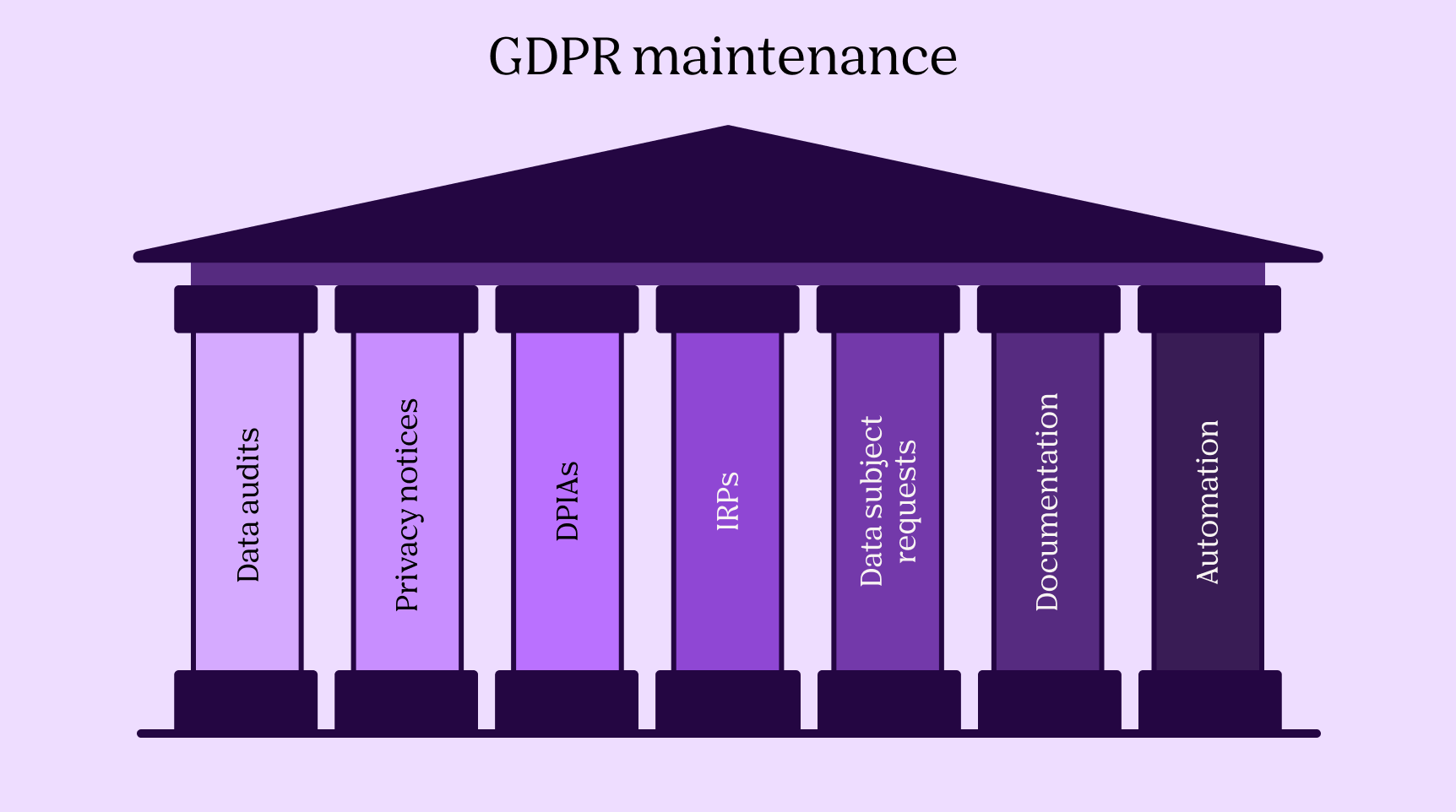
- Schedule regular data audits
- Review and update privacy notices
- Perform data protection impact assessments (DPIAs)
- Test and update incident response plans
- Track and fulfill data subject requests
- Maintain detailed documentation
- Implement automation solutions
1. Schedule regular data audits
Conduct regular data audits that confirm your organization is meeting GDPR requirements. These audits should also verify that the data you store is accurate and still relevant to your processing activities, since GDPR asks that the information you keep should be limited to the minimum necessary for that purpose.
As part of each assessment, compare your stored data against your retention policy. Delete any information that is outdated, redundant, or no longer necessary for your operations.
While the GDPR doesn’t mandate a specific cadence for conducting audits, they should ideally be performed at least once a year. You should also conduct audits after any major operational changes or regulatory updates.
If your organization handles large volumes of sensitive data or systematically monitors individuals, you must also appoint a data protection officer (DPO). The DPO is responsible for overseeing GDPR compliance, managing audits, and leading data protection training across the organization.
{{cta_withimage11="/cta-blocks"}}| The US data privacy checklist
2. Review and update privacy notices
As part of GDPR compliance, you must make your data subjects aware of how and why their data is being collected, and whether it’s shared with third parties. Provide this information in written form and in plain language as a privacy notice before any data collection takes place.
The privacy notice should also include contact information so that data subjects can reach your organization with any questions or requests related to their personal information.
Regularly review and update your privacy policies to reflect potential regulatory or any internal changes, such as new data collection practices, product launches, or vendor onboarding.
“
As a general best practice, review your privacy policies and notices at least annually to ensure they are up-to-date and reflect the current state of your business practices.””

3. Perform data protection impact assessments (DPIAs)
Before you begin any new processing activity, you should conduct a data protection impact assessment (DPIA) to identify and mitigate potential risks to personal data. DPIAs are especially important when handling special categories of sensitive data that require additional protections.
According to Article 35 of the GDPR, conducting a DPIA is mandatory when an organization is:
- Using new technologies to process data
- Systematically monitoring public areas at a large scale
- Extensively monitoring or profiling individuals
- Conducting activities that may impact the rights and freedoms of data subjects
You should also revisit and update your DPIAs whenever new threats emerge or your processing activities change to confirm that your existing measures are still adequate.
To make your DPIAs more effective, involve stakeholders from different departments—this ensures deeper insights and thorough risk identification. It’s also important to keep records of your previous assessments, as historical findings can streamline future DPIAs and offer valuable insights into recurring or evolving risks.
4. Test and update incident response plans
Articles 33 and 34 of the GDPR outline strict requirements for incident response and reporting timelines. To ensure compliance, you must be ready to act quickly and send out breach notifications to the relevant supervisory authorities within the defined time frames.
In practice, this means you’ll need to create and regularly test incident response workflows to keep them effective. Simulation tests and tabletop exercises are particularly useful here, as they demonstrate how your response plans perform under real-world conditions and help you spot and address any gaps before an incident materializes.
An ineffective incident response plan can lead to major consequences for your organization, including extended operational downtime, reputational damage, and even fines from data protection authorities.
You can strengthen your overall incident response preparedness by running regular training sessions. These help you embed a culture of GDPR awareness so that each team member is clear on their responsibilities during a breach.
5. Track and fulfill data subject requests
The GDPR defines eight data subject rights. These rights give data subjects greater control over their personal information and allow them to hold organizations accountable for how that data is used.
To maintain GDPR compliance, you must set up clear communication channels that make it easier for data subjects to exercise their rights. You’ll also need consistent, repeatable workflows that allow individuals to:
- Access their data
- Request corrections or updates
- Object to data processing
- Have their data erased
{{cta_withimage14="/cta-blocks"}} | GDPR compliance checklist
6. Maintain thorough documentation and data inventories
Maintaining detailed documentation helps you remain audit-ready at all times and supports ongoing GDPR compliance by allowing you to reference past actions and decisions.
One of the key documents you’ll need to maintain is your record of processing activities (RoPA), which should include:
- The name and contact details of the data controller
- The purpose of processing
- Descriptions of data subjects and the types of data collected
- Details of any recipients, including transfers to third countries
- Data retention periods
- Implemented safeguards
Aside from your RoPA, you should also maintain access logs, training completion records, data processing agreements, and DPIA reports. Keep detailed records of all completed and ongoing data subject requests, along with the steps taken/planned to fulfill them.
Store all records in a centralized, easily accessible location and review them regularly so that they accurately reflect your current processing activities.
7. Implement automation solutions
Maintaining GDPR compliance can be a resource-intensive process. When done manually, many required workflows can overwhelm your IT and compliance teams, increasing the risk of inefficiencies, bottlenecks, and potential delays.
These delays, along with the remediation work they often trigger, can quickly drive up overall compliance costs, especially if the task scope is extensive or issues are addressed reactively.
A more efficient approach is to implement dedicated GDPR compliance software that automates repetitive and time-heavy tasks, reducing team fatigue, lowering the risk of non-compliance, and cutting operational costs in the long run.
Ongoing GDPR compliance: Common mistakes
Even with strong policies in place, several common errors can make ongoing GDPR compliance far more challenging.
A frequent mistake is using vendors or third parties without verifying their GDPR compliance status. Failing to vet vendors and subprocessors or not establishing data processing agreements (DPAs) can be risky as it gives third parties access to personal data without confirming whether they’ll meet GDPR standards. Any security gaps on their end becomes your compliance failure.
Another common mistake is failing to define a clear chain of responsibility. When you don’t assign specific roles for updating policies, managing compliance tasks, and reviewing RoPAs and DPIAs, you risk creating compliance lapses, such as being unaware of what data you’re collecting, why you’re collecting it, and how it impacts your risk exposure.
Finally, using fragmented tools or systems to manage controls, audits, and sensitive data can complicate audit trails and increase the risk of processing errors. To avoid this, consolidate your GDPR workflows within a single platform, such as Vanta, that centralizes documentation, monitoring, and reporting—making compliance easier to track and maintain.
Maintain GDPR compliance effortlessly with Vanta
Vanta is a leading agentic trust platform that streamlines GDPR compliance by automating essential compliance workflows. It provides built-in guidance that translates complex regulatory requirements into actionable tasks, helping your teams save time and resources on legal research.
The platform offers a dedicated GDPR product that comes with valuable features that help you achieve and maintain compliance, such as:
- Automated evidence collection powered by 400+ integrations
- GDPR-specific training materials
- A single dashboard for tracking GDPR activities
- Continuous monitoring with instant report generation
- Pre-built policy templates and a built-in customization tool
If you’ve already achieved compliance with other frameworks such as SOC 2 and ISO 27001, you can use Vanta’s cross-mapping feature to align existing controls with GDPR requirements faster. And, if you need GDPR expertise, Vanta can connect you with its network partners to provide the right guidance for your team.
Schedule a custom demo to see how Vanta streamlines GDPR compliance for your team.
{{cta_simple19="/cta-blocks"}} | GDPR product page
FAQs
What happens if you don’t maintain GDPR compliance?
Failing to maintain GDPR compliance can result in serious consequences, including severe financial penalties, corrective action, and lasting reputational damage to your organization.
Can GDPR compliance be maintained automatically?
Although you can streamline many of the required GDPR compliance workflows, automating the entire compliance process isn’t possible. The regulation has many complex requirements that demand human oversight and nuanced decision-making.
What’s the difference between achieving and maintaining GDPR compliance?
Achieving GDPR compliance often involves extensive internal audits and adjustments to existing policies and procedures to meet the regulation’s strict standards. Once you’ve achieved compliance, maintaining it requires ongoing monitoring, reviews, and updates—a relatively lighter but continuous effort to stay aligned with the GDPR’s evolving requirements.
A note from Vanta: Vanta is not a law firm, and this article does not constitute or contain legal advice or create an attorney-client relationship. When determining your obligations and compliance with respect to relevant laws and regulations, you should consult a licensed attorney.
Streamlining GDPR compliance
How to maintain GDPR compliance: An actionable guide
Looking to streamline the work for GDPR compliance?
Achieving GDPR compliance isn’t a one-and-done task. Your organization must stay aligned with the regulation’s evolving requirements as long as it processes the personal information of individuals in the EU/EEA.
That means regularly reviewing and updating your data protection policies and procedures. Without structured continuous compliance practices, you risk operational disruptions, reputational damage, and even severe financial penalties.
In this article, we’ll discuss:
- Why continuous GDPR compliance matters
- Seven best practices for ongoing GDPR compliance
- Common mistakes to avoid
Why continuous GDPR compliance matters
Continuous GDPR compliance matters because your obligations don’t end after initial implementation. The purpose of the GDPR is to guarantee the ongoing safety and privacy of the personal data of people in the EU, which means the framework evolves to address new threats, technologies, and enforcement expectations. Naturally, your compliance activities must also evolve with it.
In practice, staying continuously compliant with the GDPR helps you demonstrate your ability to detect issues early, adjust controls, and prove that your privacy posture remains strong. This is done by implementing real-time monitoring and conducting regular internal audits to keep your data protection practices aligned with GDPR requirements and core principles, including lawfulness, data minimization, and accountability.
Without continuous compliance, organizations in scope risk severe penalties. Failing to align with this mandatory regulation can result in fines of up to €20 million or 4% of your organization’s global annual turnover (whichever is higher), as well as potential corrective actions.
{{cta_withimage14="/cta-blocks"}} | GDPR compliance checklist
7 best practices for ongoing GDPR compliance
While the specifics may vary across organizations, these seven general practices can help you maintain GDPR compliance:
- Schedule regular data audits
- Review and update privacy notices
- Perform data protection impact assessments (DPIAs)
- Test and update incident response plans
- Track and fulfill data subject requests
- Maintain detailed documentation
- Implement automation solutions
1. Schedule regular data audits
Conduct regular data audits that confirm your organization is meeting GDPR requirements. These audits should also verify that the data you store is accurate and still relevant to your processing activities, since GDPR asks that the information you keep should be limited to the minimum necessary for that purpose.
As part of each assessment, compare your stored data against your retention policy. Delete any information that is outdated, redundant, or no longer necessary for your operations.
While the GDPR doesn’t mandate a specific cadence for conducting audits, they should ideally be performed at least once a year. You should also conduct audits after any major operational changes or regulatory updates.
If your organization handles large volumes of sensitive data or systematically monitors individuals, you must also appoint a data protection officer (DPO). The DPO is responsible for overseeing GDPR compliance, managing audits, and leading data protection training across the organization.
{{cta_withimage11="/cta-blocks"}}| The US data privacy checklist
2. Review and update privacy notices
As part of GDPR compliance, you must make your data subjects aware of how and why their data is being collected, and whether it’s shared with third parties. Provide this information in written form and in plain language as a privacy notice before any data collection takes place.
The privacy notice should also include contact information so that data subjects can reach your organization with any questions or requests related to their personal information.
Regularly review and update your privacy policies to reflect potential regulatory or any internal changes, such as new data collection practices, product launches, or vendor onboarding.
“
As a general best practice, review your privacy policies and notices at least annually to ensure they are up-to-date and reflect the current state of your business practices.””
3. Perform data protection impact assessments (DPIAs)
Before you begin any new processing activity, you should conduct a data protection impact assessment (DPIA) to identify and mitigate potential risks to personal data. DPIAs are especially important when handling special categories of sensitive data that require additional protections.
According to Article 35 of the GDPR, conducting a DPIA is mandatory when an organization is:
- Using new technologies to process data
- Systematically monitoring public areas at a large scale
- Extensively monitoring or profiling individuals
- Conducting activities that may impact the rights and freedoms of data subjects
You should also revisit and update your DPIAs whenever new threats emerge or your processing activities change to confirm that your existing measures are still adequate.
To make your DPIAs more effective, involve stakeholders from different departments—this ensures deeper insights and thorough risk identification. It’s also important to keep records of your previous assessments, as historical findings can streamline future DPIAs and offer valuable insights into recurring or evolving risks.
4. Test and update incident response plans
Articles 33 and 34 of the GDPR outline strict requirements for incident response and reporting timelines. To ensure compliance, you must be ready to act quickly and send out breach notifications to the relevant supervisory authorities within the defined time frames.
In practice, this means you’ll need to create and regularly test incident response workflows to keep them effective. Simulation tests and tabletop exercises are particularly useful here, as they demonstrate how your response plans perform under real-world conditions and help you spot and address any gaps before an incident materializes.
An ineffective incident response plan can lead to major consequences for your organization, including extended operational downtime, reputational damage, and even fines from data protection authorities.
You can strengthen your overall incident response preparedness by running regular training sessions. These help you embed a culture of GDPR awareness so that each team member is clear on their responsibilities during a breach.
5. Track and fulfill data subject requests
The GDPR defines eight data subject rights. These rights give data subjects greater control over their personal information and allow them to hold organizations accountable for how that data is used.
To maintain GDPR compliance, you must set up clear communication channels that make it easier for data subjects to exercise their rights. You’ll also need consistent, repeatable workflows that allow individuals to:
- Access their data
- Request corrections or updates
- Object to data processing
- Have their data erased
{{cta_withimage14="/cta-blocks"}} | GDPR compliance checklist
6. Maintain thorough documentation and data inventories
Maintaining detailed documentation helps you remain audit-ready at all times and supports ongoing GDPR compliance by allowing you to reference past actions and decisions.
One of the key documents you’ll need to maintain is your record of processing activities (RoPA), which should include:
- The name and contact details of the data controller
- The purpose of processing
- Descriptions of data subjects and the types of data collected
- Details of any recipients, including transfers to third countries
- Data retention periods
- Implemented safeguards
Aside from your RoPA, you should also maintain access logs, training completion records, data processing agreements, and DPIA reports. Keep detailed records of all completed and ongoing data subject requests, along with the steps taken/planned to fulfill them.
Store all records in a centralized, easily accessible location and review them regularly so that they accurately reflect your current processing activities.
7. Implement automation solutions
Maintaining GDPR compliance can be a resource-intensive process. When done manually, many required workflows can overwhelm your IT and compliance teams, increasing the risk of inefficiencies, bottlenecks, and potential delays.
These delays, along with the remediation work they often trigger, can quickly drive up overall compliance costs, especially if the task scope is extensive or issues are addressed reactively.
A more efficient approach is to implement dedicated GDPR compliance software that automates repetitive and time-heavy tasks, reducing team fatigue, lowering the risk of non-compliance, and cutting operational costs in the long run.
Ongoing GDPR compliance: Common mistakes
Even with strong policies in place, several common errors can make ongoing GDPR compliance far more challenging.
A frequent mistake is using vendors or third parties without verifying their GDPR compliance status. Failing to vet vendors and subprocessors or not establishing data processing agreements (DPAs) can be risky as it gives third parties access to personal data without confirming whether they’ll meet GDPR standards. Any security gaps on their end becomes your compliance failure.
Another common mistake is failing to define a clear chain of responsibility. When you don’t assign specific roles for updating policies, managing compliance tasks, and reviewing RoPAs and DPIAs, you risk creating compliance lapses, such as being unaware of what data you’re collecting, why you’re collecting it, and how it impacts your risk exposure.
Finally, using fragmented tools or systems to manage controls, audits, and sensitive data can complicate audit trails and increase the risk of processing errors. To avoid this, consolidate your GDPR workflows within a single platform, such as Vanta, that centralizes documentation, monitoring, and reporting—making compliance easier to track and maintain.
Maintain GDPR compliance effortlessly with Vanta
Vanta is a leading agentic trust platform that streamlines GDPR compliance by automating essential compliance workflows. It provides built-in guidance that translates complex regulatory requirements into actionable tasks, helping your teams save time and resources on legal research.
The platform offers a dedicated GDPR product that comes with valuable features that help you achieve and maintain compliance, such as:
- Automated evidence collection powered by 400+ integrations
- GDPR-specific training materials
- A single dashboard for tracking GDPR activities
- Continuous monitoring with instant report generation
- Pre-built policy templates and a built-in customization tool
If you’ve already achieved compliance with other frameworks such as SOC 2 and ISO 27001, you can use Vanta’s cross-mapping feature to align existing controls with GDPR requirements faster. And, if you need GDPR expertise, Vanta can connect you with its network partners to provide the right guidance for your team.
Schedule a custom demo to see how Vanta streamlines GDPR compliance for your team.
{{cta_simple19="/cta-blocks"}} | GDPR product page
FAQs
What happens if you don’t maintain GDPR compliance?
Failing to maintain GDPR compliance can result in serious consequences, including severe financial penalties, corrective action, and lasting reputational damage to your organization.
Can GDPR compliance be maintained automatically?
Although you can streamline many of the required GDPR compliance workflows, automating the entire compliance process isn’t possible. The regulation has many complex requirements that demand human oversight and nuanced decision-making.
What’s the difference between achieving and maintaining GDPR compliance?
Achieving GDPR compliance often involves extensive internal audits and adjustments to existing policies and procedures to meet the regulation’s strict standards. Once you’ve achieved compliance, maintaining it requires ongoing monitoring, reviews, and updates—a relatively lighter but continuous effort to stay aligned with the GDPR’s evolving requirements.
A note from Vanta: Vanta is not a law firm, and this article does not constitute or contain legal advice or create an attorney-client relationship. When determining your obligations and compliance with respect to relevant laws and regulations, you should consult a licensed attorney.
Explore more GDPR articles
Introduction to GDPR
Understanding GDPR requirements
Preparing for GDPR compliance
Streamlining GDPR compliance
Get started with GDPR:
Start your GDPR journey with these related resources.

GDPR basics: Everything you need to know to keep your business compliant
Learn the basics of GDPR, what GDPR compliance means for your organization, and how the GDPR rights granted to those in the EU may impact your business.

A step-by-step GDPR compliance checklist
Vanta makes it easy to prove your GDPR compliance.
An essential guide to GDPR compliance for SaaS companies
Learn about the basic principles of GDPR compliance for SaaS companies.