The General Data Protection Regulation (GDPR) is a law that sets strict standards for safeguarding the personal data of individuals. While compliance is mandatory for any organization processing such data, the regulation distinguishes between two roles: data controller and data processor.
Each role carries distinct responsibilities under the GDPR. Understanding what they are and how they apply to your organization is the first step toward compliance.
In this article, we’ll clarify:
- What is a data controller responsible for?
- What is a data processor responsible for?
- Can an organization be both?
Note: This article addresses the EU GDPR. The UK GDPR is a separate legal framework post-Brexit. The two regimes share many similarities, but the enforcement and oversight logistics may vary.
What is a data controller?
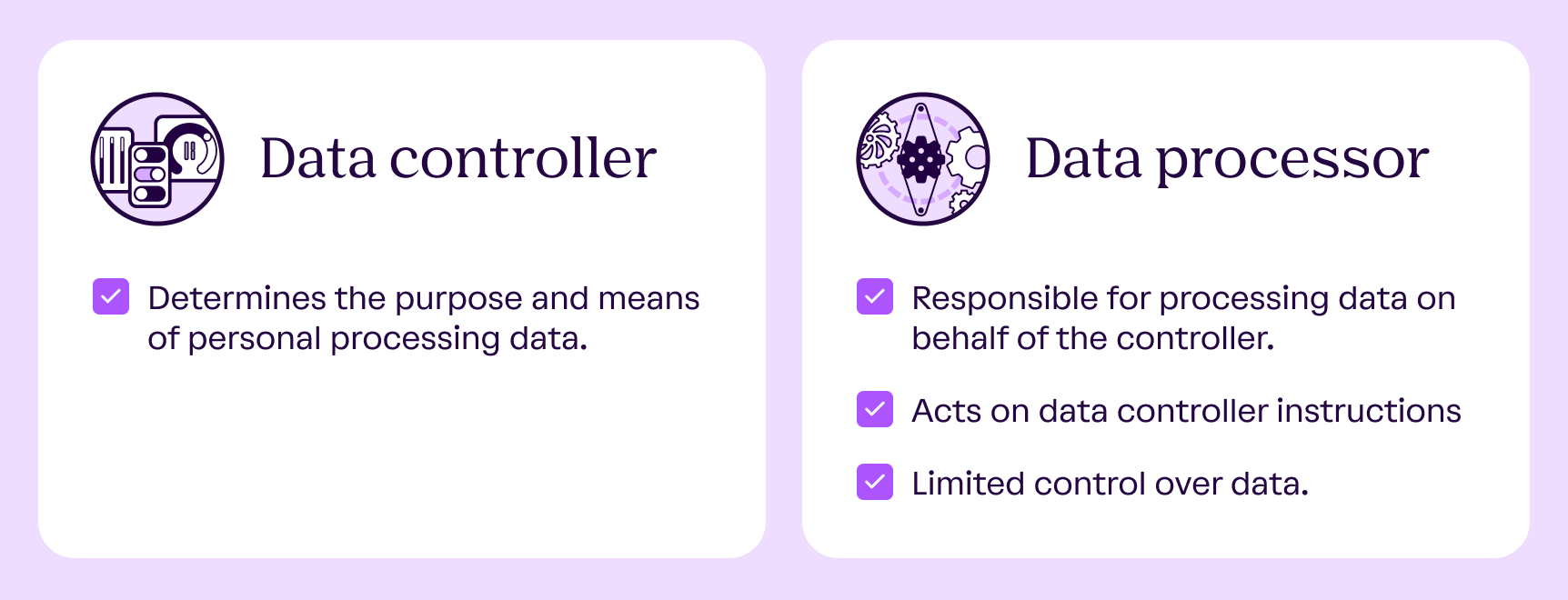
Under the GDPR, a data controller is an organization or authority that determines how and why personal data should be processed. In many cases, the controller also carries out the processing itself. For instance, a social media platform has to determine what user data to collect and how to use it for features, feed recommendations, and advertising, which would make it a data controller.
Control over processing activities isn’t always held by a single entity. If two organizations jointly determine the purposes and means of data processing, they’re considered joint controllers. While this relationship doesn’t require a DPA, joint controllers must have a clear arrangement setting out respective roles and responsibilities regarding GDPR compliance.
Note: A controller can also appoint a data processor—a third party that processes personal data on their behalf. In this case, the controller remains accountable for ensuring that the processor handles the data in compliance with the regulation. These responsibilities, including the purposes and specific conditions for processing, are set out in a document called a data processing agreement (DPA).
{{cta_withimage14="/cta-blocks"}} | GDPR compliance checklist
What are the responsibilities of a data controller?
Data controllers are expected to fully comply with all GDPR requirements relevant to their processing activities and be able to demonstrate this compliance.
In practice, this requires implementing appropriate technical and organizational measures proportionate to:
- Nature, scope, and purpose of processing: Implement safeguards proportional to the amount and type of information you collect and the lawful basis for processing
- Likelihood and impact of potential breaches and risks to rights and freedoms: Conduct data protection impact assessments (DPIAs) both before and upon changes to processing activities to proactively identify threats
Controllers may also choose to adhere to industry-specific codes of conduct regarding data processing. While alignment with these codes is voluntary and doesn’t replace GDPR compliance, it’s another way to build trust with customers.
Data controllers aren’t only responsible for their own GDPR compliance. According to Article 28 of the GDPR, controllers must also ensure that any third party they engage as a processor meets GDPR requirements.
“
In practice, it may be tempting to focus on controller responsibilities and leave processor obligations vague in your DPA. That mistake can quickly lead to confusion around breach timelines, subprocessor management, and data return, putting both parties at risk of noncompliance.”

What is a data processor?
A data processor is an organization that collects, stores, or processes personal information on behalf of a controller. The processor does not own the data, and so does not determine the purposes and essential means of processing.
Common examples of data processors include:
- Payroll companies
- Cloud service providers
- Marketing platforms
Processors may engage subprocessors with explicit authorization from their controller. In such cases, the processor must impose the same data protection obligations on the subprocessor and remain fully liable to the controller for compliance.
What are the responsibilities of a data processor?
Although data processors handle the same sensitive information, their responsibilities under the GDPR slightly differ from those of controllers. A processor's key obligations revolve around adhering to the DPA, and typically include:
- Implementing appropriate safeguards for GDPR compliance: Processors must have technical and organizational safeguards in place, such as access controls, multi-factor authentication, and encryption, to protect personal data. These measures should be proportional and appropriate to the sensitivity of the data and the type of processing.
- Making compliance information available to the controller during audits: Processors must maintain and update Records of Processing Activities (RoPAs), internal audit reports, and other relevant documentation that may be used to efficiently demonstrate compliance to controllers during reviews.
- Supporting the controller in fulfilling data subject rights: Processors establish workflows to help controllers meet data subject requests, such as access, correction, or deletion, as outlined in the DPA.
- Deleting or returning sensitive information after the contract ends: Unless required otherwise by law, processors must make sure that all personal data is either returned to the controller or safely disposed of after the contract ends. They should also document these procedures to demonstrate compliance.
- Notifying the controller of data breaches: Processors must inform the controller without undue delay once they become aware of a personal data breach.
Can an organization be a data processor and a data controller at the same time?
An organization can be both a data controller and a processor, but not for the same processing activity. Let’s consider two examples:
- Digital health platform: The company is considered a controller for the personal data of its employees and the data it collects for its own purposes, such as usage analytics. When integrated clinics or providers send patient data to the platform, the company acts as a processor, handling the data strictly as per their instructions.
- AI SaaS startup: The company is a controller for its own product usage data, which it can leverage to improve algorithms, manage subscriptions, or generate insights about feature adoption. However, when a client uploads customer datasets for analysis, the startup serves as a processor and follows the client’s directives.
Regardless of your organization’s typical operations, as soon as you start making decisions about the means and purposes of processing sensitive data, you are considered a controller under the GDPR and must meet the corresponding requirements.
{{cta_withimage14="/cta-blocks"}} | GDPR compliance checklist
Data controller or data processor: Why it’s important to define your role
Because controllers and processors have different scopes and responsibilities, understanding your role in each processing activity is imperative. Misclassifying your position can lead to GDPR violations, which can result in:
- Financial risks: Aside from the substantial financial penalties, unclear roles can slow audits and inflate compliance costs
- Reputational risks: While fines can be paid, lost trust is typically harder to rebuild, especially as users increasingly expect high standards for transparency and accountability
- Operational risks: Misunderstanding your organization's role can create gaps in your security and compliance processes, increasing the likelihood of incidents and remediation burdens
To avoid potential issues, thoroughly assess your organization’s role for each processing activity. If you lack in-house expertise, engage an external consultant for support.
With role clarity in place, you can make GDPR compliance more efficient by implementing an automation solution that streamlines some of the most time- and resource-intensive workflows.
Choose Vanta for clear, guided GDPR compliance
Vanta is a leading trust management platform that streamlines GDPR compliance by automating up to 50% of the related workload. Whether you operate as a controller or a processor, Vanta’s resources and guidance will help you operationalize both EU GDPR and UK GDPR obligations as clear, actionable tasks.
Vanta’s GDPR compliance solution is designed to serve as a single source of truth for everything GDPR-related, including evidence collection, document uploads, and instant security reports. You get:
- Automated evidence collection powered by 400+ integrations
- Real-time monitoring on a unified dashboard
- Materials for security awareness training
- Gap assessment for GDPR-specific controls
- Pre-built and customizable GDPR policy templates
If you are looking for GDPR consultants, Vanta can connect you to its network partners and help you access the right expertise for your team.
If you already have a compliance program, Vanta’s cross-framework mapping lets you reuse existing controls (including those from ISO 27001 and SOC 2) to meet GDPR requirements faster.
Schedule a custom demo today to see how Vanta makes GDPR compliance manageable.
{{cta_simple19="/cta-blocks"}} | GDPR product page
A note from Vanta: Vanta is not a law firm, and this article does not constitute or contain legal advice or create an attorney-client relationship. When determining your obligations and compliance with respect to relevant laws and regulations, you should consult a licensed attorney.
Introduction to GDPR
Data controller vs. data processor: Differences explained
Looking to streamline the work for GDPR compliance?
The General Data Protection Regulation (GDPR) is a law that sets strict standards for safeguarding the personal data of individuals. While compliance is mandatory for any organization processing such data, the regulation distinguishes between two roles: data controller and data processor.
Each role carries distinct responsibilities under the GDPR. Understanding what they are and how they apply to your organization is the first step toward compliance.
In this article, we’ll clarify:
- What is a data controller responsible for?
- What is a data processor responsible for?
- Can an organization be both?
Note: This article addresses the EU GDPR. The UK GDPR is a separate legal framework post-Brexit. The two regimes share many similarities, but the enforcement and oversight logistics may vary.
What is a data controller?
Under the GDPR, a data controller is an organization or authority that determines how and why personal data should be processed. In many cases, the controller also carries out the processing itself. For instance, a social media platform has to determine what user data to collect and how to use it for features, feed recommendations, and advertising, which would make it a data controller.
Control over processing activities isn’t always held by a single entity. If two organizations jointly determine the purposes and means of data processing, they’re considered joint controllers. While this relationship doesn’t require a DPA, joint controllers must have a clear arrangement setting out respective roles and responsibilities regarding GDPR compliance.
Note: A controller can also appoint a data processor—a third party that processes personal data on their behalf. In this case, the controller remains accountable for ensuring that the processor handles the data in compliance with the regulation. These responsibilities, including the purposes and specific conditions for processing, are set out in a document called a data processing agreement (DPA).
{{cta_withimage14="/cta-blocks"}} | GDPR compliance checklist
What are the responsibilities of a data controller?
Data controllers are expected to fully comply with all GDPR requirements relevant to their processing activities and be able to demonstrate this compliance.
In practice, this requires implementing appropriate technical and organizational measures proportionate to:
- Nature, scope, and purpose of processing: Implement safeguards proportional to the amount and type of information you collect and the lawful basis for processing
- Likelihood and impact of potential breaches and risks to rights and freedoms: Conduct data protection impact assessments (DPIAs) both before and upon changes to processing activities to proactively identify threats
Controllers may also choose to adhere to industry-specific codes of conduct regarding data processing. While alignment with these codes is voluntary and doesn’t replace GDPR compliance, it’s another way to build trust with customers.
Data controllers aren’t only responsible for their own GDPR compliance. According to Article 28 of the GDPR, controllers must also ensure that any third party they engage as a processor meets GDPR requirements.
“
In practice, it may be tempting to focus on controller responsibilities and leave processor obligations vague in your DPA. That mistake can quickly lead to confusion around breach timelines, subprocessor management, and data return, putting both parties at risk of noncompliance.”
What is a data processor?
A data processor is an organization that collects, stores, or processes personal information on behalf of a controller. The processor does not own the data, and so does not determine the purposes and essential means of processing.
Common examples of data processors include:
- Payroll companies
- Cloud service providers
- Marketing platforms
Processors may engage subprocessors with explicit authorization from their controller. In such cases, the processor must impose the same data protection obligations on the subprocessor and remain fully liable to the controller for compliance.
What are the responsibilities of a data processor?
Although data processors handle the same sensitive information, their responsibilities under the GDPR slightly differ from those of controllers. A processor's key obligations revolve around adhering to the DPA, and typically include:
- Implementing appropriate safeguards for GDPR compliance: Processors must have technical and organizational safeguards in place, such as access controls, multi-factor authentication, and encryption, to protect personal data. These measures should be proportional and appropriate to the sensitivity of the data and the type of processing.
- Making compliance information available to the controller during audits: Processors must maintain and update Records of Processing Activities (RoPAs), internal audit reports, and other relevant documentation that may be used to efficiently demonstrate compliance to controllers during reviews.
- Supporting the controller in fulfilling data subject rights: Processors establish workflows to help controllers meet data subject requests, such as access, correction, or deletion, as outlined in the DPA.
- Deleting or returning sensitive information after the contract ends: Unless required otherwise by law, processors must make sure that all personal data is either returned to the controller or safely disposed of after the contract ends. They should also document these procedures to demonstrate compliance.
- Notifying the controller of data breaches: Processors must inform the controller without undue delay once they become aware of a personal data breach.
Can an organization be a data processor and a data controller at the same time?
An organization can be both a data controller and a processor, but not for the same processing activity. Let’s consider two examples:
- Digital health platform: The company is considered a controller for the personal data of its employees and the data it collects for its own purposes, such as usage analytics. When integrated clinics or providers send patient data to the platform, the company acts as a processor, handling the data strictly as per their instructions.
- AI SaaS startup: The company is a controller for its own product usage data, which it can leverage to improve algorithms, manage subscriptions, or generate insights about feature adoption. However, when a client uploads customer datasets for analysis, the startup serves as a processor and follows the client’s directives.
Regardless of your organization’s typical operations, as soon as you start making decisions about the means and purposes of processing sensitive data, you are considered a controller under the GDPR and must meet the corresponding requirements.
{{cta_withimage14="/cta-blocks"}} | GDPR compliance checklist
Data controller or data processor: Why it’s important to define your role
Because controllers and processors have different scopes and responsibilities, understanding your role in each processing activity is imperative. Misclassifying your position can lead to GDPR violations, which can result in:
- Financial risks: Aside from the substantial financial penalties, unclear roles can slow audits and inflate compliance costs
- Reputational risks: While fines can be paid, lost trust is typically harder to rebuild, especially as users increasingly expect high standards for transparency and accountability
- Operational risks: Misunderstanding your organization's role can create gaps in your security and compliance processes, increasing the likelihood of incidents and remediation burdens
To avoid potential issues, thoroughly assess your organization’s role for each processing activity. If you lack in-house expertise, engage an external consultant for support.
With role clarity in place, you can make GDPR compliance more efficient by implementing an automation solution that streamlines some of the most time- and resource-intensive workflows.
Choose Vanta for clear, guided GDPR compliance
Vanta is a leading trust management platform that streamlines GDPR compliance by automating up to 50% of the related workload. Whether you operate as a controller or a processor, Vanta’s resources and guidance will help you operationalize both EU GDPR and UK GDPR obligations as clear, actionable tasks.
Vanta’s GDPR compliance solution is designed to serve as a single source of truth for everything GDPR-related, including evidence collection, document uploads, and instant security reports. You get:
- Automated evidence collection powered by 400+ integrations
- Real-time monitoring on a unified dashboard
- Materials for security awareness training
- Gap assessment for GDPR-specific controls
- Pre-built and customizable GDPR policy templates
If you are looking for GDPR consultants, Vanta can connect you to its network partners and help you access the right expertise for your team.
If you already have a compliance program, Vanta’s cross-framework mapping lets you reuse existing controls (including those from ISO 27001 and SOC 2) to meet GDPR requirements faster.
Schedule a custom demo today to see how Vanta makes GDPR compliance manageable.
{{cta_simple19="/cta-blocks"}} | GDPR product page
A note from Vanta: Vanta is not a law firm, and this article does not constitute or contain legal advice or create an attorney-client relationship. When determining your obligations and compliance with respect to relevant laws and regulations, you should consult a licensed attorney.
Explore more GDPR articles
Introduction to GDPR
Understanding GDPR requirements
Preparing for GDPR compliance
Streamlining GDPR compliance
Get started with GDPR:
Start your GDPR journey with these related resources.

GDPR basics: Everything you need to know to keep your business compliant
Learn the basics of GDPR, what GDPR compliance means for your organization, and how the GDPR rights granted to those in the EU may impact your business.

A step-by-step GDPR compliance checklist
Vanta makes it easy to prove your GDPR compliance.
An essential guide to GDPR compliance for SaaS companies
Learn about the basic principles of GDPR compliance for SaaS companies.