Share this article


Accelerating security solutions for small businesses Tagore offers strategic services to small businesses. | A partnership that can scale Tagore prioritized finding a managed compliance partner with an established product, dedicated support team, and rapid release rate. | Standing out from competitors Tagore's partnership with Vanta enhances its strategic focus and deepens client value, creating differentiation in a competitive market. |
As artificial intelligence becomes deeply integrated into business operations, organizations have started feeling the pressure to keep up. According to Vanta’s 2025 survey, more than 50% of the organizations report being overwhelmed by the speed of AI adoption and growing compliance obligations.
This issue is aggravated by the fact that AI tools evolve faster than governance policies can adapt, potentially leaving complex gaps for security teams to fill. One of the standardized ways to address this issue is to conduct regular AI security assessments, as they help evaluate and proactively plan for the risks associated with AI systems.
In this article, we’ll explore an AI-informed approach to security assessments and discuss:
An AI security assessment is a formalized process of identifying, evaluating, and mitigating security threats associated with the design, deployment, and monitoring of AI systems. Its primary goals are to proactively address AI system vulnerabilities, ensure operational resilience, and support compliance with emerging AI regulations and standards.
Given the variety of threats AI systems face, an effective AI security assessment should address risks such as:
{{cta_withimage28="/cta-blocks"}}
To ensure a comprehensive review, your AI security risk assessment must cover the following components:
Regular AI security assessments strengthen your organization’s AI governance program. Here are some granular benefits:
{{cta_webinar6="/cta-blocks"}}
The specifics of your AI security assessment will depend on your industry, tech stack, and applicable AI use cases, but the following steps provide a strong foundation:
To properly scope your AI security assessment, you first need to define its objective, build an inventory of all AI assets, assign a risk profile to each, and include support systems that aren’t necessarily AI systems but can impact AI security. IT systems without AI integrations, those that don’t handle sensitive data, and decommissioned systems are usually out of scope.
When building your inventory, include all internal AI models, third-party services, and tools with embedded AI features in your list. Keep the inventory data in a centralized hub to enable your security and IT teams to maintain a holistic view of your AI systems and their dependencies.
You should also consider the possibility of undetected AI programs, (shadow AI). You may have to ask your team to disclose the use of any such programs and add them to your inventory. In the long run, you can establish technical oversight and clear policies that govern the use of shadow AI.
It’s worth noting that asset inventory is a core compliance requirement for several AI-related standards and regulations, such as the NIST AI RMF and the EU AI Act, which emphasize the need to identify and document AI systems as part of broader security efforts.
Regardless of whether you build and use internal AI models or rely on external partners, verifying your security safeguards is essential for risk assessment and gap remediation.
For this step, you can start by identifying AI regulations that apply to your industry and region, and use them as a reference point to conduct a gap assessment. After identifying regulatory and security gaps, conduct a thorough threat modeling and risk assessment exercise to prioritize what gaps to remediate first.
Typically, threat modeling and risk analysis of AI systems is the most time-consuming part of an AI security assessment. Lack of mature frameworks, complex attack surfaces, and resource dependencies from multiple teams leads to increased effort.”

AI gap assessments require you to perform reviews of:
Remediation measures will depend on the risks uncovered and their impact. For instance, Samsung banned the use of generative AI tools like ChatGPT after discovering the upload of sensitive code to the platform, which is a high-impact risk.
{{cta_withimage28="/cta-blocks"}}
Instead of building their own models, many organizations use managed AI services, which only expands their attack surface. Before you integrate vendor tools into your tech stack, it’s essential to vet each vendor through detailed questionnaires and ensure that they meet your internal security standards and regulatory requirements.
Some of the most important aspects of vendor services you should address include:
With AI’s rapid evolution, the technology is introducing new and unpredictable vulnerabilities, making AI-informed incident response plans essential. Your incident response plan should include procedures for detecting and responding to mapped AI threats, as well as rollback procedures for deployment issues.
You should also establish continuous monitoring for AI security controls so that you can detect and respond to security incidents faster, minimizing their impact and reducing potential downtime.
It’s equally important to develop communication protocols for materialized incidents. Define task owners and communication channels for reporting to customers, partners, and, if applicable, regulatory bodies, to demonstrate transparency and build trust.
Although frequent AI security audits are useful, they don’t capture risks that emerge between cycles. To bridge this gap, integrate AI oversight into your existing monitoring processes. With the right setup and system integrations, you can monitor suspicious data flows, model update logs, unusual outputs, and access logs in real time.
However, manually monitoring all AI security aspects can be time-consuming, even for a medium-sized team. That’s because AI systems tend to generate huge amounts of data, which can result in audit fatigue. The better solution is to configure existing tools to flag anomalies, record key events, and generate audit-friendly reports.
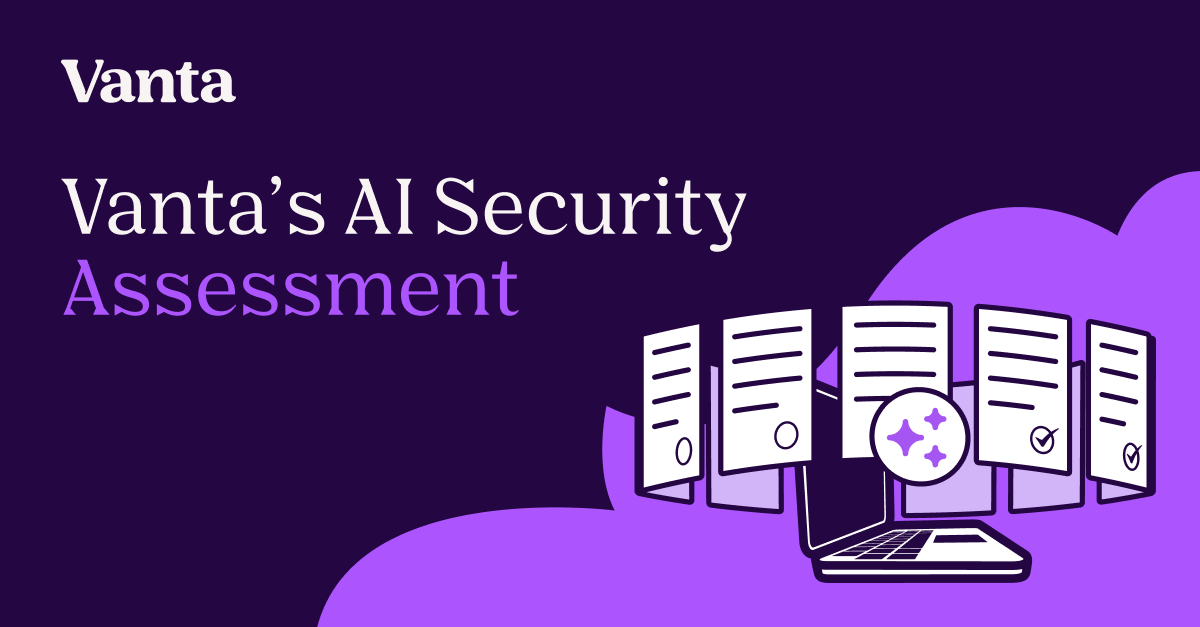
Vanta is a leading trust management platform that helps organizations demonstrate responsible AI practices and strengthen customer trust. We achieve this by providing tailored resources and guidance for robust AI governance, aligned with AI-relevant regulations and frameworks like the EU AI Act and ISO 42001.
Vanta also offers a standardized, expert-vetted AI Security Assessment Template that you can follow to guide your internal and external (vendor) AI security assessments. It covers all key risk areas and is a demonstrable tool for trust management across industries.
Vanta can support other AI security and governance aspects with capabilities like:
Schedule a custom demo to explore how Vanta can support your AI security program.
{{cta_simple34="/cta-blocks"}}

Learn how to scale, manage, and optimize alongside your business goals.
.svg)
.svg)





.png)




.png)
.png)