
Governance, risk, and compliance (GRC) remains critical for maintaining trust and regulatory assurance in any organization. However, traditional GRC approaches are breaking under the weight of today’s complex cloud ecosystems and expectations for continuous oversight.
In response, GRC engineering has appeared as a more scalable solution. It aims to move away from manual processes and legacy artifacts and achieve efficiency by designing systemized controls, workflows, and evidence. This shift isn’t just about tooling, as it transforms the very framework of how GRC tasks get done.
At the core of this new approach are eight GRC engineering values. In this guide, we’ll break down each and explore what they mean in practice, as well as where teams could go wrong.
What are the eight values of GRC engineering?
The eight values of GRC engineering are a set of foundational principles defined in the GRC Engineering Manifesto for how modern GRC programs should be engineered (designed) and run. The goal is to shift from process-driven compliance to an engineering-led approach grounded in systems thinking and outcome-driven design. The values guide organizations as they move from scattered GRC processes and static audit cycles to a system that is structured, repeatable, and easier to scale.
One of the biggest benefits of GRC engineering values is reducing compliance debt.
According to the 2026 State of GRC Report by GRC Engineer, a spreadsheet is still the most widely used GRC tool in 2026—reflecting the fact that most of the work is manual-heavy. Teams chase compliance around workarounds and fragmented evidence, creating fragile processes that increase long-term compliance risk and operational overhead.
Implementing GRC engineering values reduces the inefficiencies that drive compliance debt and helps maintain consistency across expectations like continuous monitoring.
The eight core values of GRC engineering are:
- Automate early and often over relying on manual workflows
- GRC-as-code over tool-specific constructs
- Measurable and meaningful risk outcomes over checkbox compliance outputs
- Evidence, logic, math, and reason over fear, uncertainty, and doubt (FUD)
- Continuous, in-depth assurance over shallow periodic monitoring
- Stakeholder-centric UX over what only works for GRC teams
- Shared fate partnerships over transactional relationships
- Open source practitioner-led solutions over closed vendor systems
1. Automate early and often over relying on manual workflows
Organizations should automate GRC processes in line with their compliance and risk management priorities. This starts with conducting internal assessments to identify high-risk, high-volume, and high-change controls. These should ideally be automated first, while retaining human judgment where it adds value.
“Automation should be guided by a risk-prioritization strategy. It’s not about automating everything, all at once.”

This approach addresses a common problem of legacy GRC: teams invest significant time maintaining elaborate manual processes that impact only a segment of their organization’s overall security environment.
By contrast, GRC automation makes compliance more manageable at scale by reducing human errors and ensuring controls perform consistently. For example, instead of manually pulling logs for review each quarter, automated systems can identify and flag accounts that violate least privilege policies in real time.
The GRC engineering manifesto defines three types of automation:
2. GRC-as-code over tool-specific constructs
GRC-as-code applies software development principles to governance, particularly where tasks and policies are expressed as code. Instead of being tied to specific tools or manual tasks, individual governance policies are translated into configuration files, scripts, or declarative templates, which are then applied directly to the organization’s systems.
Treating GRC as code has several notable advantages:
- Broad applicability and scalability across GRC processes
- Consistent enforcement
- Visible and auditable logic
- Versions can be saved or iterated over time
For example, instead of manually verifying whether databases have backups, a coded policy could automatically scan and flag any discrepancies.
3. Measurable and meaningful risk outcomes over checkbox compliance outputs
GRC engineering values measurable outcomes over static, checklist-based assessments. The focus is on ensuring controls actually work instead of just confirming that they exist.
A notable issue with legacy GRC is a poor signal-to-noise ratio. Organizations have to track all compliance outputs regardless of relevance, which results in teams sifting through large data volumes to identify what really matters.
To improve efficiency, it’s important to distinguish between lagging and leading indicators:
- Lagging indicators: Show what’s already happened, such as the number of incidents last quarter
- Leading indicators: Signal potential risk and guide preventive action
This approach guides you to focus on metrics that drive decisions forward. An effective way to distinguish between the two is to apply the “So what?” test. Ask whether a metric change would affect your current security posture. If not, it’s noise.
In practice, this means that instead of metrics like the number of implemented controls, you would allocate more resources to tracking the specific controls that prevented incidents.
4. Evidence, logic, math, and reason over fear, uncertainty, and doubt
GRC engineering prioritizes decisions grounded in evidence-based understanding of current threats. This is notably different from the legacy approach, where risk management is a checklist-driven practice. Controls are based on potential what-if scenarios and applied too broadly.
The fear, uncertainty, and doubt (FUD) approach guides organizations to replace reactive decision-making with data-driven risk assessment automation, so that controls are proportional to the likelihood and impact of risk. Quantifiable metrics play a key role in this switch, providing a transparent, auditable logic for why controls are applied to relevant systems.
For example, instead of applying daily backups across all systems as a blanket best practice, your organization defines recovery time objectives (RTOs) and recovery point objectives (RPOs) based on business impact, like:
- Hourly backups for mission-critical systems
- Daily backups for low-impact internal tools
- Weekly backups for archived systems
5. Continuous, in-depth assurance over shallow periodic monitoring
Traditional GRC approaches are often audit-calendar driven with quarterly check-ins and annual evidence drives, primarily oriented toward passing audits. GRC engineering changes the operating model entirely as organizations first need to evaluate which of their processes and evidence are high-value candidates for automated assurance. Continuous assurance is control health-driven, with daily and near-real-time signals indicating whether it's working as intended.
“Continuous assurance can be the most intimidating shift to anticipate with GRC engineering because it breaks the audit-season mindset. Instead of proving controls are working well over an ideal timeframe, you’re proving they working day in and day out (hourly in most circumstances—and that level of visibility pushes real operational ownership.”
In contrast, periodic monitoring can leave significant gaps between snapshots, during which controls can decay or become outdated. Continuous assurance makes failures visible earlier, helping organizations move on from retrospective remediation.
For example, collecting screenshots as proof of control effectiveness between audits generates evidence documentation, but it offers little to inform real-time control effectiveness. Continuous assurance provides visibility with live dashboards that enable you to address gaps as they appear.
6. Stakeholder-centric UX over what only works for GRC teams
GRC engineering prioritizes the experience of all relevant stakeholders rather than optimizing only for GRC teams. This contracts GRC solutions that are designed by and for compliance experts, often creating interpretation gaps, information silos, or friction with other departments.
Designing controls and workflows around how teams actually work improves cross-functional collaboration and supports clearer task ownership. As a result, GRC adoption increases, and you minimize the risk of workarounds, reducing wasted time and effort.
For instance, instead of building an access review workflow to support a GRC analyst, you design it around how an IT admin will eventually manage the reviews.
{{cta_withimage25="/cta-blocks"}} | GRC Buyer’s Guide
7. Shared fate partnerships over transactional relationships
One of the central values of GRC engineering is creating a shared-fate partnership, meaning that instead of GRC teams acting solely as supervisors, they build a collaborative relationship with other departments.
In traditional models, the relationship is transactional. GRC teams define changes, engineering implements them, and then validation happens later or during the audit lifecycle.
A shared-fate model integrates GRC earlier in the process, starting from system development. That way, controls are considered during system design, not after implementation, reducing late-stage surprises and rework. You also distribute control ownership between teams on a more logical basis, making it a collective responsibility instead of a handoff.
Also, if you’re working with third-party SaaS vendors for everyday operations, it’s also important to distinguish between compliance ownership and operational risk.
“Compliance responsibility rarely transfers fully to the vendor, but operational risk can be shared. When your audit evidence lives in a contracted SaaS platform with uptime guarantees and defect remediation obligations, you’re not just trusting the tool but relying on enforceable commitments around its integrity and availability.”
In practice, this means:
- Clear accountability if evidence is corrupted or lost due to platform issues
- Defined ownership for remediation if integrations fail
- Support and recovery commitment during critical periods (such as audits)
8. Open source practitioner-led solutions over closed vendor systems
GRC engineering emphasizes that compliance practitioners are in the best position to define solutions, since they regularly engage with the workflows, pain points, and real-world cases that vendor-defined systems may miss or deprioritize.
Relying on open source, practitioner-led solutions allow for a faster feedback loop, letting your teams:
- Design features quickly and more intentionally
- Enhance UI and UX based on operational workflows
- Address issues as they arise
This doesn’t mean you exclude vendor platforms. Quality vendor solutions also support an iterative model by enabling customization, integration, and version control, giving teams a more structured baseline to run GRC workflows. You can work with platforms like Vanta that help implement custom policies, workflows, and templates, as well as support organization-driven standards and integrations.
Common misinterpretations of the GRC engineering values
Although the eight values provide a clear GRC engineering implementation framework, the approach is still evolving and is often misunderstood in practice.
One of the most common mistakes is treating GRC engineering as something that ends with a GRC automation tool. While these tools do help systems become more reliable and scalable, you’d still need to plan for human judgment at crucial stages.
"Automate early and often” is often misinterpreted as “automate everything immediately”—when it should be planned around high-risk, high-volume, or high-impact areas.
Similarly, continuous compliance doesn’t mean that teams will be swimming in alerts and reports, but that automation will surface issues earlier and reduce tedious manual oversight.
A major misconception: many teams assume GRC-as-code means that their compliance teams need software engineering or coding knowledge. In practice, it’s an underlying approach to how procedures and policies are defined, while user-friendly interfaces keep the systems accessible.
Overall, GRC engineering isn’t an overnight rebuild of compliance architecture, but a gradual shift in how controls are designed, automated, and validated over time, with support from the right tools. Top-rated GRC platforms, such as Vanta, support this transition by allowing for user-friendly customization and iterative workflows aligned with these values.
How Vanta helps align with GRC engineering values faster
Vanta is the #1 agentic trust management platform that helps organizations modernize their GRC program through workflow automation, pre-built workflows, agile risk management, and unified visibility through a live dashboard.
As per the 2026 report by GRC Engineer, technical skill gap is one of the biggest issues that prevents GRC practitioners from adopting GRC engineering. That’s why Vanta’s interface is designed to support both technical and non-technical users, enabling faster adoption.
Vanta’s GRC product comes with numerous helpful features, such as:
- Built-in, adaptable support for 35+ leading frameworks and regulations
- Control cross-mapping for reusable evidence
- Workflow automation powered by 400+ integrations
- Customizable, on-demand reports
- Centralized risk visibility and management
- Vulnerability management
Schedule a custom demo today to discuss how Vanta can help you make the shift in your GRC workflows.
{{cta_simple7="/cta-blocks"}} | GRC product page
GRC Engineering
Your guide to the 8 values of GRC engineering
Looking to upgrade to continuous, automated GRC and get visibility across your entire program?
Governance, risk, and compliance (GRC) remains critical for maintaining trust and regulatory assurance in any organization. However, traditional GRC approaches are breaking under the weight of today’s complex cloud ecosystems and expectations for continuous oversight.
In response, GRC engineering has appeared as a more scalable solution. It aims to move away from manual processes and legacy artifacts and achieve efficiency by designing systemized controls, workflows, and evidence. This shift isn’t just about tooling, as it transforms the very framework of how GRC tasks get done.
At the core of this new approach are eight GRC engineering values. In this guide, we’ll break down each and explore what they mean in practice, as well as where teams could go wrong.
What are the eight values of GRC engineering?
The eight values of GRC engineering are a set of foundational principles defined in the GRC Engineering Manifesto for how modern GRC programs should be engineered (designed) and run. The goal is to shift from process-driven compliance to an engineering-led approach grounded in systems thinking and outcome-driven design. The values guide organizations as they move from scattered GRC processes and static audit cycles to a system that is structured, repeatable, and easier to scale.
One of the biggest benefits of GRC engineering values is reducing compliance debt.
According to the 2026 State of GRC Report by GRC Engineer, a spreadsheet is still the most widely used GRC tool in 2026—reflecting the fact that most of the work is manual-heavy. Teams chase compliance around workarounds and fragmented evidence, creating fragile processes that increase long-term compliance risk and operational overhead.
Implementing GRC engineering values reduces the inefficiencies that drive compliance debt and helps maintain consistency across expectations like continuous monitoring.
The eight core values of GRC engineering are:
- Automate early and often over relying on manual workflows
- GRC-as-code over tool-specific constructs
- Measurable and meaningful risk outcomes over checkbox compliance outputs
- Evidence, logic, math, and reason over fear, uncertainty, and doubt (FUD)
- Continuous, in-depth assurance over shallow periodic monitoring
- Stakeholder-centric UX over what only works for GRC teams
- Shared fate partnerships over transactional relationships
- Open source practitioner-led solutions over closed vendor systems
1. Automate early and often over relying on manual workflows
Organizations should automate GRC processes in line with their compliance and risk management priorities. This starts with conducting internal assessments to identify high-risk, high-volume, and high-change controls. These should ideally be automated first, while retaining human judgment where it adds value.
“Automation should be guided by a risk-prioritization strategy. It’s not about automating everything, all at once.”
This approach addresses a common problem of legacy GRC: teams invest significant time maintaining elaborate manual processes that impact only a segment of their organization’s overall security environment.
By contrast, GRC automation makes compliance more manageable at scale by reducing human errors and ensuring controls perform consistently. For example, instead of manually pulling logs for review each quarter, automated systems can identify and flag accounts that violate least privilege policies in real time.
The GRC engineering manifesto defines three types of automation:
2. GRC-as-code over tool-specific constructs
GRC-as-code applies software development principles to governance, particularly where tasks and policies are expressed as code. Instead of being tied to specific tools or manual tasks, individual governance policies are translated into configuration files, scripts, or declarative templates, which are then applied directly to the organization’s systems.
Treating GRC as code has several notable advantages:
- Broad applicability and scalability across GRC processes
- Consistent enforcement
- Visible and auditable logic
- Versions can be saved or iterated over time
For example, instead of manually verifying whether databases have backups, a coded policy could automatically scan and flag any discrepancies.
3. Measurable and meaningful risk outcomes over checkbox compliance outputs
GRC engineering values measurable outcomes over static, checklist-based assessments. The focus is on ensuring controls actually work instead of just confirming that they exist.
A notable issue with legacy GRC is a poor signal-to-noise ratio. Organizations have to track all compliance outputs regardless of relevance, which results in teams sifting through large data volumes to identify what really matters.
To improve efficiency, it’s important to distinguish between lagging and leading indicators:
- Lagging indicators: Show what’s already happened, such as the number of incidents last quarter
- Leading indicators: Signal potential risk and guide preventive action
This approach guides you to focus on metrics that drive decisions forward. An effective way to distinguish between the two is to apply the “So what?” test. Ask whether a metric change would affect your current security posture. If not, it’s noise.
In practice, this means that instead of metrics like the number of implemented controls, you would allocate more resources to tracking the specific controls that prevented incidents.
4. Evidence, logic, math, and reason over fear, uncertainty, and doubt
GRC engineering prioritizes decisions grounded in evidence-based understanding of current threats. This is notably different from the legacy approach, where risk management is a checklist-driven practice. Controls are based on potential what-if scenarios and applied too broadly.
The fear, uncertainty, and doubt (FUD) approach guides organizations to replace reactive decision-making with data-driven risk assessment automation, so that controls are proportional to the likelihood and impact of risk. Quantifiable metrics play a key role in this switch, providing a transparent, auditable logic for why controls are applied to relevant systems.
For example, instead of applying daily backups across all systems as a blanket best practice, your organization defines recovery time objectives (RTOs) and recovery point objectives (RPOs) based on business impact, like:
- Hourly backups for mission-critical systems
- Daily backups for low-impact internal tools
- Weekly backups for archived systems
5. Continuous, in-depth assurance over shallow periodic monitoring
Traditional GRC approaches are often audit-calendar driven with quarterly check-ins and annual evidence drives, primarily oriented toward passing audits. GRC engineering changes the operating model entirely as organizations first need to evaluate which of their processes and evidence are high-value candidates for automated assurance. Continuous assurance is control health-driven, with daily and near-real-time signals indicating whether it's working as intended.
“Continuous assurance can be the most intimidating shift to anticipate with GRC engineering because it breaks the audit-season mindset. Instead of proving controls are working well over an ideal timeframe, you’re proving they working day in and day out (hourly in most circumstances—and that level of visibility pushes real operational ownership.”
In contrast, periodic monitoring can leave significant gaps between snapshots, during which controls can decay or become outdated. Continuous assurance makes failures visible earlier, helping organizations move on from retrospective remediation.
For example, collecting screenshots as proof of control effectiveness between audits generates evidence documentation, but it offers little to inform real-time control effectiveness. Continuous assurance provides visibility with live dashboards that enable you to address gaps as they appear.
6. Stakeholder-centric UX over what only works for GRC teams
GRC engineering prioritizes the experience of all relevant stakeholders rather than optimizing only for GRC teams. This contracts GRC solutions that are designed by and for compliance experts, often creating interpretation gaps, information silos, or friction with other departments.
Designing controls and workflows around how teams actually work improves cross-functional collaboration and supports clearer task ownership. As a result, GRC adoption increases, and you minimize the risk of workarounds, reducing wasted time and effort.
For instance, instead of building an access review workflow to support a GRC analyst, you design it around how an IT admin will eventually manage the reviews.
{{cta_withimage25="/cta-blocks"}} | GRC Buyer’s Guide
7. Shared fate partnerships over transactional relationships
One of the central values of GRC engineering is creating a shared-fate partnership, meaning that instead of GRC teams acting solely as supervisors, they build a collaborative relationship with other departments.
In traditional models, the relationship is transactional. GRC teams define changes, engineering implements them, and then validation happens later or during the audit lifecycle.
A shared-fate model integrates GRC earlier in the process, starting from system development. That way, controls are considered during system design, not after implementation, reducing late-stage surprises and rework. You also distribute control ownership between teams on a more logical basis, making it a collective responsibility instead of a handoff.
Also, if you’re working with third-party SaaS vendors for everyday operations, it’s also important to distinguish between compliance ownership and operational risk.
“Compliance responsibility rarely transfers fully to the vendor, but operational risk can be shared. When your audit evidence lives in a contracted SaaS platform with uptime guarantees and defect remediation obligations, you’re not just trusting the tool but relying on enforceable commitments around its integrity and availability.”
In practice, this means:
- Clear accountability if evidence is corrupted or lost due to platform issues
- Defined ownership for remediation if integrations fail
- Support and recovery commitment during critical periods (such as audits)
8. Open source practitioner-led solutions over closed vendor systems
GRC engineering emphasizes that compliance practitioners are in the best position to define solutions, since they regularly engage with the workflows, pain points, and real-world cases that vendor-defined systems may miss or deprioritize.
Relying on open source, practitioner-led solutions allow for a faster feedback loop, letting your teams:
- Design features quickly and more intentionally
- Enhance UI and UX based on operational workflows
- Address issues as they arise
This doesn’t mean you exclude vendor platforms. Quality vendor solutions also support an iterative model by enabling customization, integration, and version control, giving teams a more structured baseline to run GRC workflows. You can work with platforms like Vanta that help implement custom policies, workflows, and templates, as well as support organization-driven standards and integrations.
Common misinterpretations of the GRC engineering values
Although the eight values provide a clear GRC engineering implementation framework, the approach is still evolving and is often misunderstood in practice.
One of the most common mistakes is treating GRC engineering as something that ends with a GRC automation tool. While these tools do help systems become more reliable and scalable, you’d still need to plan for human judgment at crucial stages.
"Automate early and often” is often misinterpreted as “automate everything immediately”—when it should be planned around high-risk, high-volume, or high-impact areas.
Similarly, continuous compliance doesn’t mean that teams will be swimming in alerts and reports, but that automation will surface issues earlier and reduce tedious manual oversight.
A major misconception: many teams assume GRC-as-code means that their compliance teams need software engineering or coding knowledge. In practice, it’s an underlying approach to how procedures and policies are defined, while user-friendly interfaces keep the systems accessible.
Overall, GRC engineering isn’t an overnight rebuild of compliance architecture, but a gradual shift in how controls are designed, automated, and validated over time, with support from the right tools. Top-rated GRC platforms, such as Vanta, support this transition by allowing for user-friendly customization and iterative workflows aligned with these values.
How Vanta helps align with GRC engineering values faster
Vanta is the #1 agentic trust management platform that helps organizations modernize their GRC program through workflow automation, pre-built workflows, agile risk management, and unified visibility through a live dashboard.
As per the 2026 report by GRC Engineer, technical skill gap is one of the biggest issues that prevents GRC practitioners from adopting GRC engineering. That’s why Vanta’s interface is designed to support both technical and non-technical users, enabling faster adoption.
Vanta’s GRC product comes with numerous helpful features, such as:
- Built-in, adaptable support for 35+ leading frameworks and regulations
- Control cross-mapping for reusable evidence
- Workflow automation powered by 400+ integrations
- Customizable, on-demand reports
- Centralized risk visibility and management
- Vulnerability management
Schedule a custom demo today to discuss how Vanta can help you make the shift in your GRC workflows.
{{cta_simple7="/cta-blocks"}} | GRC product page
| Role: | GRC responsibilities: |
|---|---|
| Board of directors | Central to the overarching GRC strategy, this group sets the direction for the compliance strategy. They determine which standards and regulations are necessary for compliance and align the GRC strategy with business objectives. |
| Chief financial officer | Primary responsibility for the success of the GRC program and for reporting results to the board. |
| Operations managers from relevant departments | This group owns processes. They are responsible for the success and direction of risk management and compliance within their departments. |
| Representatives from relevant departments | These are the activity owners. These team members are responsible for carrying out specific compliance and risk management tasks within their departments and for integrating these tasks into their workflows. |
| Contract managers from relevant department | These team members are responsible for managing interactions with vendors and other third parties in their department to ensure all risk management and compliance measures are being taken. |
| Chief information security officer (CISO) | Defines the organization’s information security policy, designs risk and vulnerability assessments, and develops information security policies. |
| Data protection officer (DPO) or legal counsel | Develops goals for data privacy based on legal regulations and other compliance needs, designs and implements privacy policies and practices, and assesses these practices for effectiveness. |
| GRC lead | Responsible for overseeing the execution of the GRC program in collaboration with the executive team as well as maintaining the organization’s library of security controls. |
| Cybersecurity analyst(s) | Implements and monitors cybersecurity measures that are in line with the GRC program and business objectives. |
| Compliance analyst(s) | Monitors the organization’s compliance with all regulations and standards necessary, identifies any compliance gaps, and works to mitigate them. |
| Risk analyst(s) | Carries out the risk management program for the organization and serves as a resource for risk management across various departments, including identifying, mitigating, and monitoring risks. |
| IT security specialist(s) | Implements security controls within the IT system in coordination with the cybersecurity analyst(s). |
Explore more GRC articles
Introduction to GRC
Implementing a GRC program
Optimizing a GRC program
Governance
Risk
Compliance
Continuous control monitoring
Get started with GRC
Start your GRC journey with these related resources.
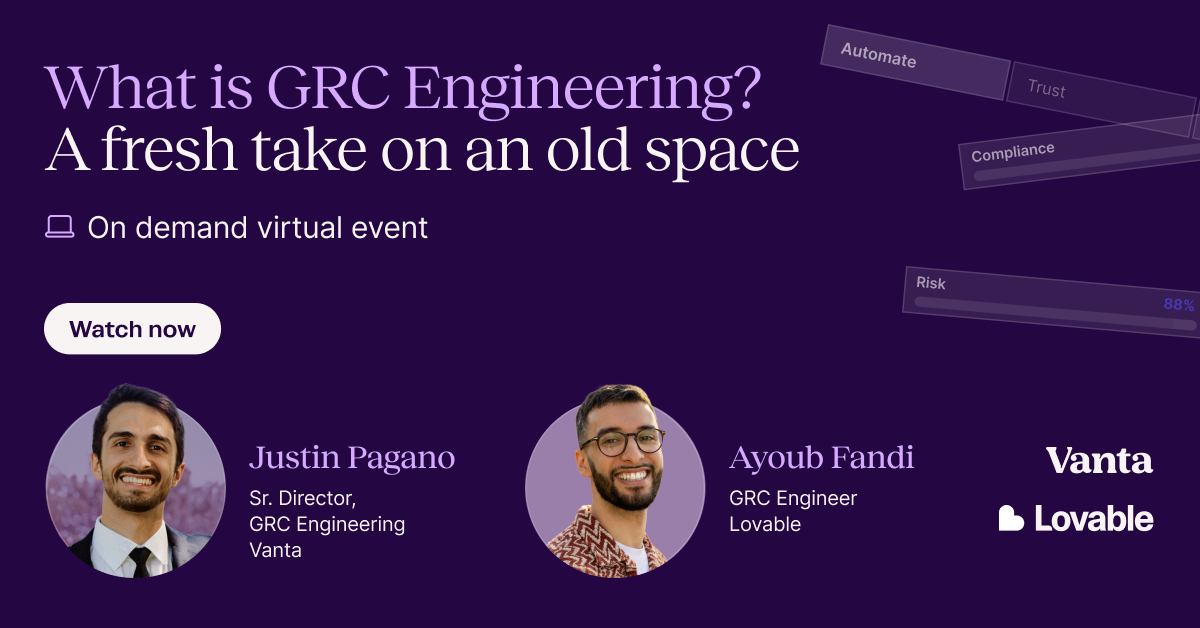
What is GRC Engineering? A fresh take on an old space
Watch on-demand to hear from Lovable and Vanta and learn what modern GRC actually looks like when it is done right.
%20.png)
How to build an enduring security program as your company grows
Join Vanta's CISO, Jadee Hanson, and seasoned security leaders at company's big and small to discuss building and maintaining an efficient and high performing security program.

Growing pains: How to evolve and scale inherited security processes
Manual processes and siloed tools can slow you down. Get our tactical guide to building a scalable, resilient security program.