
Most modern organizations are cloud-reliant and software-driven. They work in interconnected systems where frequent deployments and evolving infrastructure have quietly redefined the assurance expectations placed on GRC teams, who now have to:
- Keep pace with rapid product releases
- Maintain continuous risk visibility
- Meet multiple, often overlapping regulatory requirements
This is where traditional GRC breaks, as teams are now handling more tasks without a proportional increase in headcount, time, or, often, tooling maturity.
This growing gap is addressed by GRC engineering. Instead of treating GRC like a dry list of operational tasks and scheduled reviews, this approach treats GRC like a living system embedded in technical, automation-first workflows that can scale faster.
In this guide, we’ll contrast GRC engineering vs traditional GRC, exploring:
- Areas where traditional GRC fails in modern environments
- Ways GRC engineering addresses those limitations
What is traditional GRC and why it no longer works
Traditional GRC programs are structured around control frameworks, documented evidence, and periodic audits—aimed at helping organizations manage accountability, trackability, and regulatory assurance. The programs typically work great in stable environments where controls can be defined and validated in a linear flow.
Despite being well-intentioned, the biggest issue with traditional GRC is that assurance is delivered as a snapshot. It’s built around manual processes, such as evidence requests and static, point-in-time reviews, which are ineffective in dynamic environments.
The same applies to risk management and control alignment. By the time risks are identified and addressed with appropriate controls, the underlying considerations may already have changed.
The limitations of traditional GRC programs surface across four recurring patterns:
- Audit-season pressure
- Siloed ownership
- Spreadsheet-based processes
- Checkbox compliance over effectiveness
1. Audit-season pressure
Traditional GRC operates on a quarterly or annual audit cycle. Teams prioritize evidence collection as deadlines approach, which can disrupt regular operations. This stresses out team capacity as everyone rushes to compile screenshots, logs, email threads, and spreadsheets as evidence.
According to the 2026 State of GRC report, more than half of GRC teams operate with four people or fewer, which makes the audit-season pressure difficult to sustain. The last-minute hustle also increases the risk of omissions, ad hoc stopgaps, and incomplete remediation workflows.
2. Siloed ownership
Compliance is generally owned by GRC and security teams, which operate separately from product development, engineering, and operations.
GRC and security are typically treated as downstream stakeholders instead of embedded partners in system design and delivery. Interactions between departments come down to sending questionnaires and evidence requests, reinforcing the perception of compliance as an external burden.
Engineering doesn’t know why specific controls are necessary, while security may not fully grasp the technical constraints, resulting in a disconnect between departments.
3. Spreadsheet-based processes
Even in 2026, when automation technologies are more accessible, core GRC processes like evidence collection, risk tracking, and management are often constrained to spreadsheets, email chains, and shared drives.
While functional, this outdated approach increases operational friction at scale. For instance:
- Multiple, often conflicting versions of the same data exist
- Limited auditability after manual updates
- No clear ownership of versions
Without a single source of truth, even basic control validation requires reconciling with scattered resources or stakeholders.
4. Checkbox compliance over effectiveness
Traditional GRC prioritizes demonstrating that a control exists rather than how impactful it is. Control implementation is often optimized to satisfy audit criteria rather than to meet the original risk intent. Evidence also comes in the form of activity metrics, such as:
- The number of implemented controls
- Percentage of approved policies
- Training completion percentages
- Evidence collection completion rate
- Framework coverage metrics
These metrics are easier to capture and prove to auditors, but they don’t actually demonstrate control effectiveness. Most existing GRC programs fail to capture outcome metrics covering higher-priority information like threat exposure reduction, risk level changes, security incidents prevented, and the time needed to detect and resolve incidents.
The lack of outcome-focused metrics creates false confidence. While teams get assurance that suggests the existence of controls, there's no visibility into actual risk.
How GRC engineering fills the gaps in traditional GRC
GRC engineering moves away from the traditional model by embedding GRC activities into daily workflows instead of treating them like separate, periodic exercises. This approach applies engineering principles—such as automation, infrastructure-as-code, and software-driven controls—to enable a GRC-aware system design, integrated ownership, and continuous risk management and assurance.
Controls are designed to be machine-enforceable, easily trackable, and testable. The risk-based logic is defined upfront and embedded into systems, so compliance becomes a byproduct of how systems operate rather than a separate review activity.
GRC engineering is defined by core features that address the limitations of traditional GRC:
- Continuous monitoring instead of periodic audits
- Shared ownership and integrated workflows
- Automated evidence collection and validation
- Real-time risk visibility and effectiveness tracking
1. Continuous monitoring instead of periodic audits
GRC engineering emphasizes a continuous monitoring and improvement cycle in which controls are automatically tested with the help of automation and integrations instead of manual reviews in the period leading up to an audit. This diffuses audit-season pressure, replacing last-minute efforts and point-in-time snapshots with a system-driven, ongoing process.
Continuous monitoring also helps organizations shift from reactive to proactive problem-solving. Teams can address issues immediately as they surface, supporting better audit readiness. With this model, compliance is no longer an additional burden but a natural outcome of effective risk management and system design.
{{cta_withimage25="/cta-blocks"}} | GRC Buyer’s Guide
2. Shared ownership and integrated workflows
GRC engineering emphasizes a shared-fate approach to ownership. Rather than being siloed within GRC, accountability is spread across engineering, operations, and development.
In software-first environments, GRC engineering supports the Shift Left approach, where compliance and risk management practices are integrated into development pipelines, and automated alerts or tickets are configured to appear in communication tools like Slack.
As a result, teams can own the controls relevant to their systems and have a better understanding of how and why they work. This reduces friction between teams and shifts compliance from being an other-department obligation to something developers see as core to building secure systems.
3. Automated evidence collection and validation
GRC engineering requires automated evidence collection through API integrations, replacing reliance on data exports and screenshots. Instead of depending on teams to pull and compile evidence, systems automatically capture access records, activity logs, configuration states, and other artifacts with time stamps and a clear custody chain.
The resulting evidence is stored in immutable, version-controlled audit trails, which serve as a single source of truth, replacing scattered spreadsheets and shared drives that plague legacy GRC. Under this model, auditors should be able to access evidence and artifacts directly from a centralized repository.
“Traditional GRC requires teams to validate controls and assemble evidence periodically, while GRC engineering focuses on real-time monitoring that generates evidence continuously through system activity. For teams, making the switch is a significant change that requires support from senior leadership for tools and resources, but the payoff is moving from reactive to proactive risk management.”

4. Real-time risk visibility and effectiveness tracking
GRC engineering heavily emphasizes outcome metrics over activity metrics, focusing on whether controls are actually working rather than whether they exist. A centralized dashboard enables tracking real-time control status and risk indicators, giving teams a live view of their compliance health and security posture.
The better visibility also changes how teams evaluate controls. Instead of relying on static evidence, teams can now track control effectiveness over time and respond to drifts earlier. This supports data-driven decisions on remediation prioritization based on real-time risk rather than just standardized audit requirements.
Key differences between GRC engineering and traditional GRC
Having looked at both GRC engineering and traditional GRC in detail, here’s how they compare across several important dimensions:
Let’s consider a sample scenario to understand how the two approaches differ in practice:
- Traditional GRC: Security controls are reviewed quarterly or annually against a framework-driven control checklist. This means that misconfigurations are discovered after deployment, long after the risk window has passed, making remediation reactive and potentially disruptive.
- GRC engineering: Control baselines are defined as code and continuously monitored. Drifting from approved states triggers alerts in real time, enabling faster response and a reduced risk of gaps being exploited.
What is GRC-as-code?
GRC as code is an approach where GRC policies are defined and managed as code instead of documents and manual processes. This means that governance policies are translated into configuration files, scripts, and declarative templates that can be automatically executed.
The approach offers several key benefits:
- Standardization and reuse: Codified policies can be used consistently across systems and projects
- Versioning and change control: Policies can be updated, expanded, or rolled back with clear traceability
- Clear inputs and outputs: The conditions that trigger policies and resulting actions are more predictable
- Consistent enforcement: Controls are applied the same way every time, eliminating the variability of manual processes
- Scalability: Policies can scale with system complexity without a proportional increase in manual effort
Legacy GRC to GRC engineering: Transition mistakes to avoid
Here are the mistakes you should look out for when planning the switch to GRC engineering:
- Assuming GRC-as-code requires a software team: Organizations often assume GRC engineering requires deep coding expertise. In practice, it’s about adopting automation and system-level thinking—there are tools like Vanta to help you rebuild your program from scratch.
- Treating tooling as the final step: Tooling is just an enabler in GRC engineering. It works best when you’re clear about ownership assignment, process flow, and risk management strategy.
- Approaching continuous monitoring as constant busywork: A common concern is that continuous monitoring will drown compliance teams in noise. Under the GRC engineering model, ongoing oversight will only help filter out alerts and let your stakeholders focus on more impactful signals.
- Thinking GRC engineering eliminates GRC professionals: Organizations often assume that GRC engineering tools eliminate the need for GRC professionals. You’ll still need teams in the loop to design controls, manage exceptions, and interpret outcomes, but with less time spent on manual coordination and more capacity for higher-impact risk management.
You can make the transition easier with top GRC software on the market offering built-in automation and workflows—Vanta is one of the best options that support GRC engineering adoption at any scale.
Upgrade and systemize your GRC program with Vanta
Vanta is a leading agentic trust management platform that helps organizations modernize their GRC program efficiently. Vanta’s agentic workflow automation, centralized dashboard visibility, risk management resources, and reporting functions help you align with GRC engineering practices faster.
Our integrated GRC product focuses on ongoing risk management and actionable coordination, which also translates to audit readiness. You’ll get:
- Built-in support for 35+ frameworks and regulations
- Control cross-mapping across overlapping requirements
- Customizable, on-demand reporting
- Continuous control monitoring through a unified dashboard
- Automated evidence collection powered by 400+ integrations
These features are particularly valuable for lean teams that need to scale faster without increasing headcount. Schedule a custom demo for a walkthrough aligned with your goals.
{{cta_simple7="/cta-blocks"}} | GRC product page
GRC Engineering
GRC engineering vs traditional GRC: What's the difference?
Looking to upgrade to continuous, automated GRC and get visibility across your entire program?
Most modern organizations are cloud-reliant and software-driven. They work in interconnected systems where frequent deployments and evolving infrastructure have quietly redefined the assurance expectations placed on GRC teams, who now have to:
- Keep pace with rapid product releases
- Maintain continuous risk visibility
- Meet multiple, often overlapping regulatory requirements
This is where traditional GRC breaks, as teams are now handling more tasks without a proportional increase in headcount, time, or, often, tooling maturity.
This growing gap is addressed by GRC engineering. Instead of treating GRC like a dry list of operational tasks and scheduled reviews, this approach treats GRC like a living system embedded in technical, automation-first workflows that can scale faster.
In this guide, we’ll contrast GRC engineering vs traditional GRC, exploring:
- Areas where traditional GRC fails in modern environments
- Ways GRC engineering addresses those limitations
What is traditional GRC and why it no longer works
Traditional GRC programs are structured around control frameworks, documented evidence, and periodic audits—aimed at helping organizations manage accountability, trackability, and regulatory assurance. The programs typically work great in stable environments where controls can be defined and validated in a linear flow.
Despite being well-intentioned, the biggest issue with traditional GRC is that assurance is delivered as a snapshot. It’s built around manual processes, such as evidence requests and static, point-in-time reviews, which are ineffective in dynamic environments.
The same applies to risk management and control alignment. By the time risks are identified and addressed with appropriate controls, the underlying considerations may already have changed.
The limitations of traditional GRC programs surface across four recurring patterns:
- Audit-season pressure
- Siloed ownership
- Spreadsheet-based processes
- Checkbox compliance over effectiveness
1. Audit-season pressure
Traditional GRC operates on a quarterly or annual audit cycle. Teams prioritize evidence collection as deadlines approach, which can disrupt regular operations. This stresses out team capacity as everyone rushes to compile screenshots, logs, email threads, and spreadsheets as evidence.
According to the 2026 State of GRC report, more than half of GRC teams operate with four people or fewer, which makes the audit-season pressure difficult to sustain. The last-minute hustle also increases the risk of omissions, ad hoc stopgaps, and incomplete remediation workflows.
2. Siloed ownership
Compliance is generally owned by GRC and security teams, which operate separately from product development, engineering, and operations.
GRC and security are typically treated as downstream stakeholders instead of embedded partners in system design and delivery. Interactions between departments come down to sending questionnaires and evidence requests, reinforcing the perception of compliance as an external burden.
Engineering doesn’t know why specific controls are necessary, while security may not fully grasp the technical constraints, resulting in a disconnect between departments.
3. Spreadsheet-based processes
Even in 2026, when automation technologies are more accessible, core GRC processes like evidence collection, risk tracking, and management are often constrained to spreadsheets, email chains, and shared drives.
While functional, this outdated approach increases operational friction at scale. For instance:
- Multiple, often conflicting versions of the same data exist
- Limited auditability after manual updates
- No clear ownership of versions
Without a single source of truth, even basic control validation requires reconciling with scattered resources or stakeholders.
4. Checkbox compliance over effectiveness
Traditional GRC prioritizes demonstrating that a control exists rather than how impactful it is. Control implementation is often optimized to satisfy audit criteria rather than to meet the original risk intent. Evidence also comes in the form of activity metrics, such as:
- The number of implemented controls
- Percentage of approved policies
- Training completion percentages
- Evidence collection completion rate
- Framework coverage metrics
These metrics are easier to capture and prove to auditors, but they don’t actually demonstrate control effectiveness. Most existing GRC programs fail to capture outcome metrics covering higher-priority information like threat exposure reduction, risk level changes, security incidents prevented, and the time needed to detect and resolve incidents.
The lack of outcome-focused metrics creates false confidence. While teams get assurance that suggests the existence of controls, there's no visibility into actual risk.
How GRC engineering fills the gaps in traditional GRC
GRC engineering moves away from the traditional model by embedding GRC activities into daily workflows instead of treating them like separate, periodic exercises. This approach applies engineering principles—such as automation, infrastructure-as-code, and software-driven controls—to enable a GRC-aware system design, integrated ownership, and continuous risk management and assurance.
Controls are designed to be machine-enforceable, easily trackable, and testable. The risk-based logic is defined upfront and embedded into systems, so compliance becomes a byproduct of how systems operate rather than a separate review activity.
GRC engineering is defined by core features that address the limitations of traditional GRC:
- Continuous monitoring instead of periodic audits
- Shared ownership and integrated workflows
- Automated evidence collection and validation
- Real-time risk visibility and effectiveness tracking
1. Continuous monitoring instead of periodic audits
GRC engineering emphasizes a continuous monitoring and improvement cycle in which controls are automatically tested with the help of automation and integrations instead of manual reviews in the period leading up to an audit. This diffuses audit-season pressure, replacing last-minute efforts and point-in-time snapshots with a system-driven, ongoing process.
Continuous monitoring also helps organizations shift from reactive to proactive problem-solving. Teams can address issues immediately as they surface, supporting better audit readiness. With this model, compliance is no longer an additional burden but a natural outcome of effective risk management and system design.
{{cta_withimage25="/cta-blocks"}} | GRC Buyer’s Guide
2. Shared ownership and integrated workflows
GRC engineering emphasizes a shared-fate approach to ownership. Rather than being siloed within GRC, accountability is spread across engineering, operations, and development.
In software-first environments, GRC engineering supports the Shift Left approach, where compliance and risk management practices are integrated into development pipelines, and automated alerts or tickets are configured to appear in communication tools like Slack.
As a result, teams can own the controls relevant to their systems and have a better understanding of how and why they work. This reduces friction between teams and shifts compliance from being an other-department obligation to something developers see as core to building secure systems.
3. Automated evidence collection and validation
GRC engineering requires automated evidence collection through API integrations, replacing reliance on data exports and screenshots. Instead of depending on teams to pull and compile evidence, systems automatically capture access records, activity logs, configuration states, and other artifacts with time stamps and a clear custody chain.
The resulting evidence is stored in immutable, version-controlled audit trails, which serve as a single source of truth, replacing scattered spreadsheets and shared drives that plague legacy GRC. Under this model, auditors should be able to access evidence and artifacts directly from a centralized repository.
“Traditional GRC requires teams to validate controls and assemble evidence periodically, while GRC engineering focuses on real-time monitoring that generates evidence continuously through system activity. For teams, making the switch is a significant change that requires support from senior leadership for tools and resources, but the payoff is moving from reactive to proactive risk management.”
4. Real-time risk visibility and effectiveness tracking
GRC engineering heavily emphasizes outcome metrics over activity metrics, focusing on whether controls are actually working rather than whether they exist. A centralized dashboard enables tracking real-time control status and risk indicators, giving teams a live view of their compliance health and security posture.
The better visibility also changes how teams evaluate controls. Instead of relying on static evidence, teams can now track control effectiveness over time and respond to drifts earlier. This supports data-driven decisions on remediation prioritization based on real-time risk rather than just standardized audit requirements.
Key differences between GRC engineering and traditional GRC
Having looked at both GRC engineering and traditional GRC in detail, here’s how they compare across several important dimensions:
Let’s consider a sample scenario to understand how the two approaches differ in practice:
- Traditional GRC: Security controls are reviewed quarterly or annually against a framework-driven control checklist. This means that misconfigurations are discovered after deployment, long after the risk window has passed, making remediation reactive and potentially disruptive.
- GRC engineering: Control baselines are defined as code and continuously monitored. Drifting from approved states triggers alerts in real time, enabling faster response and a reduced risk of gaps being exploited.
What is GRC-as-code?
GRC as code is an approach where GRC policies are defined and managed as code instead of documents and manual processes. This means that governance policies are translated into configuration files, scripts, and declarative templates that can be automatically executed.
The approach offers several key benefits:
- Standardization and reuse: Codified policies can be used consistently across systems and projects
- Versioning and change control: Policies can be updated, expanded, or rolled back with clear traceability
- Clear inputs and outputs: The conditions that trigger policies and resulting actions are more predictable
- Consistent enforcement: Controls are applied the same way every time, eliminating the variability of manual processes
- Scalability: Policies can scale with system complexity without a proportional increase in manual effort
Legacy GRC to GRC engineering: Transition mistakes to avoid
Here are the mistakes you should look out for when planning the switch to GRC engineering:
- Assuming GRC-as-code requires a software team: Organizations often assume GRC engineering requires deep coding expertise. In practice, it’s about adopting automation and system-level thinking—there are tools like Vanta to help you rebuild your program from scratch.
- Treating tooling as the final step: Tooling is just an enabler in GRC engineering. It works best when you’re clear about ownership assignment, process flow, and risk management strategy.
- Approaching continuous monitoring as constant busywork: A common concern is that continuous monitoring will drown compliance teams in noise. Under the GRC engineering model, ongoing oversight will only help filter out alerts and let your stakeholders focus on more impactful signals.
- Thinking GRC engineering eliminates GRC professionals: Organizations often assume that GRC engineering tools eliminate the need for GRC professionals. You’ll still need teams in the loop to design controls, manage exceptions, and interpret outcomes, but with less time spent on manual coordination and more capacity for higher-impact risk management.
You can make the transition easier with top GRC software on the market offering built-in automation and workflows—Vanta is one of the best options that support GRC engineering adoption at any scale.
Upgrade and systemize your GRC program with Vanta
Vanta is a leading agentic trust management platform that helps organizations modernize their GRC program efficiently. Vanta’s agentic workflow automation, centralized dashboard visibility, risk management resources, and reporting functions help you align with GRC engineering practices faster.
Our integrated GRC product focuses on ongoing risk management and actionable coordination, which also translates to audit readiness. You’ll get:
- Built-in support for 35+ frameworks and regulations
- Control cross-mapping across overlapping requirements
- Customizable, on-demand reporting
- Continuous control monitoring through a unified dashboard
- Automated evidence collection powered by 400+ integrations
These features are particularly valuable for lean teams that need to scale faster without increasing headcount. Schedule a custom demo for a walkthrough aligned with your goals.
{{cta_simple7="/cta-blocks"}} | GRC product page
| Role: | GRC responsibilities: |
|---|---|
| Board of directors | Central to the overarching GRC strategy, this group sets the direction for the compliance strategy. They determine which standards and regulations are necessary for compliance and align the GRC strategy with business objectives. |
| Chief financial officer | Primary responsibility for the success of the GRC program and for reporting results to the board. |
| Operations managers from relevant departments | This group owns processes. They are responsible for the success and direction of risk management and compliance within their departments. |
| Representatives from relevant departments | These are the activity owners. These team members are responsible for carrying out specific compliance and risk management tasks within their departments and for integrating these tasks into their workflows. |
| Contract managers from relevant department | These team members are responsible for managing interactions with vendors and other third parties in their department to ensure all risk management and compliance measures are being taken. |
| Chief information security officer (CISO) | Defines the organization’s information security policy, designs risk and vulnerability assessments, and develops information security policies. |
| Data protection officer (DPO) or legal counsel | Develops goals for data privacy based on legal regulations and other compliance needs, designs and implements privacy policies and practices, and assesses these practices for effectiveness. |
| GRC lead | Responsible for overseeing the execution of the GRC program in collaboration with the executive team as well as maintaining the organization’s library of security controls. |
| Cybersecurity analyst(s) | Implements and monitors cybersecurity measures that are in line with the GRC program and business objectives. |
| Compliance analyst(s) | Monitors the organization’s compliance with all regulations and standards necessary, identifies any compliance gaps, and works to mitigate them. |
| Risk analyst(s) | Carries out the risk management program for the organization and serves as a resource for risk management across various departments, including identifying, mitigating, and monitoring risks. |
| IT security specialist(s) | Implements security controls within the IT system in coordination with the cybersecurity analyst(s). |
Explore more GRC articles
Introduction to GRC
Implementing a GRC program
Optimizing a GRC program
Governance
Risk
Compliance
Continuous control monitoring
Get started with GRC
Start your GRC journey with these related resources.
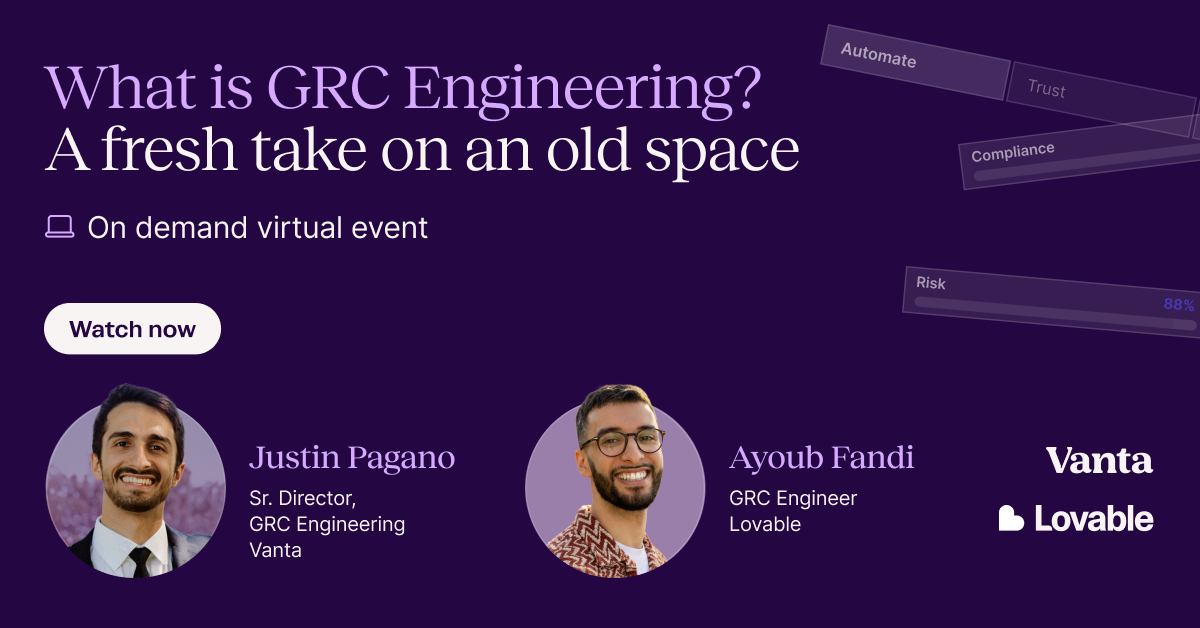
What is GRC Engineering? A fresh take on an old space
Watch on-demand to hear from Lovable and Vanta and learn what modern GRC actually looks like when it is done right.
%20.png)
How to build an enduring security program as your company grows
Join Vanta's CISO, Jadee Hanson, and seasoned security leaders at company's big and small to discuss building and maintaining an efficient and high performing security program.

Growing pains: How to evolve and scale inherited security processes
Manual processes and siloed tools can slow you down. Get our tactical guide to building a scalable, resilient security program.