Additional resources
GovRAMP vs. FedRAMP: What are the similarities and differences?

Additional resources
Looking to streamline the work for FedRAMP compliance?
Cloud Service Providers (CSPs) working with government agencies must meet rigorous safety criteria to prove they can safeguard sensitive data. Historically, scattered security expectations across federal and state agencies have led to fragmented compliance efforts, slowing down adoption and driving up costs.
Both the Federal Risk and Authorization Management Program (FedRAMP) and GovRAMP (formally known as StateRAMP as of February 2025) are standardized authorization frameworks required by federal and state agencies, respectively. If you intend to pursue public sector contracts, understanding their similarities and differences is an essential first step.
In this guide, we’ll compare the two frameworks and discuss their similarities and differences.
What is FedRAMP?
The FedRAMP is a US federal security program aimed at CSPs working with government agencies. It standardizes the security baselines that contracting organizations and underlying cloud services must meet.
These baselines are built on the FIPS 199 impact levels—Low, Moderate, and High—which categorize systems based on the potential impact a breach of data confidentiality, integrity, or availability would have on an agency. To reflect this, progressing baselines include an increasing number of mandatory controls aligned with NIST SP 800-53 (Rev. 5).
To be considered FedRAMP authorized, an organization must obtain an Authority to Operate (ATO) from a sponsoring agency after undergoing 3PAO assessments. Authorized services get listed on the FedRAMP marketplace for other agencies to review and adopt.
The idea behind FedRAMP is to reuse approved Cloud Service Offerings (CSOs) across multiple federal contracts, speeding up procurement cycles and streamlining scattered assessment logistics for different agencies.
{{cta_withimage44="/cta-blocks"}} | FedRAMP checklist
What is GovRAMP (fka StateRAMP)?
The GovRAMP cybersecurity framework provides standardized security baselines to CSPs working with state and local governments, tribal governments, and educational institutions. It was formerly known as StateRAMP, but rebranded to GovRAMP in February 2025 to emphasize the program’s true scope and mission to support broader public sector cybersecurity—not just state governments.
GovRAMP also uses FIPS 199 impact tiers to classify systems alongside a maturity model aligned with NIST SP 800-53. Compliance with the program is currently voluntary, but in practice, many state and local agencies and public sector organizations expect vendors to demonstrate compliance during procurement cycles.
Some of the state governments currently participating in GovRAMP include:
- Michigan
- Minnesota
- Missouri
- Nebraska—Judicial Branch
- Nevada
- New Hampshire
- New York
- North Carolina
- North Dakota
- Ohio
- Oklahoma
- Oregon
- Texas
- Utah
- Vermont
- West Virginia
“
FedRAMP has historically required cloud service providers to obtain authorization through a sponsoring federal agency, a model that is beginning to evolve under the ongoing FedRAMP 20x pilot. GovRAMP offers a more flexible path to demonstrate compliance with NIST 800-53-aligned controls. This makes GovRAMP ideal for cloud providers looking to build a government-aligned security posture while actively pursuing FedRAMP sponsorship.”

How similar are GovRAMP and FedRAMP?
GovRAMP largely mirrors the FedRAMP framework, aligning closely with its controls, assessment logistics, and overall compliance structure.
FedRAMP and GovRAMP share several important similarities:
- Both require controls heavily derived from NIST 800-53 (Rev. 5)
- Both frameworks emphasize continuous monitoring after authorization
- Both use tiered authorization levels based on FIPS 199
- Both have a similar lifecycle—documentation, assessment, authorization, and continuous monitoring
- Both allow for control inheritance
In practice, if you’ve already achieved or are pursuing one of the frameworks, you’ll likely have a head start with the other—but there are still critical differences to keep in mind.
Key differences between GovRAMP and FedRAMP
The four most notable FedRAMP and GovRAMP differences are:
- Coverage and oversight
- Governance structure
- Time and resource investment
- Ready status duration
1. Coverage and oversight
The biggest difference between FedRAMP and GovRAMP is the scope of their application, as well as their governance. FedRAMP applies to US federal agencies and is enforced through a centralized model, with oversight handled by the General Services Administration (GSA) and Office of Management and Budget (OMB). Authorization decisions are ultimately made by individual federal agencies, which issue Authorities to Operate (ATOs) based on risk determinations.
GovRAMP is built on the same NIST 800-53 foundation as FedRAMP, but applies those standards to state, local, tribal, and educational entities through a more decentralized approach. Instead of a single federal authority mandating authorization, adoption is driven by individual jurisdictions and agencies based on their procurement needs and risk tolerance.
This also means that GovRAMP covers a wider range of sensitive non-federal information, including individual health records and student data.
2. Governance structure
FedRAMP operates under a complex federal structure with several bodies being in charge of different elements of program enforcement and maintenance:
- FedRAMP Board: Provides the strategic direction and oversees the FedRAMP program
- FedRAMP Program Management Office (PMO) within the GSA: Manages day-to-day program operations, publishes guidance and templates, maintains the FedRAMP Marketplace, and supports agencies and CSPs throughout the authorization lifecycle.
- Federal agencies: Act as the primary enforcement mechanism by sponsoring cloud services, reviewing authorization packages, and issuing Authorities to Operate (ATOs), based on risk determinations.
- OMB: Defines the program scope, establishes usage rules for federal agencies, and ensures consistency in the assessment, authorization, and governance
The GovRAMP enforcement model is shared between two primary enforcement bodies:
- GovRAMP PMO: Oversees the GovRAMP program, standardizes its security requirements, and manages the authorization process for CSPs
- Participating state, local, tribal, or education (SLTT/E) entities: Determine how GovRAMP authorization is applied within their jurisdiction, review assessment results, accept or issue authorization decisions, and maintain ongoing oversight based on local procurement and regulatory requirements.
3. Time and resource investment
Due to FedRAMP’s comprehensive and rigorous setup, compliance requires significant time and costs. While the specifics still depend on your organization's impact level, sponsoring agency, system complexity, and security maturity, the typical timelines look like:
The FedRAMP PMO has acknowledged the strain this can put on CSPs. As a way to streamline assessments in some cases, FedRAMP offers:
- Low Impact SaaS (LI–SaaS): A variation of FedRAMP Low designed for CSPs offering low-risk systems. Under LI-SaaS, the 3PAO tests a smaller subset of controls, while the remaining are satisfied by CSP attestation.
- FedRAMP 20x (limited scale): Currently in pilot mode, this initiative aims to accelerate FedRAMP authorizations by emphasizing a cloud-native, automated approach to compliance. The core documentation package is submitted and reviewed in a machine-readable format, which makes assessments faster.
GovRAMP is designed for state and local organizations with constrained resources and shorter procurement cycles. Compared to FedRAMP, GovRAMP authorizations typically go through fewer mandatory review layers, allowing for more flexibility in sequencing assessments. This also means shorter timelines and lower resource demands in many cases.
The costs of pursuing GovRAMP also includes annual membership fee starting at $1,500 and can go over $10,000 for the Champion tier. Full authorization still requires a 3PAO assessment, typically starting at $70,000, but the GovRAMP Core path enables direct PMO evaluation against a limited control set, reducing assessment scope and cost.
4. Ready status duration
After completing a 3PAO readiness assessment and achieving FedRAMP Ready status, a cloud service offering is listed in the FedRAMP Marketplace as Ready for a limited period. If the designation expires before the provider progresses toward full authorization, the assessment must be repeated to regain the Ready status.
Keep in mind that the FedRAMP Ready is not the same as FedRAMP Authorized. Ready indicates that the system is prepared to go through a formal 3PAO assessment for the Authorized status. Once the service is authorized, its designation doesn’t lapse after one year but is maintained through demonstrable continuous monitoring (ConMon) and monthly reporting.
By comparison, once you achieve a Ready status with GovRAMP, your designation is valid for as long as you maintain a membership. While the Ready status here also does not constitute authorization, providers are still expected to continuously monitor and audit their systems to demonstrate continued alignment with GovRAMP requirements.
{{cta_withimage44="/cta-blocks"}} | FedRAMP checklist
FedRAMP vs. GovRAMP: Which one should you pursue?
The choice between FedRAMP and GovRAMP primarily depends on your organizational goals, target agencies, and available resources.
If you want to work with federal agencies, you must pursue FedRAMP and be prepared for the multi-step preparation and assessment cycles, as well as the inherent costs. If the scope of your cloud system is more oriented toward state, local, tribal, and educational (SLTT) bodies, GovRAMP would make more sense.
For most CSPs, though, meeting FedRAMP requirements is the strategic priority, since it’s considered the gold standard for federal security and establishes a core security foundation accepted across agencies and use cases
“
In practice, GovRAMP serves as the strategic entry point for CSPs. It allows you to prove your commitment to government security standards, gain traction with SLTT customers, and build essential references.
These customer successes can surely strengthen your case for future FedRAMP authorization. Ultimately, GovRAMP is a crucial move for companies aiming to capture the full public-sector market, extending credibility beyond the federal space.”
Because GovRAMP is built on the same NIST 800-53 framework, FedRAMP-authorized CSPs can reuse and quickly adapt their existing controls to GovRAMP through the GovRAMP Fast Track program. This approach expands your market access with minimal redundant effort.
Alignment with both opens up several important operational benefits, including:
- Broader business opportunities
- Enhanced cybersecurity
- Streamlined ongoing maintenance
Whether you’re approaching singular or dual compliance, use compliance and trust platforms like Vanta to systemize the process and make compliance more cost- and resource-efficient.
Streamline government compliance with Vanta
Vanta is a leading agentic trust platform that helps organizations streamline and manage compliance across 35+ leading security standards and frameworks. The platform offers a dedicated public sector product to help commercial vendors confidently work with the government.
To achieve the ultimate gold standard in compliance, use Vanta’s FedRAMP package to plan and execute your compliance program. With operationalized requirements, automation-enabled agentic workflows, continuous monitoring, risk management, and centralized visibility, you can get FedRAMP ready faster. Key features include:
- Automated evidence collection through 400+ integrations
- AI-powered policy drafting and customization
- Continuous monitoring with a unified dashboard
- Vendor risk management tools
- Auditor-approved pre-built policies (mapped to FedRAMP baselines)
- Expert support from Vanta’s compliance specialists and partner network
If you pursue GovRAMP, Vanta can help you cross-map evidence with FedRAMP where possible. You can also pursue other frameworks, such as ISO 27001 and SOC 2, and demonstrate your compliance posture via a public Trust Center.
Book your demo today to request a walkthrough tailored to your compliance requirements.
{{cta_simple39="/cta-blocks"}} | FedRAMP product page
Explore more FedRAMP articles
Introduction to FedRAMP
FedRAMP levels
FedRAMP requirements
Get started with FedRAMP:
Start your FedRAMP journey with these related resources.
FedRAMP Authorization Checklist
Here’s the step-by-step process to achieve FedRAMP authorization for the first time.

The ultimate guide to FedRAMP: A requirements guide for authorization
Learn about FedRAMP authorization, from impact levels to compliance steps, to unlock opportunities with U.S. federal agencies.
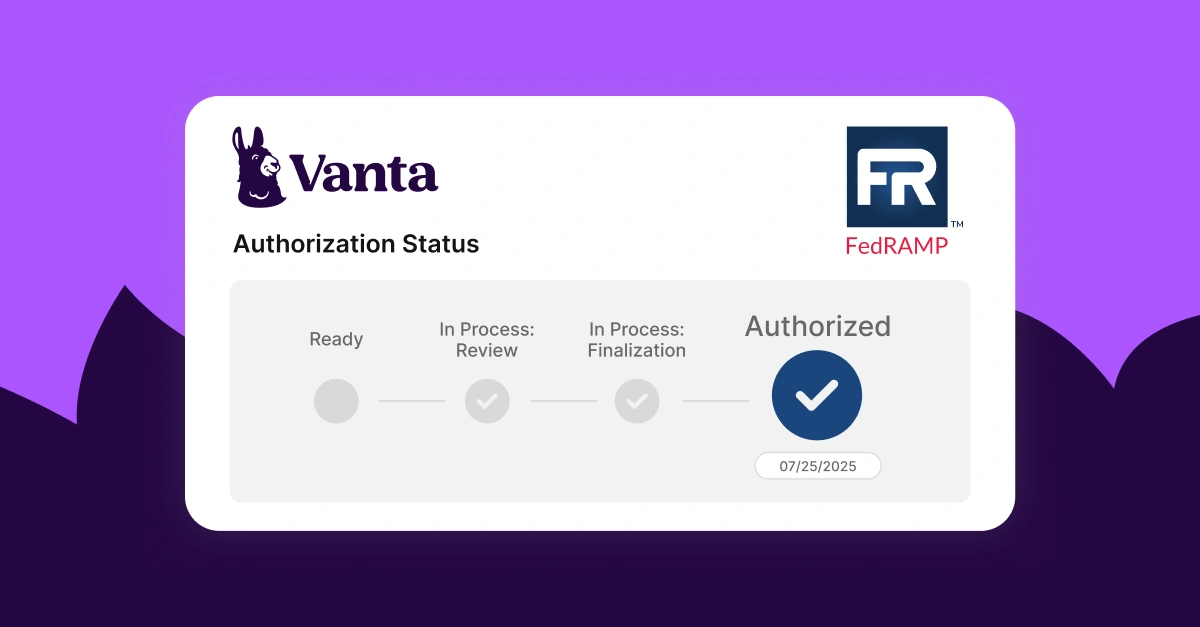
Lessons learned from Vanta’s FedRAMP® 20x pilot program
A behind-the-scenes look at how Vanta navigated the FedRAMP 20x pilot.